
Crawler readiness
also called AI crawler readinessCrawl-to-citation readiness
Definition
Whether the pages you want cited are both fetchable in practice and fit to be indexed, log-observed crawling crossed with indexability and orphan status on the same URLs.
Scope, grain and dimensions
- Grain
- Would be one judgment per URL if it existed.
- Dimensions
- url
- Metric type
- derived metric · not defined, the composition does not exist
Data sources
Where you'll see this
Named reports that normally include this metric.
Skills and analyses that use it
Skills carry the judgment; the analysis verbs do the reading.
Skills
Method rungs and levers
This sits on the bottom rung: if it reads badly, every measurement above it is unreliable.
levers L1 Technical & crawl healthL4 Internal linking & architecture
Ask Quattr
- "Are AI crawlers reaching the content we want cited?" Simulate this →
- "Which citation targets are unreachable?" Simulate this →
Caveats, freshness and failure modes
There is no single readiness number: nothing crosses log hits with indexability and orphan status for you.
Answering a readiness question means running the underlying reads separately and presenting them as separate sections, saying that the per-URL join is not available rather than implying a composed judgment.
The two contributing sources are on different clocks: logs arrive hours to nightly, the crawl runs on its own per-site schedule. Even a manual cross-read compares observations taken at different times.
Absence of a bot in the logs is evidence your logs do not have it, not proof it never came, a weaker claim, and it is made as the weaker one.
No answer-engine crawler has address verification, so the log side of any manual cross-read rests on user-agent strings.
- Freshness
- per crawl schedule, cadence is set per site; the card names the crawl it read.
Common failure modes
- Presenting bot fetch counts as readiness or as AI visibility.
- Simulating the join by pairing rows from separate tool results and presenting the pairing as a product output.
- Reading a page as ready because it is indexable, without log evidence that anything fetched it.
Not the same as
The confusions that cause the most wrong decisions.
Crawler readiness Bot hits Compare definitions →
Observed bot visits are what was fetched, from server logs. Readiness is a composed judgment over fetching, indexability and orphan status, and that composition is not implemented, so the two must never be presented as the same claim.
Crawler readiness Incoming internal links Compare definitions →
Orphan status is one input readiness would need, not readiness itself.
Watch this metric read in a real run
All runs →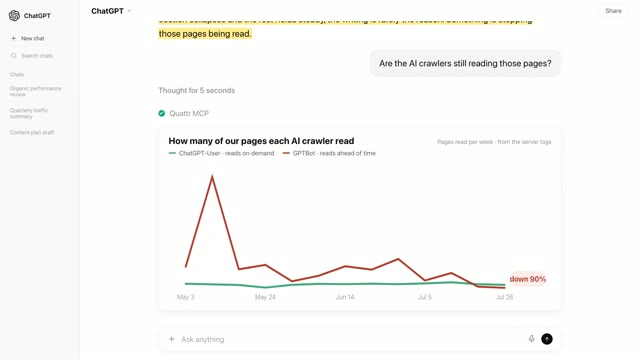
Related metrics and workflows
Verification
A definition is the smallest part of this.
The measurement matters because something acts on it. Here is the rest of the showcase, in the order most people find useful.