
Yours, read with your permission
Google Search Console as an MCP data source
Request a demo Play this question →
- 1 to 2 days behind, always labelled
- OAuth 2.1 · read-only
- Claude, ChatGPT, Cursor, VS Code
- Query · page · country · device
- BigQuery bulk export supported
Asked in your assistant
Organic clicks are down 18% this month, is that us or the market?
This source, on its own
- Clicks34,590
- Impressions−4%
- CTR−14%
this source stops here
- ✕Did our rank actually move?averaged, not observed
- ✕Which pages are indexable?no crawl of the site
- ✕Was the page fast enough?no page experience
- ✕Are we bidding on this too?no spend data
The same question, routed wider
- ✓ Search Console clicks, impressions, CTR, position
- ✓ Market share tracked demand fell 12%
- ✓ Your taxonomy isolated to one template
- ✓ Statistical engine tested against the band
What comes back
- Market movement−12%
- Your shareheld
- Site-specific−6%
Illustrative
- Setup~2 minutesOAuth sign-in, no keys to mint, no config JSON.
- ScopeRead-onlySessions bound to your organisation. Nothing is written back.
- Sources behind itEightSearch Console alone works. Seven more join when connected.
- Tools58 across 11 categoriesFour cover search performance; the assistant routes to them.
What a Search Console MCP server does
An MCP server is the connection between your assistant and a system that holds data. Connect one for Search Console and your assistant stops guessing about your site: it queries the property you own and answers from the rows it gets back, in the chat window you already work in.
The four dimensions Search Console exposes, query, page, country and device, are the ones every organic question eventually reduces to. Quattr handles them and treats the property as one of eight sources rather than the whole world, which is what lets a question leave those four dimensions without leaving the conversation.
Connect Search Console in about two minutes
One endpoint, an OAuth sign-in, and the property list you already have access to.
- 01 Add the endpoint Paste it into your client's MCP settings. One server, every source, there is no per-source endpoint to manage.
https://mcp.quattr.com/mcp - 02 Sign in with Quattr OAuth 2.1 in the browser. The session is bound to your organisation and scoped read-only; no API key is created or stored in your client.
- 03 Ask a question No tool names, no query syntax. The assistant picks the analysis, states the scope it used, and shows the date the data was current as of.
What you can ask on day one
Plain questions, not query syntax. Each one runs against Search Console alone, nothing else has to be connected first.
-
Which queries lost the most clicks last month, and did they lose rank or lose CTR? -
Show me pages ranking 5 to 15 with high impressions, where is the striking-distance upside? -
Split non-brand organic clicks by device and country for the last 8 weeks. -
Which pages gained position but lost clicks? Something changed on the results page. -
What is our actual CTR at position 3, versus what our own curve expects?
The Search Console tools it exposes
-
search_performanceClicks, impressions, CTR and position over a window, filtered and grouped. R2 Retrieved -
gsc_breakdownThe same figures split by query, page, country, device or rank bucket. R2 Retrieved -
gsc_dimensional_trendHow one dimension moved across periods, on a stable entity set rather than per bucket. R2 Retrieved -
seo_ranking_movement_reportWhich queries and pages changed position, and by how much. R2 Retrieved
You never name one of these. The assistant routes the question; the reference is public so an answer can be checked against what it was built from.
Where Search Console reads, what it assumes beneath, and what it cannot reach. Filled rungs are measured; hatched rungs are taken on faith.
- R5 Rewarded out of reach Nothing this source records reaches up here.
- R4 Represented out of reach Nothing this source records reaches up here.
- R3 Referenced out of reach Nothing this source records reaches up here.
- R2 Retrieved reads here Google retrieved the page into a results set. Impressions are Google's count of that, not yours.
- R1 Reachable assumed, not measured This source takes this rung on faith. Another one has to prove it.
A reading at any rung is only as trustworthy as the rungs beneath it. Every Search Console reading assumes the page was reachable. If a crawl or log answer says it was not, the impression data above is describing a different page than you think.
Where a single-source Search Console MCP stops
Not at a feature the vendor forgot. At the edge of what Search Console records.
- Is that us, or the market? Search Console shows your property and nothing else. A fall every competitor shared is a different problem from one you caused, and nothing inside your own property can tell them apart. needs Rank tracking
- Did the impressions go elsewhere? Impressions falling while position holds can mean the question is being answered above the results, or inside an answer engine that never sends a click. Neither is recorded here. needs AI visibility
- Did anything still fetch the page? Coverage reports say what Google indexed. They do not say which crawlers reached the page, when, or what status they were served, which is recorded only at your origin. needs Server logs
- Did the clicks turn into anything? Search Console stops at the click. Whether it became a configured goal, and what that was worth, lives in a different system with a different definition of a visit. needs GA4 / Adobe
Seven more sources answer what Search Console structurally cannot
Every source is one you already own or one Quattr collects for you. Connect none of them and the Search Console answers still work. Connect any of them and the questions above become answerable in the same sentence, joined on your own segments rather than on a URL string.
- Rank tracking Quattr The comparison this source structurally cannot make. Your clicks read against share, so a fall splits into market movement and the part that is yours. ~1 day behind
- GA4 or Adobe yours What the click became. The only source that says whether search produced a result the business recognises, against goals you configured yourself. loads nightly
- Google Ads yours The same keyword from the paid side, including the terms you are bidding on while already holding the organic position. ~1 day behind
- Server logs yours What GPTBot, ClaudeBot and Google-Extended actually fetched, with status codes. Everything else infers crawler behaviour; logs record it. hours to nightly
- Site crawl Quattr Whether a page that lost clicks is still reachable and indexable at all, orphans, canonicals and depth behind the ranking. per crawl schedule
- AI visibility Quattr Whether answer engines cite the same pages, kept separate from Google's on-SERP AI Overviews. No first-party system records either. ~1 day behind
- Lighthouse / CWV Quattr LCP, INP and CLS on the templates behind your rankings, weighted by the clicks each page actually earns. varies by site
- The ladder that orders them R1 Reachable → R2 Retrieved → R3 Referenced → R4 Represented → R5 Rewarded. A broken lower rung invalidates every reading above it. The method →
Quattr MCP compared with a standalone Search Console MCP
A category comparison, not a claim about any one vendor. A standalone connector is a good piece of software doing a narrower job; the table is here so you can tell which situation you are in before installing anything.
| Dimension | A standalone connector | Quattr MCP | When it matters |
|---|---|---|---|
| Search Console coverage | Search analytics, and often more: URL inspection, sitemap listings, and in some cases the Indexing API. | The four search-analytics dimensions, plus CTR-curve fitting and striking-distance modelling on top. | If you need URL inspection or sitemap handling, a standalone connector does what this one does not. |
| Other sources | None. One server per source; your assistant holds several unrelated connectors. | Seven more behind the same endpoint, joined on your segments rather than on URL strings. | The moment a question contains the word "or", us or the market, rank or CTR. |
| How a question is answered | You name the tool, or the assistant guesses from a tool list. Rows come back; you interpret. | Routed to a governed analysis that returns a verdict carrying its source, its scope and the date it was current as of. | When someone other than you has to trust the number. |
| Significance | Not offered. A 3% move and a 30% move look alike. | Movements are tested against the series' own variance before being called a change. | Weekly reporting, where most movements are noise. |
| Segmentation | Regex and string filters on URLs and queries. | Your own taxonomy, product lines, intents, page groups, configured before the first question. | When "which pages" means a business grouping, not a URL pattern. |
| Blast radius | Usually read-only, though some expose sitemap submission or indexing requests behind a configuration flag. | Read-only with no flag to flip. Nothing can be submitted, deleted or requested against your property. | When an agent runs unattended against a production property. |
| Time to first answer | Minutes. Install, authorise the property, ask. | Minutes once the account is set up, because the taxonomy that makes joins work exists before the first question. | Honestly, this row favours the standalone tool when you want an answer in the next ten minutes. |
| Cost | Usually free and open source, and Search Console itself is free for everyone. | Included with a Quattr subscription. No separate MCP product, no separate bill. | If you are not a Quattr customer, the standalone tool is the one you can use this afternoon. |
Rows describe a category, checked against publicly documented behaviour. Named-vendor claims live on the comparison pages, dated. If a row is wrong or out of date, it is a defect, tell us and it changes.
What Search Console itself will not tell you
- Query rows are sampled and suppressedRows below a privacy threshold are omitted, so the sum of the parts is smaller than the total. Breakdowns say when they do not reconcile rather than presenting a smaller number as the whole.
- Average position is not a rankIt is averaged over the impressions you received. Your impression mix changing will move it without any ranking changing, which is why an independent daily observation is a separate source.
- It will not reconcile with analyticsSearch Console counts clicks on a results page; analytics counts sessions that started. They measure different events at different moments and are not made to agree.
- There is no query-level conversion dataNot in Search Console, not anywhere. Attribution stops at the landing page, and any tool claiming per-keyword revenue for organic is modelling rather than measuring.
Freshness, permissions and what is stored
- Freshness
- 1 to 2 days behind, which is Google's own reporting lag. Any answer touching the last 48 hours says so on the card.
- Scope
- Read-only. The MCP cannot write, delete or submit anything to Search Console.
- Sign-in
- OAuth 2.1 in the browser. No API key is minted or stored in your client config.
- Tenancy
- Sessions are bound to your organisation. A session cannot reach another tenant's property.
- Your prompts
- Your assistant sends the question to the server to route it. It is not used to train anything.
- History and export
- Three years is standard, so history accrues past the roughly sixteen months the API returns on its own. Where you are entitled to it, BigQuery can be read instead, on request, never silently.
Origin event to answered card for Search Console, with the stage each stated limit attaches to.
- lag enters
- data leaves
- modelling begins
- 01 A query runs on Google
- 02 Google's own aggregation and privacy thresholds
- data leaves: Query rows are sampled and suppressed below a privacy threshold. The parts do not sum to the total.
- 03 Reporting lag
- lag enters: 1 to 2 days behind, always stamped rather than assumed.
- 04 API or BigQuery read
- 05 Joined to your segments
- modelling begins: Average position is a weighted average over impressions, not a rank you held.
Who can connect it, and what it costs
The MCP is included with a Quattr subscription. There is no separate MCP product and no separate bill. If your organisation already uses Quattr, Search Console is almost certainly connected on the platform side already, and the MCP is a new doorway to data you are already paying for.
The joins depend on setup. Your segments, product lines and competitor set are configured before the first question, which is what lets an answer speak your business language instead of a URL pattern. If you want a number in the next ten minutes with none of that in place, a standalone connector is the honest recommendation, most are free, and Search Console itself costs nothing.
Learn to read the numbers yourself
- topic What moved, and where Decompose a click delta into volume, position and CTR, then localise it.
- topic Build your own CTR curve Opportunity engineering: your own curve, striking distance, and the AI Overview haircut.
- metric Expected CTR How the curve is fitted, what it is a prediction of, and where it stops being reliable.
- report The weekly search report What belongs in it, what does not, and which metrics are guardrails rather than headlines.
Questions people ask before connecting
Is this an official Google product?
No. Google publishes official MCP servers for Analytics and Ads but not for Search Console, so every Search Console connector including this one is third-party, reading the property you authorise through Google's own OAuth flow.
Can I use it with the free version of Search Console?
Search Console is free for everyone, and the connector reads whatever property you have access to. What is not free is the Quattr subscription the MCP is included with.
Does it work with domain and URL-prefix properties?
Both. The assistant names which property it read when your account has more than one, because the two can return meaningfully different numbers for the same site.
How far back can it look?
The API returns roughly sixteen months on its own. Quattr keeps three years as standard, so history accrues beyond that window once collection starts, and the BigQuery export keeps whatever you keep in the table.
Can it write to Search Console, submit sitemaps or request indexing?
No, and there is no setting that enables it. Some standalone connectors do offer sitemap submission or indexing requests behind a flag, which is a materially different risk profile for an unattended agent.
What happens if I only connect Search Console?
Everything on this page above the comparison table works. Questions that need another source get an honest refusal naming what is missing, not a modelled guess.
Do I have to learn tool names?
No. You ask in plain language and the assistant routes it. The tool reference is public so you can check what an answer was built from, not so you can memorise it.
Is a standalone Search Console MCP ever the better choice?
Yes. If your questions never leave search analytics, or you want URL inspection and sitemap handling this connector does not offer, a standalone one is lighter and free.
All eight sources, one spine
Watch this source answer real questions
All runs →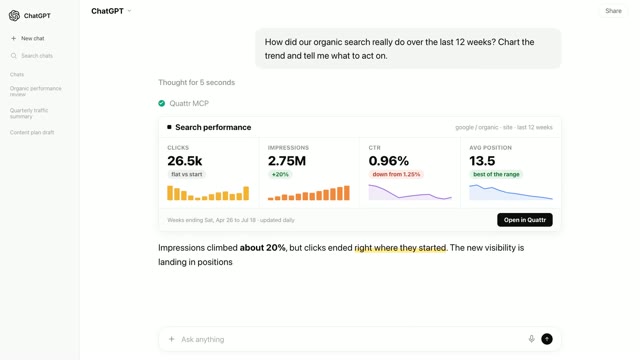 1 min 12 secCan your search data tell you what to do next?Search Console · Search pulse · Chart composer◐Recreated from an anonymized session
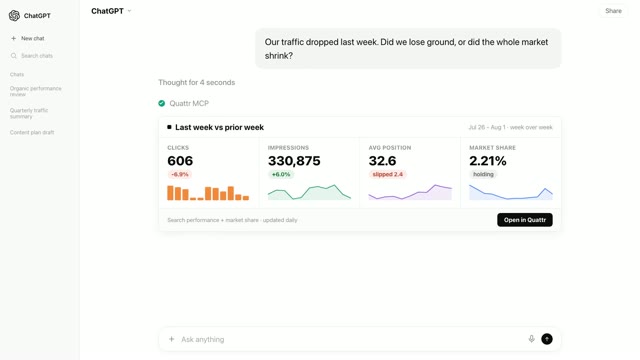 1 min 44 secTraffic just dropped. Is it you, or the market?Search Console + Rank tracking · Market share review◐Recreated from an anonymized session
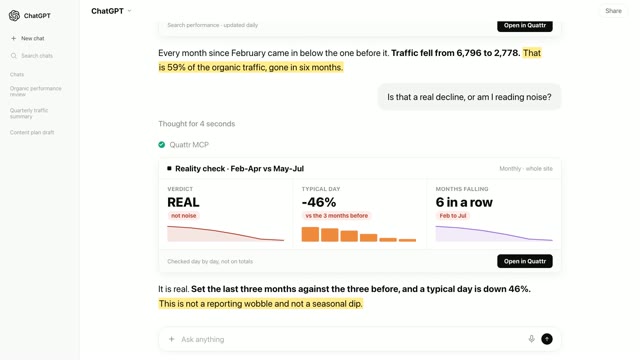 2 min 5 secTraffic more than halved in six months. Nobody could say why.Search Console · Anomaly investigator◐Recreated from an anonymized session
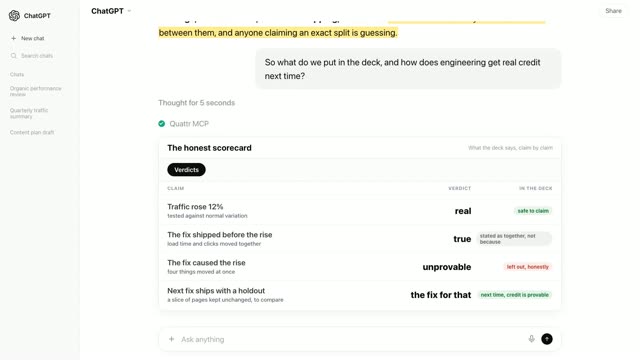 3 min 4 secThe fix shipped. Traffic rose. Now two teams want the credit.Lighthouse + Search Console + Rank tracking · Significance referee · Cross domain correlator◐Recreated from an anonymized session
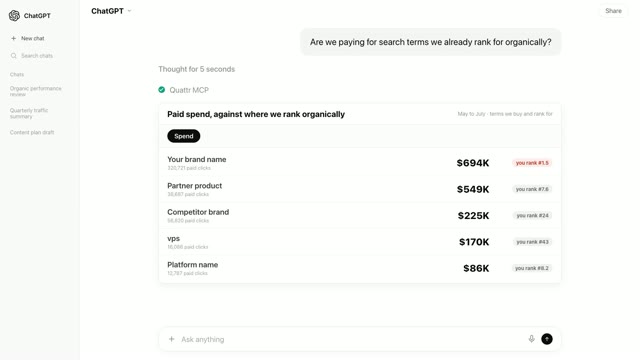 2 min 3 secYou are buying clicks you already own. So cut them?Google Ads + Search Console · Paid organic balance◐Recreated from an anonymized session
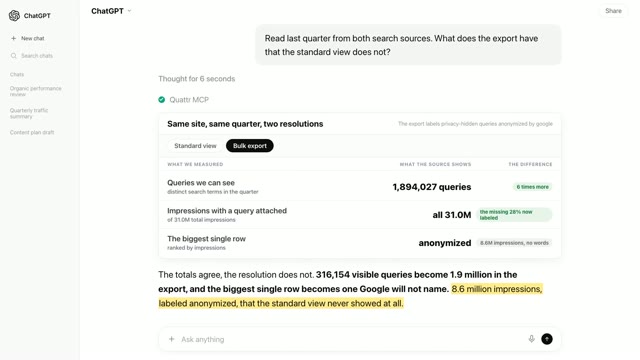 2 min 13 secYour dashboards read a slice of your search data. You own more.Search Console · Set analysis scope◐Recreated from an anonymized session