
Search impression share
also called Impression shareIS
Definition
The share of the paid impressions available to you in the auction that your ads actually received.
How it's calculated
The average of Google Ads' own per-row search impression share across the rows in scope. The share itself is computed by Google Ads, not by Quattr; the semantic layer averages it.
Scope, grain and dimensions
- Grain
- One number per segment and date range, or one row per keyword or campaign.
- Dimensions
- keyword · campaign_name
- Required filters
- segment_id · date_range
- Aggregation
- An unweighted average across keyword-day rows, not an impression-weighted one, a low-volume keyword counts the same as a high-volume one.
- Metric type
- share · share of available auction impressions (stored 0 to 1, shown as a percent)
Data sources
Where you'll see this
Named reports that normally include this metric.
Paid and organic overlap reportPaid search performance report
Skills and analyses that use it
Skills carry the judgment; the analysis verbs do the reading.
Analysis verbs
paid_impression_sharetotal_search_share
Method rungs and levers
A rung tells you what a movement here can and cannot explain, read the rungs below it first.
levers L8 Paid/organic interplay
Ask Quattr
- "How much of the available auction are we winning?" Simulate this →
- "Is our impression share improving?" Simulate this →
How to read it
The coverage half of paid: not how well the ads performed, but how often they were eligible and shown at all. Read it beside the rank-lost measures, the gap between what you won and what you lost to rank is the auction ground a bid or quality change can recover.
Caveats, freshness and failure modes
Called without a segment, the verb returns the list of tracked segments rather than a number, this metric is always per segment.
The averaging is unweighted across rows, so a keyword with a handful of impressions moves the number as much as a keyword with thousands.
Stored as a fraction between 0 and 1 while search market share is stored 0 to 100; combining the two without normalising erases the paid side.
Click share is not surfaced anywhere in the product, the underlying column exists only on a campaign-grain dataset that no tool reads. Do not present impression share as a click-share proxy.
The dataset has no country or device columns, so this metric cannot be sliced by geography or device.
- Freshness
- ~1 day behind, Ads reporting settles overnight; same-day spend is provisional.
Common failure modes
- Assuming impression share can be broken down by country or device.
- Comparing impression share to search market share as if they were on the same scale.
Not the same as
The confusions that cause the most wrong decisions.
Search impression share Impression share lost to rank Compare definitions →
One is what you won, the other is a specific named reason for what you did not win. They are separate columns and do not sum to a whole.
Search impression share Total search share Compare definitions →
Impression share is paid coverage inside the ad auction; total search share is a combined estimate of paid and organic presence on the results page.
Search impression share Paid impressions Compare definitions →
Impressions count what you got; impression share expresses that as a fraction of what was available in the auction. Neither is derivable from the other in this product.
Search impression share Paid click-through rate Compare definitions →
CTR measures what happened after the ad was shown; impression share measures how often it was shown at all.
Search impression share Average CTR Compare definitions →
CTR is the share of impressions you received that clicked; impression share is the share of an available paid auction you appeared in at all. They share no numerator and no denominator, and click share, the metric people reach for when they conflate the two, does not exist in the product.
Watch this metric read in a real run
All runs →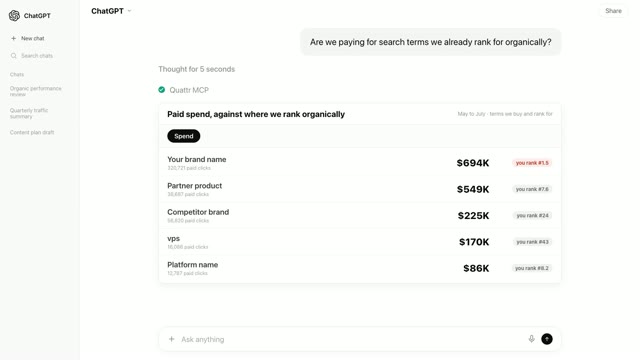
Related metrics and workflows
Verification
A definition is the smallest part of this.
The measurement matters because something acts on it. Here is the rest of the showcase, in the order most people find useful.