
Total search share
also called Combined paid and organic shareTotal SERP share
Definition
A single estimate of how much of a segment's results-page presence you hold once paid and organic are combined.
How it's calculated
Both legs are first normalised to a fraction between 0 and 1 using the shared unit contract, CTR-modeled search market share is stored 0 to 100 and divided by a hundred, paid impression share is already a fraction and is left alone. The two are then combined as a complement union: one minus the product of the two complements, times a hundred. Written out on the two fractions: `CASE WHEN organic IS NULL AND paid IS NULL THEN NULL ELSE (1 - (1 - COALESCE(organic,0)) * (1 - COALESCE(paid,0))) * 100 END`. A single missing leg is coalesced to zero presence; only when BOTH legs are missing is the result null rather than zero.
- Numerator
- The combined presence probability from the two legs
- Denominator
- One, by construction, the complement union is bounded at 100%
Scope, grain and dimensions
- Grain
- One number per segment, medium and date range.
- Dimensions
- segment · source_medium
- Required filters
- segment_id · date_range
- Aggregation
- Computed once over a single already-aggregated row. It is not summable, averageable, or decomposable back into its legs.
- Metric type
- derived metric · percent of the segment's results-page presence (estimate)
Data sources
Where you'll see this
Named reports that normally include this metric.
Paid and organic overlap report
Skills and analyses that use it
Skills carry the judgment; the analysis verbs do the reading.
Analysis verbs
total_search_share
Method rungs and levers
A rung tells you what a movement here can and cannot explain, read the rungs below it first.
levers L8 Paid/organic interplay
Ask Quattr
- "What is our total share of the search results page?" Simulate this →
- "How much of search do we own once paid is counted?" Simulate this →
How to read it
A labelled estimate of combined presence, useful for direction and for leadership framing, and not a measured share of the page. The complement union assumes the two presences are independent; on the same query they are not, so the estimate leans high where paid and organic compete for the same result pages. Present it as an estimate every time.
Caveats, freshness and failure modes
Results-page geometry is approximated: paid and organic occupy different real estate, so this is not a measured share of the page. The tool carries this caveat in its own payload.
The independence assumption is stated and known to be wrong on the same query, that is the estimate's main source of overstatement.
The two legs live on different scales and are normalised by name before being combined; an earlier version divided both by a hundred and erased the paid leg roughly a hundredfold.
If the client row cannot be identified in the segment's competitor mapping, the organic leg is unavailable and the total reflects paid presence only, the response says so.
Search market share is always CTR-modeled search market share of tracked demand, directional and scoped to a tracked segment.
Slowest contributing source is Google Search Console.
The combined total and both legs ship in one payload under camel-case keys. The shared format contract classifies by name and its word-boundary rules do not fire across camel case, so all three fall through to the plain-count family: no percent sign, no scale correction, and the 0 to 100 organic leg and the 0 to 1 paid leg are indistinguishable to any consumer that formats by name.
- Freshness
- 1 to 2 days behind, Google's own reporting lag. Any answer touching the last 48 hours says so on the card.
Common failure modes
- Presenting the number as a measured share of the results page.
- Subtracting one leg from the total to recover the other, the union is not additive.
- Reading a paid-only total as a combined total when the client row was unresolved.
Not the same as
The confusions that cause the most wrong decisions.
Total search share Search impression share Compare definitions →
Impression share is paid auction coverage on its own scale; total search share is a combined estimate that includes the organic leg and is bounded differently.
Total search share Total search share, organic leg Compare definitions →
The organic leg is one input to the combination, on its own 0 to 100 scale; the total is the union of both legs and cannot be decomposed back into them.
Watch this metric read in a real run
All runs →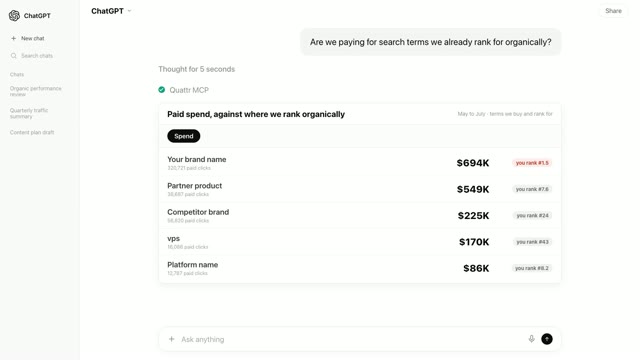 2 min 3 secYou are buying clicks you already own. So cut them?Google Ads + Search Console · Paid organic balance◐Recreated from an anonymized session
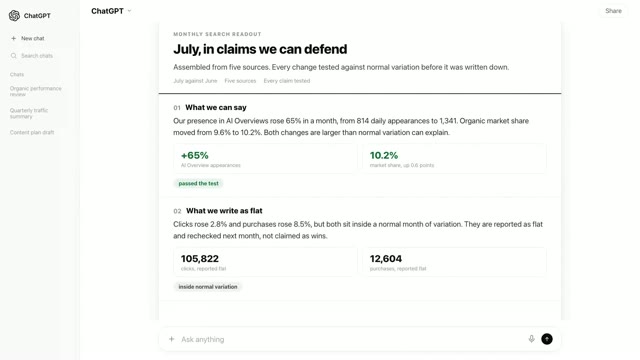 2 min 18 secThe deck is due tomorrow. The numbers live in five places.Search Console + Rank tracking + AI visibility + Web analytics + Google Ads · Monthly exec review◐Recreated from an anonymized session
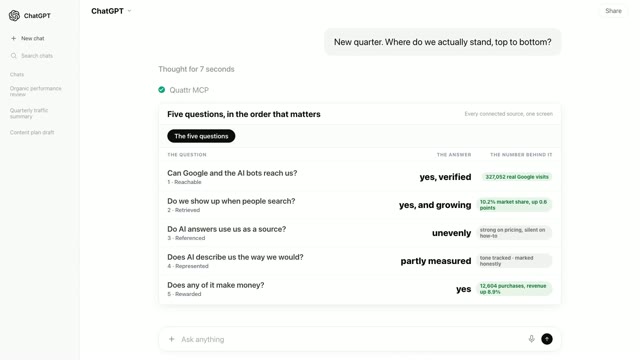 2 min 20 secWhere do we stand? Five questions answer it, in order.Search Console + Rank tracking + AI visibility · Monthly exec review◐Recreated from an anonymized session
Related metrics and workflows
Verification
A definition is the smallest part of this.
The measurement matters because something acts on it. Here is the rest of the showcase, in the order most people find useful.