
Paying for an owned term
also called Wasted-spend candidatePaid on owned keyword
Definition
A per-keyword flag marking an overlapping keyword whose organic average position is already at or better than the chosen rank threshold.
How it's calculated
For each keyword in the paid-and-organic join, the flag is true when the organic average position is a positive number at or better than the rank threshold, which defaults to the top three. The response also carries the count of flagged keywords.
Scope, grain and dimensions
- Grain
- One flag per overlapping keyword.
- Dimensions
- keyword
- Required filters
- date_range
- Aggregation
- A per-row boolean and its count. It is analysis on top of the joined frames, computed in the tool rather than defined in the semantic layer, and it is labelled as such.
- Metric type
- derived metric · flag per keyword, plus a count of flagged keywords
Data sources
Where you'll see this
Named reports that normally include this metric.
Paid and organic overlap report
Skills and analyses that use it
Skills carry the judgment; the analysis verbs do the reading.
Skills
Analysis verbs
paid_organic_overlap
Method rungs and levers
A rung tells you what a movement here can and cannot explain, read the rungs below it first.
levers L8 Paid/organic interplay
Ask Quattr
- "Which keywords are we buying that we already rank top-3 for?" Simulate this →
- "Where might paid spend be redundant?" Simulate this →
How to read it
A candidate list, not a verdict. The tool ships its own caveat with the number: paying for a term you rank for does not prove the paid click would have arrived for free, and only a controlled pause test can settle that. The right output of this metric is a test design with day-7, day-14 and day-30 readouts.
Caveats, freshness and failure modes
Overlap is not cannibalization, the payload states this in its own caveat field.
The threshold is a caller-chosen parameter defaulting to the top three, so the flagged count moves with the parameter and is not comparable across calls that used different thresholds.
Organic position is an impression-weighted average over the period, so a keyword that ranked well for part of the period can clear the threshold.
The position lookup runs only for the paid-cost-ranked overlap candidates up to the row cap, so a keyword below that cut can never be flagged however well it ranks.
A rank threshold says nothing about whether the paid and organic results appeared on the same result pages.
Slowest contributing source is Google Search Console.
- Freshness
- 1 to 2 days behind, Google's own reporting lag. Any answer touching the last 48 hours says so on the card.
Common failure modes
- Pausing spend on the flagged list without a holdout and reading the resulting organic traffic as recovered clicks.
- Comparing flagged counts across periods that used different thresholds.
Not the same as
The confusions that cause the most wrong decisions.
Paying for an owned term Paid and organic keyword overlap Compare definitions →
Overlap is the whole intersection; this flag is the rank-qualified subset of it. Reporting the flagged count as the overlap overstates the spend at issue.
Watch this metric read in a real run
All runs →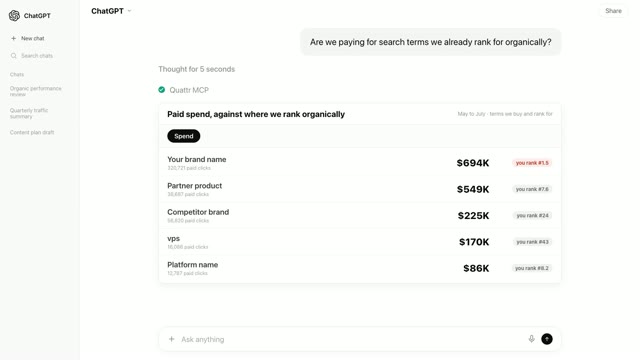
Related metrics and workflows
Verification
A definition is the smallest part of this.
The measurement matters because something acts on it. Here is the rest of the showcase, in the order most people find useful.