
Average position
also called Average weighted positionAvg positionPosition
Definition
Where your results sat on the Google results page over the period, averaged across every impression rather than across every keyword.
How it's calculated
Σ(position × impressions) / Σ(impressions), built from a hidden per-row column defined as position × impressions on the keyword-and-page fact.
- Numerator
- Sum of position × impressions
- Denominator
- Sum of impressions
Scope, grain and dimensions
- Grain
- One date range × the selected slice, over the ranked keyword-and-page rows in that slice.
- Dimensions
- query · page · country · device · intent · category · brand · rank bucket
- Required filters
- date range · source medium
- Aggregation
- Impression-weighted at every grain. It cannot be re-averaged from a column of positions, and two periods' averages cannot be added or differenced without their impression weights.
- Metric type
- rank · results-page position (1 = top)
Data sources
Where you'll see this
Named reports that normally include this metric.
AI Overview and SERP feature reportCannibalization reportContent decay reportContent performance reportCTR opportunity reportKeyword ranking and movement reportMonthly executive search reportPaid and organic overlap reportSearch market share reportSearch opportunity reportSERP volatility and algorithm update reportWeekly search report
Skills and analyses that use it
Skills carry the judgment; the analysis verbs do the reading.
Skills
rank-movement-reviewweekly-search-reportstriking-distance-sprintanomaly-investigatorcannibalization-check
Analysis verbs
search_performancegsc_breakdownseo_ranking_movement_report
Method rungs and levers
A rung tells you what a movement here can and cannot explain, read the rungs below it first.
levers L3 Refresh & content qualityL4 Internal linking & architecture
Ask Quattr
- "What is our average position for non-brand keywords?" Simulate this →
- "Did average position improve versus last month?" Simulate this →
- "Average position by device" Simulate this →
- "Which keywords sit between positions 8 and 20?" Simulate this →
How to read it
A weighted read of the consideration set: how prominently you appeared, with the loudest keywords counting most. Movement is only meaningful against a stable mix, a shift in which countries or devices produced the impressions moves this number without anything ranking differently.
Caveats, freshness and failure modes
Site-level position is not read from the site rollup table. That table's weighted-position column holds the raw position instead of position × impressions, so its average divides positions by impressions and returns a meaningless small number, roughly 0.05 where the correct weighted value is around 15. Site-grain position is sourced from a second read of the ranked keyword-and-page rows and merged over it.
Because of that split, a site-grain average position describes ranked keyword rows only, while the clicks and impressions beside it are whole-site totals. The two halves of the card have different coverage and the card says so.
Average position is an organic measure. For a paid medium there is no position source at all and it reads null rather than zero.
A blended device or country cut can move average position through mix shift alone; the mix check comes before the narration.
Windows straddling Google's September 2025 num=100 reporting change carry an artifact in position as well as impressions.
- Freshness
- 1 to 2 days behind, Google's own reporting lag. Any answer touching the last 48 hours says so on the card.
Common failure modes
- Quoting the site rollup table's position field directly and publishing a number near zero as an average rank.
- Comparing a site-grain average position to a keyword-level one as if the two covered the same rows.
- Calling a position move an improvement when the underlying device or geography mix changed.
Not the same as
The confusions that cause the most wrong decisions.
Average position Search market share Compare definitions →
Average position is an impression-weighted ordinal on your own results; search market share is a CTR-modeled share of tracked demand, aggregated across a segment and comparable to competitors. Position can improve while share falls, because share depends on what everyone else did with the same demand.
Average position Our rank on a tracked keyword Compare definitions →
This is your own reported position across all impressions Google recorded for you; our rank is Quattr's observed position for one keyword inside one tracked segment, alongside competitor ranks on that keyword. Different sources, different keyword universes, they are not expected to reconcile.
Watch this metric read in a real run
All runs →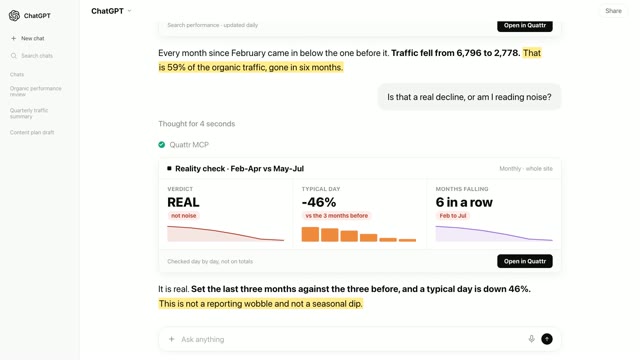 2 min 5 secTraffic more than halved in six months. Nobody could say why.Search Console · Anomaly investigator◐Recreated from an anonymized session
 2 min 19 secOn some queries, your toughest rival is your own other page.Search Console + Rank tracking · Cannibalization check◐Recreated from an anonymized session
Related metrics and workflows
Verification
A definition is the smallest part of this.
The measurement matters because something acts on it. Here is the rest of the showcase, in the order most people find useful.