
Striking-distance candidates
also called Striking distance keywordsNear-page-1 keywords
Definition
The keywords sitting inside the near-page-1 band that still rank below the target position, the rows where a small ranking nudge is the lever.
How it's calculated
A keyword-and-page row qualifies when its impression-weighted average position falls inside the band (default 8 to 20 inclusive), is strictly below the target position (default 5), and the row has positive impressions. Qualifying rows are ranked by adjusted upside and cut to the requested top N.
Scope, grain and dimensions
- Grain
- One keyword × one page × the window.
- Dimensions
- query · page · brand · intent · device
- Required filters
- date range
- Aggregation
- A count of qualifying rows; the returned list is the top N of them and not the whole set.
- Metric type
- raw measure · candidate keyword-and-page rows
Data sources
Where you'll see this
Named reports that normally include this metric.
Skills and analyses that use it
Skills carry the judgment; the analysis verbs do the reading.
Analysis verbs
striking_distance
Method rungs and levers
A rung tells you what a movement here can and cannot explain, read the rungs below it first.
levers L3 Refresh & content qualityL4 Internal linking & architecture
Ask Quattr
- "Which keywords are closest to page 1?" Simulate this →
- "What are our quick wins this week?" Simulate this →
- "Show me positions 8 to 20 for non-brand demand" Simulate this →
How to read it
The candidate pool, not the plan. Membership is a position fact; whether a candidate is worth working depends on the modeled upside beside it and on business value the data does not carry.
Caveats, freshness and failure modes
The band and the target are defaults rather than findings, widening the band changes both the count and the ranking.
Position is the window's impression-weighted average, so a keyword that swung between position 4 and position 25 can average into the band without ever having sat there.
Rows already at or above the target are excluded rather than shown with zero upside.
Windows stretched far enough back to cross Google's September 2025 reporting change carry that artifact into the band membership.
- Freshness
- 1 to 2 days behind, Google's own reporting lag. Any answer touching the last 48 hours says so on the card.
Common failure modes
- Treating band membership as a difficulty assessment.
- Comparing candidate counts across runs that used different bands or targets.
Watch this metric read in a real run
All runs →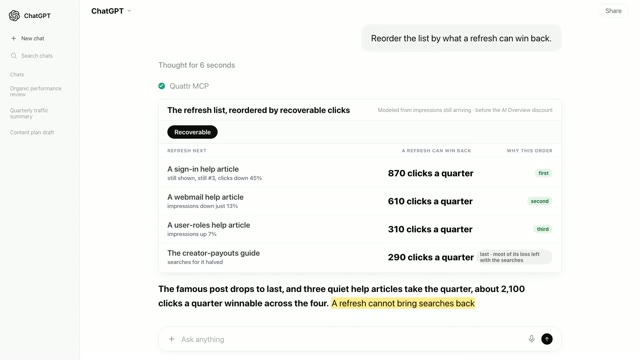
Related metrics and workflows
Verification
A definition is the smallest part of this.
The measurement matters because something acts on it. Here is the rest of the showcase, in the order most people find useful.