
Actual CTR (keyword and page)
also called Observed CTRRow CTR
Definition
The click-through rate one keyword-and-page row actually earned in the window: its clicks divided by its impressions.
How it's calculated
actualCtr = clicks / impressions for the single keyword-and-page row, rounded to four decimals. Rows with no impressions, non-positive impressions or no position are skipped rather than counted as zero.
- Numerator
- The row's clicks
- Denominator
- The row's impressions
Scope, grain and dimensions
- Grain
- One keyword × one page × the window.
- Dimensions
- query · page · brand · intent · device · position
- Required filters
- date range
- Aggregation
- Row-level only. Rolling it up means re-pooling the clicks and impressions, not averaging the rates.
- Metric type
- rate · share of impressions that clicked (0 to 1)
Data sources
Where you'll see this
Named reports that normally include this metric.
CTR opportunity reportSearch opportunity report
Skills and analyses that use it
Skills carry the judgment; the analysis verbs do the reading.
Analysis verbs
ctr_curve_model
Method rungs and levers
A rung tells you what a movement here can and cannot explain, read the rungs below it first.
levers L3 Refresh & content quality
Ask Quattr
- "Which query and page combinations underperform their expected CTR?" Simulate this →
- "What CTR does this page get for this query?" Simulate this →
How to read it
The measured half of the expectation gap. On its own it says little, a high rate at position 1 and a high rate at position 15 mean different things, which is why it is only ever read against the fitted expectation for the same cell.
Caveats, freshness and failure modes
Expressed as a 0 to 1 fraction, unlike the Search Console average CTR measure, which is already a percentage.
The position it is read against is an impression-weighted average over the window, so a row that moved between positions is measured against a blend.
Rounded to four decimals, which flattens differences on very low-rate rows.
- Freshness
- 1 to 2 days behind, Google's own reporting lag. Any answer touching the last 48 hours says so on the card.
Common failure modes
- Comparing it to the percentage-scaled average CTR and reporting a hundredfold difference.
- Interpreting it without the position it was earned at.
Not the same as
The confusions that cause the most wrong decisions.
Actual CTR (keyword and page) Average CTR Compare definitions →
Average CTR is a warehouse measure on a 0 to 100 scale computed over whatever slice was queried; actual CTR is a 0 to 1 fraction computed in our own pass for one keyword-and-page row. They are different scales at different grains and cannot be substituted for each other.
Watch this metric read in a real run
All runs →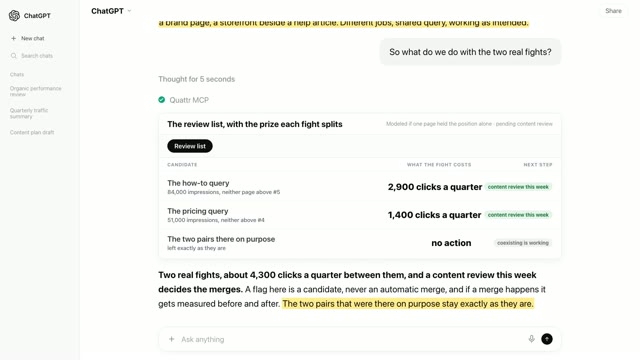
Related metrics and workflows
Verification
A definition is the smallest part of this.
The measurement matters because something acts on it. Here is the rest of the showcase, in the order most people find useful.