
Search market share
also called Share of voice in searchSearch SOVCTR-modeled search market share
Definition
Your CTR-modeled share of the tracked search demand inside one segment, read from the share-of-voice competitor column that carries your own domain.
How it's calculated
The tracked-competitor roster for the segment and medium is read first, and the row that is yours carries a rank; that rank picks out your own domain's share column on the dataset being read. That column is returned exactly as the semantic layer computes it, nothing downstream recomputes it. Each column is that domain's summed share over the tracked family's daily total, already expressed as a percentage. The figure you receive is final, nothing downstream re-scales it.
Scope, grain and dimensions
- Grain
- One segment × period × medium. Whole-segment is the default lens; site, keyword, page and category members are separate lenses with their own field sets.
- Dimensions
- intent · brand · keyword · page · category · country · device · rank_bucket
- Required filters
- segment_id · selected_period · source_medium
- Aggregation
- Never summed. Each per-domain share value is already a share of its own slice's demand, so adding intents, pages or keywords together produces a number with no denominator. Compare like slices, or re-read at the grain you want.
- Metric type
- share · % of the tracked search demand in the segment
Data sources
Where you'll see this
Named reports that normally include this metric.
AI Overview and SERP feature reportMonthly executive search reportSearch market share reportSERP volatility and algorithm update report
Skills and analyses that use it
Skills carry the judgment; the analysis verbs do the reading.
Analysis verbs
market_share_overviewmarket_share_querymarket_share_breakdowngrowth_vs_market_sharecompetitive_trends
Method rungs and levers
A rung tells you what a movement here can and cannot explain, read the rungs below it first.
levers L2 Demand modeling
Ask Quattr
- "What is our search market share in this segment?" Simulate this →
- "Are we gaining or losing ground against tracked rivals?" Simulate this →
- "How does our share split between branded and non-branded demand?" Simulate this →
How to read it
Read it as a direction and a distance, not as a precise level. It is modelled from click-through at observed positions over the keywords a segment tracks, so it answers "how much of this demand are we plausibly taking, relative to the rivals we track", not "what fraction of a market we own". Movement of the gap matters more than the absolute number.
Caveats, freshness and failure modes
Always CTR-modeled search market share of tracked demand, directional, scoped to a segment's keywords, and never revenue share.
Only roster ranks one to forty have a selectable share column. A roster row beyond forty is dropped from the standings, and if your own row sits there your share comes back unavailable even though your domain identity still resolves from the full roster.
A competitor a segment does not track is invisible to this number, so absence from the standings means untracked, not absent.
Without a segment the read spans segments and the result is meaningless; reads default to the primary whole-domain segment rather than running unscoped.
Every read is also pinned to the canonical customer-site URL and, where the dataset exposes it, to web search, the same always-on scope the product applies. A read without them is not the product's number.
Intent and brand are applied as parameters that re-weight the measure, not as ordinary row filters; filtering the plain intent or brand dimension instead returns a materially different number.
- Freshness
- ~1 day behind, Daily observation, available the following day.
Common failure modes
- Reading a segment total and a keyword-grain total as the same quantity, they are different reads with different denominators.
- Summing shares across a breakdown to reach a segment total.
- Treating a rival's absence from the standings as evidence they are not competing.
Not the same as
The confusions that cause the most wrong decisions.
Search market share Total daily share denominator Compare definitions →
That measure is the share-of-voice denominator, documented in code as a decoy and never returned as anyone's share; this is your own SOV-adjusted column.
Search market share Average SERP rank vs competitors Compare definitions →
Rank is impression-weighted position on a keyword; this is CTR-modeled share of tracked demand. The two live on different explores and can move in opposite directions.
Search market share Page-level search market share Compare definitions →
Page-level share is a separate client-only measure with its own contract, not the same per-domain share column read at page grain.
Search market share AI share of voice Compare definitions →
Both get called "share of voice". This one is CTR-modeled search market share of tracked demand on the Google SERP; the other is share of answer-engine responses. Different surfaces, different denominators, and they move independently.
Search market share Content-category search market share Compare definitions →
Segment share is share of voice against tracked rivals; category share is your own share within a content category, on a member that has no competitor columns.
Search market share Average position Compare definitions →
Average position is an impression-weighted ordinal on your own results; search market share is a CTR-modeled share of tracked demand, aggregated across a segment and comparable to competitors. Position can improve while share falls, because share depends on what everyone else did with the same demand.
Search market share Our rank on a tracked keyword Compare definitions →
A rank is an ordinal on a single keyword; search market share is a CTR-modeled share of the tracked demand aggregated across the segment. You can hold better ranks on more keywords and still hold less share, because share weights by the demand behind each keyword.
Search market share Keyword rank gap Compare definitions →
A rank gap is a per-keyword position difference; search market share is a CTR-modeled share of tracked demand across the whole segment. Closing gaps on low-demand keywords can leave share unchanged, and share can move with no gap changing at all.
Watch this metric read in a real run
All runs →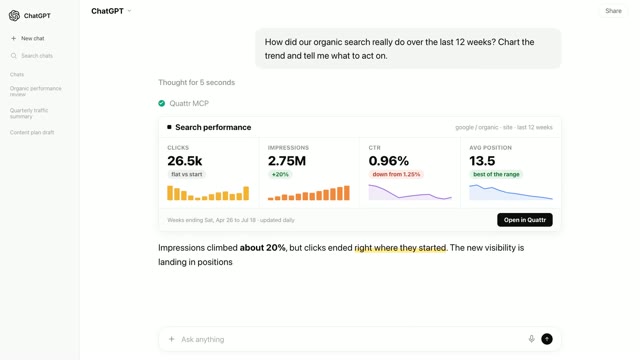 1 min 12 secCan your search data tell you what to do next?Search Console · Search pulse · Chart composer◐Recreated from an anonymized session
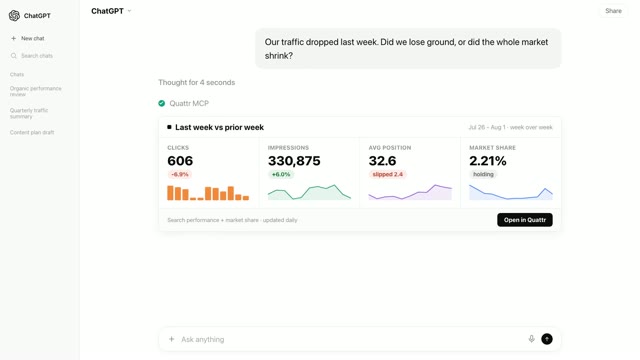 1 min 44 secTraffic just dropped. Is it you, or the market?Search Console + Rank tracking · Market share review◐Recreated from an anonymized session
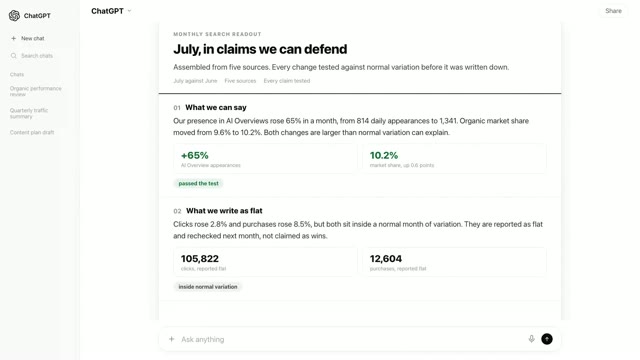 2 min 18 secThe deck is due tomorrow. The numbers live in five places.Search Console + Rank tracking + AI visibility + Web analytics + Google Ads · Monthly exec review◐Recreated from an anonymized session
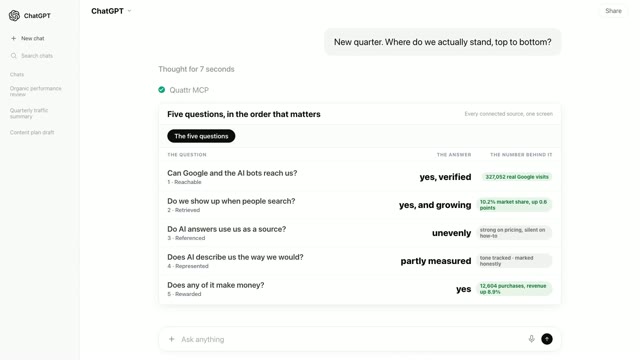 2 min 20 secWhere do we stand? Five questions answer it, in order.Search Console + Rank tracking + AI visibility · Monthly exec review◐Recreated from an anonymized session
Related metrics and workflows
Verification
A definition is the smallest part of this.
The measurement matters because something acts on it. Here is the rest of the showcase, in the order most people find useful.