
Gap to leader
also called Leader gapDistance to the leader
Definition
The distance in share points between the segment leader's CTR-modeled search market share and your own, for the same period and slice.
How it's calculated
The leader's share minus your own, both taken at FULL PRECISION from the same standings before any rounding, with the single difference then rounded to one decimal place. Null when either side is missing. Computed in the MCP, not in the semantic layer.
- Numerator
- leader's share value for the slice
- Denominator
- not a ratio, a difference in share points
Scope, grain and dimensions
- Grain
- One segment × period × medium.
- Dimensions
- intent · brand · keyword · page · country · device
- Required filters
- segment_id · selected_period · source_medium
- Aggregation
- Not summable. Recompute per slice and per period; a gap across periods is a pair of gaps, not an average.
- Metric type
- derived metric · share points (percentage points of tracked search demand)
Data sources
Where you'll see this
Named reports that normally include this metric.
Monthly executive search reportSearch market share report
Skills and analyses that use it
Skills carry the judgment; the analysis verbs do the reading.
Analysis verbs
market_share_overviewmarket_share_query
Method rungs and levers
A rung tells you what a movement here can and cannot explain, read the rungs below it first.
levers L2 Demand modeling
Ask Quattr
- "How far behind the leader are we?" Simulate this →
- "Is the gap closing or widening?" Simulate this →
- "Which intents carry the widest gap?" Simulate this →
How to read it
The most usable number in the family, because it survives the modelling caveat: both sides are computed the same way from the same period, so the difference and its direction are meaningful even where the absolute levels are approximations. Zero means you are the leader.
Caveats, freshness and failure modes
It is a difference in share points, not a percentage change, a gap that moves from 8 to 6 points closed by 2 points, not by 25%.
The difference is taken before rounding while the two share figures are published after it, so subtracting the two published shares will not always reproduce the published gap.
The gap is only against the leading TRACKED domain; an untracked domain ahead of both of you is invisible.
When you lead, the gap is zero by construction rather than a measured advantage over the runner-up.
- Freshness
- ~1 day behind, Daily observation, available the following day.
Common failure modes
- Quoting the gap as a percentage and mixing points with percent in the same sentence.
- Comparing gaps across segments, which have different tracked demand and different rosters.
Not the same as
The confusions that cause the most wrong decisions.
Gap to leader Head-to-head rank gap Compare definitions →
That gap is a difference in ranking positions on shared keywords; this one is a difference in CTR-modeled share of tracked demand.
Gap to leader Search market share change Compare definitions →
The gap compares two domains in one period; this compares one domain across two periods.
Watch this metric read in a real run
All runs →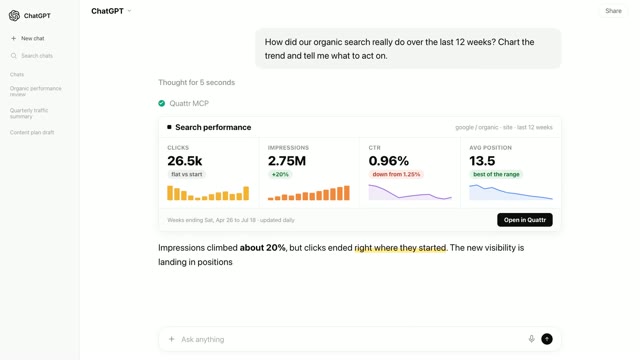 1 min 12 secCan your search data tell you what to do next?Search Console · Search pulse · Chart composer◐Recreated from an anonymized session
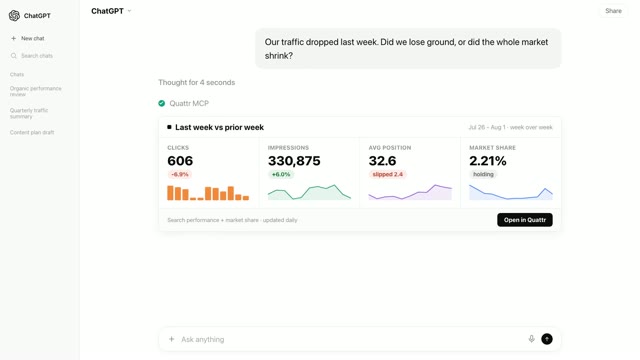 1 min 44 secTraffic just dropped. Is it you, or the market?Search Console + Rank tracking · Market share review◐Recreated from an anonymized session
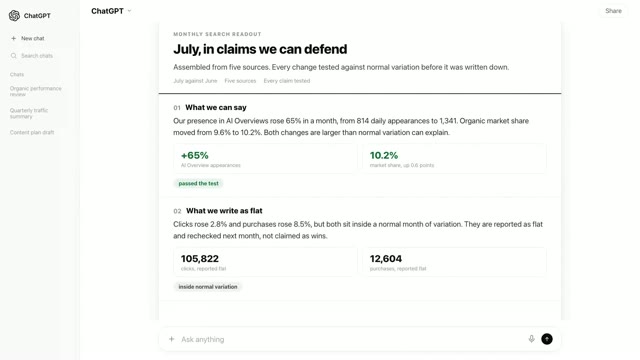 2 min 18 secThe deck is due tomorrow. The numbers live in five places.Search Console + Rank tracking + AI visibility + Web analytics + Google Ads · Monthly exec review◐Recreated from an anonymized session
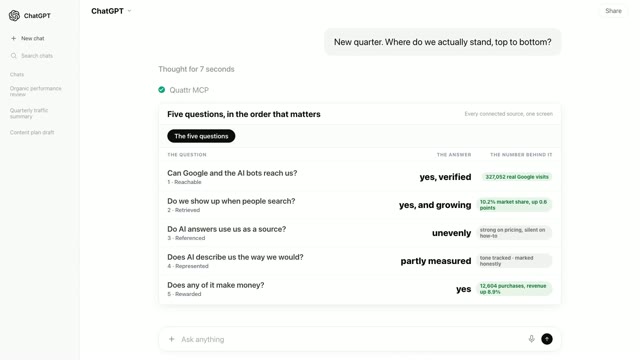 2 min 20 secWhere do we stand? Five questions answer it, in order.Search Console + Rank tracking + AI visibility · Monthly exec review◐Recreated from an anonymized session
Related metrics and workflows
Verification
A definition is the smallest part of this.
The measurement matters because something acts on it. Here is the rest of the showcase, in the order most people find useful.