
Competitor share by rank bucket
also called Rival share by ranking bandShare by SERP position band
Definition
A named tracked competitor's share within each ranking band, bucketed from their observed results-page positions rather than from the share-of-voice columns.
Scope, grain and dimensions
- Grain
- One ranking band × competitor × segment × period × medium.
- Dimensions
- rank_bucket
- Required filters
- segment_id · selected_period · source_medium · competitor label
- Aggregation
- Not summable across bands. Each band is read independently, and your own leg and the competitor leg are bucketed by two different position vocabularies.
- Metric type
- share · % of the tracked search demand within the ranking band
Data sources
Where you'll see this
Named reports that normally include this metric.
Competitor search reportSearch market share reportSERP volatility and algorithm update report
Skills and analyses that use it
Skills carry the judgment; the analysis verbs do the reading.
Analysis verbs
market_share_breakdown
Method rungs and levers
A rung tells you what a movement here can and cannot explain, read the rungs below it first.
Ask Quattr
- "Where in the rankings does this rival take their share?" Simulate this →
- "Are they winning from the top three, or from deeper positions?" Simulate this →
How to read it
A shape read rather than a level read: it says where in the results a rival's presence sits. Because the competitor leg and your own leg are bucketed by different position vocabularies, compare each domain to itself across bands before comparing the two domains within a band.
Caveats, freshness and failure modes
The competitor leg is bucketed independently by observed results-page position, while your own leg in the same table comes from the customer-category share measure, two vocabularies in one view.
Both legs are now readable in the semantic layer and they are genuinely different measures: your band value is that category slice's daily demand over the period's category total, and the rival's is the competitor-pages share over its own total. Both are scaled to a percentage, but they do not share a denominator, which is why the row is not published as one verified measure.
It needs the roster's own competitor label; where a roster row has no label the verb returns null instead of substituting a domain into the filter.
It is unavailable together with a brand or intent filter, the competitor-pages source cannot apply that slice, and the column is returned null with the reason stated.
Clicks in the same table come from a third source and are returned null on a tracked segment, because a whole-domain search-analytics read would overstate them.
- Freshness
- ~1 day behind, Daily observation, available the following day.
Common failure modes
- Reading a null competitor column as zero presence when it is a stated capability gap.
- Comparing your band value with the rival's band value as if both came from the same measure.
Not the same as
The confusions that cause the most wrong decisions.
Competitor share by rank bucket Average SERP rank vs competitors Compare definitions →
Average rank is one number per keyword; this distributes share across ranking bands. Position is the axis here, not the measurement.
Watch this metric read in a real run
All runs →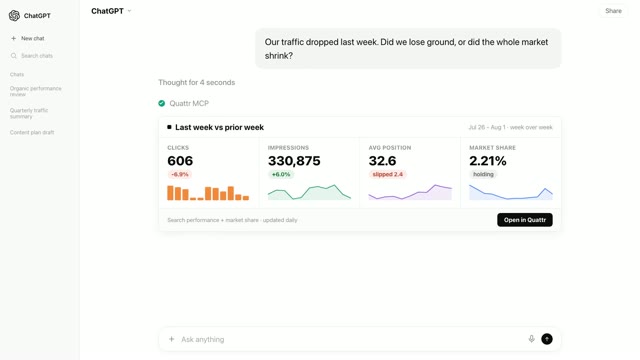
Related metrics and workflows
Verification
A definition is the smallest part of this.
The measurement matters because something acts on it. Here is the rest of the showcase, in the order most people find useful.