
Our rank on a tracked keyword
also called Client rankOur position (tracked)
Definition
Your own average ranking position for one keyword inside a tracked segment, taken from Quattr's daily results-page observation rather than from Search Console.
How it's calculated
`nvl(Σ(position × impressions) / Σ(impressions), 0)` on the tracked-rank table, computed per keyword and domain, the same impression-weighted average used for organic position, wrapped in a zero floor that fires when the impression denominator is empty. Your own domain is identified from the segment's competitor mapping, taking the first row flagged as the client.
- Numerator
- Sum of position × impressions for that keyword and domain
- Denominator
- Sum of impressions for that keyword and domain
Scope, grain and dimensions
- Grain
- One keyword × one domain × the date range, inside one tracked segment.
- Dimensions
- query · competitor domain · segment
- Required filters
- segment_id · date range
- Aggregation
- Impression-weighted per keyword and domain; ranks across keywords are never averaged into a site rank.
- Metric type
- rank · results-page position (1 = top)
Data sources
Where you'll see this
Named reports that normally include this metric.
Skills and analyses that use it
Skills carry the judgment; the analysis verbs do the reading.
Analysis verbs
seo_keyword_gap_analysiscompetitive_keyword_ranking
Method rungs and levers
A rung tells you what a movement here can and cannot explain, read the rungs below it first.
levers L2 Demand modeling
Ask Quattr
- "Where do we rank for this keyword versus our competitors?" Simulate this →
- "Which tracked keywords do we rank for at all?" Simulate this →
- "How do our ranks compare in the buying-intent segment?" Simulate this →
How to read it
The observed side of the competitive picture: not what your own reporting says about you, but where you were seen relative to everyone else competing for the same tracked demand. It is only defined inside a segment, because the competitor set is resolved per segment.
Caveats, freshness and failure modes
Segment-scoped by construction: a keyword outside the tracked segment has no rank here, and a query without a segment filter returns meaningless cross-segment data.
Your own ranks are read in a separate, domain-scoped query from the competitors'. A single combined read drops the client's own rows for most keywords and pushes almost everything into the not-ranked bucket.
A missing row means no observed rank in this segment and window, not that the keyword has no demand.
The measure never returns null. Where a row exists but carries no impressions, the zero floor returns a rank of 0, which sorts ahead of position 1, is carried into the winning bucket as a negative gap, and is not flagged anywhere in the response.
This is an impression-weighted average over the window, not a discrete position observed on a given day.
- Freshness
- ~1 day behind, daily observation, available the following day.
Common failure modes
- Reconciling this to the Search Console average position and treating the difference as an error.
- Reading a rank of 0 as the best possible position rather than as the measure's zero floor on a row with no impressions.
- Reading a null as a ranking of zero or as a page that cannot rank.
- Running the comparison without a segment and interpreting the blended result.
Not the same as
The confusions that cause the most wrong decisions.
Our rank on a tracked keyword Average position Compare definitions →
Search Console average position is your own reported position across every impression Google recorded; this is Quattr's observed position on one tracked keyword inside one segment, alongside competitors on the same keyword. Different sources, different keyword universes, and they are not built to reconcile.
Our rank on a tracked keyword Search market share Compare definitions →
A rank is an ordinal on a single keyword; search market share is a CTR-modeled share of the tracked demand aggregated across the segment. You can hold better ranks on more keywords and still hold less share, because share weights by the demand behind each keyword.
Watch this metric read in a real run
All runs →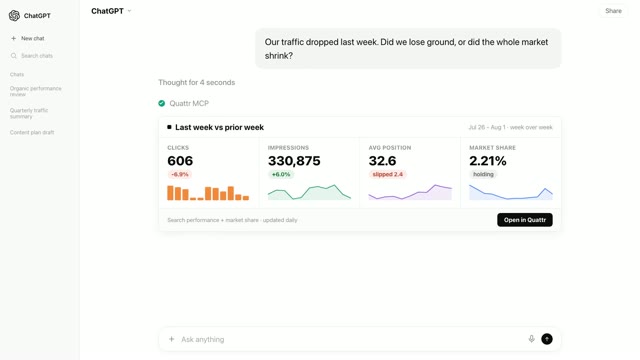
Related metrics and workflows
Verification
A definition is the smallest part of this.
The measurement matters because something acts on it. Here is the rest of the showcase, in the order most people find useful.