
Winning keywords
also called Winning bucketKeywords we lead on
Definition
Tracked keywords where you rank at or above the best tracked competitor.
How it's calculated
A keyword falls into the winning bucket when your rank exists and the gap to the best tracked competitor is zero or negative. Up to 25 rows are returned; the bucket total is reported separately and is not capped.
Scope, grain and dimensions
- Grain
- One tracked segment × the date range.
- Dimensions
- query · competitor domain · segment
- Required filters
- segment_id · date range
- Aggregation
- A count of keywords, partitioning with the losing and not-ranked buckets.
- Metric type
- raw measure · keywords
Data sources
Where you'll see this
Named reports that normally include this metric.
Skills and analyses that use it
Skills carry the judgment; the analysis verbs do the reading.
Analysis verbs
seo_keyword_gap_analysis
Method rungs and levers
A rung tells you what a movement here can and cannot explain, read the rungs below it first.
Ask Quattr
- "Which keywords do we already win?" Simulate this →
- "Where are we ahead of this competitor?" Simulate this →
- "How much of the tracked set do we lead?" Simulate this →
How to read it
Ground to defend, and the counterweight to a gap list that would otherwise read as an all-loss picture. A winning keyword is a position held on a given window, not a position secured.
Caveats, freshness and failure modes
A tie is counted as winning: a gap of exactly zero falls on this side of the split.
Winning means ahead of the best TRACKED competitor; an untracked rival above you both is invisible here.
The returned rows are capped at 25 while the total is not, so the list under-describes the bucket by design.
The rank measure floors to zero on a row with no impressions, and a zero rank produces a negative gap, so that artifact lands here rather than in the losing bucket.
- Freshness
- ~1 day behind, daily observation, available the following day.
Common failure modes
- Reading a tie-heavy winning count as clear leadership.
- Presenting the winning count as a share of the market.
Watch this metric read in a real run
All runs →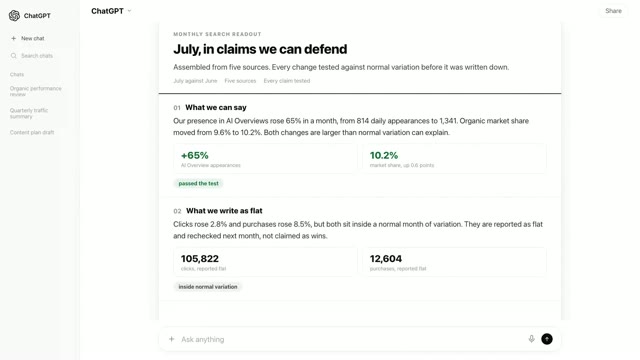 2 min 18 secThe deck is due tomorrow. The numbers live in five places.Search Console + Rank tracking + AI visibility + Web analytics + Google Ads · Monthly exec review◐Recreated from an anonymized session
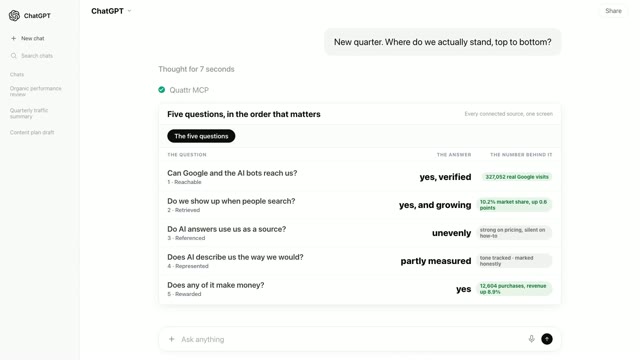 2 min 20 secWhere do we stand? Five questions answer it, in order.Search Console + Rank tracking + AI visibility · Monthly exec review◐Recreated from an anonymized session
Related metrics and workflows
Verification
A definition is the smallest part of this.
The measurement matters because something acts on it. Here is the rest of the showcase, in the order most people find useful.