
Losing keywords
also called Losing bucketKeywords where competitors beat us
Definition
Tracked keywords where you rank but the best tracked competitor ranks above you.
How it's calculated
A keyword falls into the losing bucket when your rank exists and the gap to the best tracked competitor is strictly greater than zero. The rows are sorted by gap descending and the top 25 are returned; the bucket total is reported separately and is not capped.
Scope, grain and dimensions
- Grain
- One tracked segment × the date range.
- Dimensions
- query · competitor domain · segment
- Required filters
- segment_id · date range
- Aggregation
- A count of keywords. The three buckets partition every keyword on which at least one tracked competitor ranks.
- Metric type
- raw measure · keywords
Data sources
Where you'll see this
Named reports that normally include this metric.
Competitor search reportSearch opportunity report
Skills and analyses that use it
Skills carry the judgment; the analysis verbs do the reading.
Analysis verbs
seo_keyword_gap_analysis
Method rungs and levers
A rung tells you what a movement here can and cannot explain, read the rungs below it first.
levers L2 Demand modelingL3 Refresh & content qualityL5 Net-new content
Ask Quattr
- "Where do competitors beat us?" Simulate this →
- "Which keywords are we losing to this rival?" Simulate this →
- "How many of our tracked keywords do we lose?" Simulate this →
How to read it
The battle map's contested column: demand you are already in, held by someone else. It is the refresh-and-push list rather than the build list, because the page already exists and already ranks.
Caveats, freshness and failure modes
The returned rows are the widest 25 gaps; the totals describe the whole bucket, so a list and a count answer different questions.
Segment-scoped, so the bucket only covers demand the segment tracks.
Rank comparisons are positions on tracked keywords, not promises of traffic, demand weighting comes before prioritisation.
- Freshness
- ~1 day behind, daily observation, available the following day.
Common failure modes
- Reading the returned rows as the whole losing set.
- Prioritising the widest gaps rather than the ones with demand behind them.
Watch this metric read in a real run
All runs →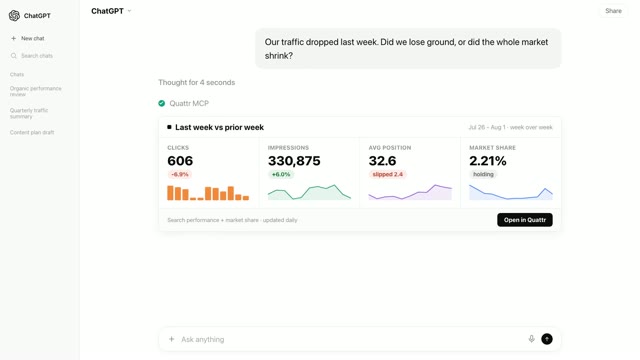
Related metrics and workflows
Verification
A definition is the smallest part of this.
The measurement matters because something acts on it. Here is the rest of the showcase, in the order most people find useful.