
Page-level search market share
also called page_market_shareShare by URL
Definition
Your own CTR-modeled share of tracked search demand attributed to one page, the share column a breakdown returns when it groups by URL, though not always from the same underlying measure.
Scope, grain and dimensions
- Grain
- One page × segment × period × medium.
- Dimensions
- page · intent · brand · category
- Required filters
- segment_id · selected_period · source_medium
- Aggregation
- Not summable across pages, each row is a share against its own demand, and the page rows do not partition the segment.
- Metric type
- share · % of the tracked search demand attributed to the page
Data sources
Where you'll see this
Named reports that normally include this metric.
Skills and analyses that use it
Skills carry the judgment; the analysis verbs do the reading.
Analysis verbs
market_share_breakdownmarket_share_query
Method rungs and levers
A rung tells you what a movement here can and cannot explain, read the rungs below it first.
Ask Quattr
- "Which of our pages hold the most share of tracked demand?" Simulate this →
- "Which URLs lost ground this month?" Simulate this →
How to read it
Use it to rank your own pages against each other, not to compare a page against a competitor. It is a client-only measure: the page breakdown has no per-competitor equivalent, so a named rival's column is simply absent at this grain.
Caveats, freshness and failure modes
TWO measures now answer to this name. The canonical full-domain page breakdown reads the customer-category share on the customer-category dataset and relabels it as page share in the response; the page measure of that name is read only on the retained path, tracked segments, click-ranked pages and comparison refills. Two page rows can carry the same column name from different definitions.
Client-only. The page drill deliberately substitutes a client measure for the per-competitor columns, so page rows carry no rival share.
The page measure itself is that page's share of the same daily denominator the rest of the family divides by, scaled to a percentage and carrying the same organic adjustment. The customer-category measure that stands in for it on the canonical route has its own denominator, so the two are not interchangeable at the row level.
It resolves to zero rather than null where there is no presence, the semantic layer wraps it in a zero default, so a zero row is not evidence the page is untracked.
Page filters are applied as a parameter rather than through the plain page dimension, because the backing column is only present when clicks are also selected.
- Freshness
- ~1 day behind, Daily observation, available the following day.
Common failure modes
- Comparing a page's value against a competitor's segment-level share as if they shared a denominator.
- Comparing a canonical page row against a tracked-segment page row without noticing they came from different measures.
- Reading a zero as an absence of tracking rather than an absence of presence.
Not the same as
The confusions that cause the most wrong decisions.
Page-level search market share Search market share Compare definitions →
Segment share is your own domain's share column; page share is a separate client-only measure with its own denominator and no competitor counterpart.
Watch this metric read in a real run
All runs →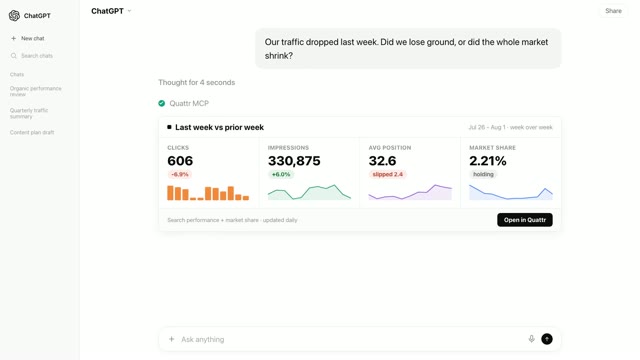
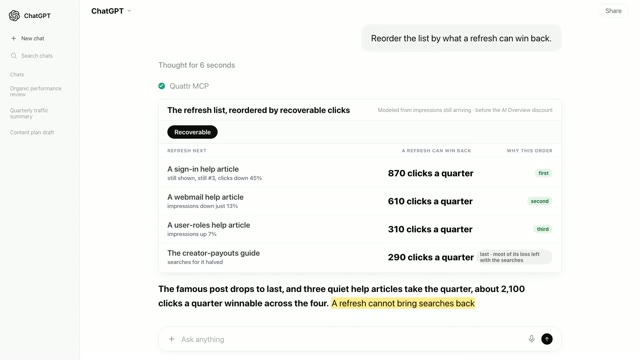
Related metrics and workflows
Verification
A definition is the smallest part of this.
The measurement matters because something acts on it. Here is the rest of the showcase, in the order most people find useful.