
Content-category search market share
also called market_share_categoryShare by content category
Definition
Your own CTR-modeled share of the tracked search demand within one page-side content category, such as product pages or help content.
How it's calculated
One grouped read on the customer-category dataset: the page-side content category as the dimension and the category share measure as the metric, with brand and intent applied as re-weighting parameters rather than ordinary row filters. The semantic layer defines that measure as the category's summed daily demand share over the period's category total, scaled to a percentage on the same basis as the rest of the family. It is YOUR share within the category, that dataset carries no per-competitor columns at all, so no rival column can be selected beside it. Reconciled against the product's own category tab on a live tenant (32.6866 read against a displayed 32.69%, and 0.0344 against 0.03%).
Scope, grain and dimensions
- Grain
- One content category × segment × period × medium.
- Dimensions
- category · intent · brand · rank_bucket
- Required filters
- segment_id · selected_period · source_medium
- Aggregation
- Not summable across categories, categories do not partition the tracked demand and each row is a share against its own slice.
- Metric type
- share · % of the tracked search demand within the category
Data sources
Where you'll see this
Named reports that normally include this metric.
Skills and analyses that use it
Skills carry the judgment; the analysis verbs do the reading.
Analysis verbs
market_share_breakdowngrowth_vs_market_share
Method rungs and levers
A rung tells you what a movement here can and cannot explain, read the rungs below it first.
Ask Quattr
- "Which content categories hold the most search market share?" Simulate this →
- "Is our product content losing ground faster than our editorial content?" Simulate this →
How to read it
A read on where your content estate is strong, not a competitive standing. Because that dataset has no rival columns, the correct sentence is "we hold X% of the tracked demand in this category", never "we lead this category".
Caveats, freshness and failure modes
This is your own share within the category, not share of voice against tracked rivals, the underlying dataset carries no competitor columns.
Categories are PAGE-side content categories, not keyword groupings; a keyword-side category read is a different question.
Category is a filter and a group-by only on this dataset: the category column on the keyword-and-page dataset is not selectable, so a category breakdown routes here and joins clicks from a separate read.
The click leg switches source with the filter, a brand or intent filter routes it to the keyword-and-page combined table, an unfiltered read to the page combined table. That mirrors the product, but the two are different populations.
Clicks come back null on a tracked segment: the whole-domain click read would overstate it and the segment's own filters cannot be reconstructed on that side. The share stays segment-scoped and correct.
The union of the share rows and the click rows keeps one-sided rows, so a category can show share with no clicks, or clicks with near-zero share.
- Freshness
- ~1 day behind, Daily observation, available the following day.
Common failure modes
- Presenting a category share as a competitive position.
- Requesting a category group-by together with competitor columns, which the verbs refuse with a steer rather than returning a plausible wrong number.
Not the same as
The confusions that cause the most wrong decisions.
Content-category search market share Search market share Compare definitions →
Segment share is share of voice against tracked rivals; category share is your own share within a content category, on a member that has no competitor columns.
Watch this metric read in a real run
All runs →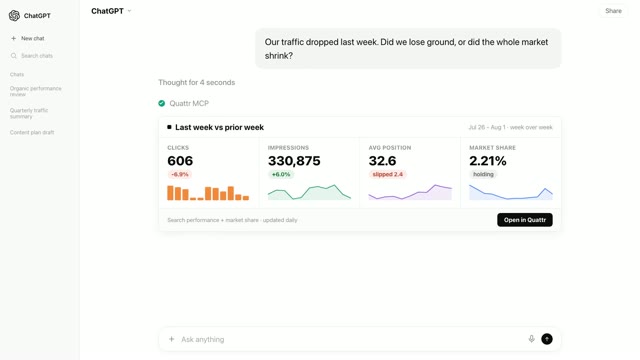 1 min 44 secTraffic just dropped. Is it you, or the market?Search Console + Rank tracking · Market share review◐Recreated from an anonymized session
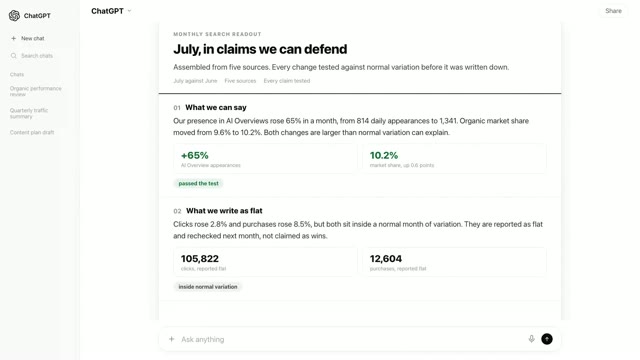 2 min 18 secThe deck is due tomorrow. The numbers live in five places.Search Console + Rank tracking + AI visibility + Web analytics + Google Ads · Monthly exec review◐Recreated from an anonymized session
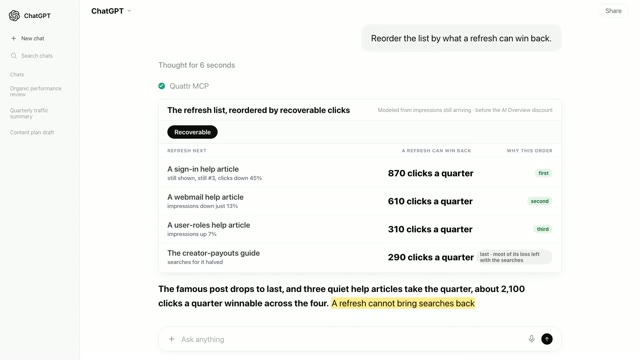 2 min 23 secYour biggest loser is not your best refresh.Search Console · Content decay refresh◐Recreated from an anonymized session
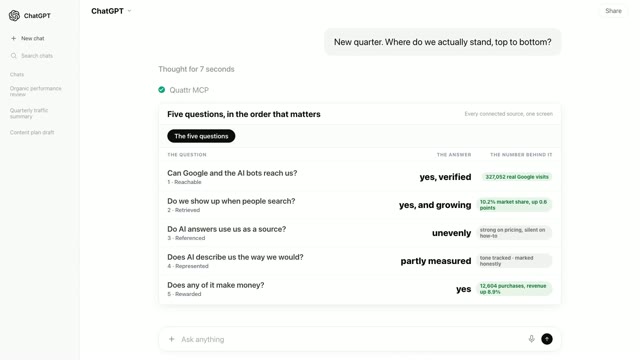 2 min 20 secWhere do we stand? Five questions answer it, in order.Search Console + Rank tracking + AI visibility · Monthly exec review◐Recreated from an anonymized session
Related metrics and workflows
Verification
A definition is the smallest part of this.
The measurement matters because something acts on it. Here is the rest of the showcase, in the order most people find useful.