
SERP volatility and algorithm update report
also called Algorithm update impact reportGoogle update reportVolatility reportMarket event report
A market-level read of ranking turbulence: how much the result pages moved across the tracked demand, which domain types gained or lost during the window, how page-one composition changed, and where your own set sits inside that movement. It exists to answer the question asked in every update week, was that us or was that everyone, before anyone starts changing pages.
Who it is for, and what it settles
- Audience
- In-house strategist
- Job to be done
- Separate a market-wide ranking event from something you did, and quantify how it landed on your keyword set.
- Cadence
- On demand
The metrics, in three tiers
Headline numbers carry the story. Diagnostics explain a headline that moved. Guardrails stop a wrong conclusion. Every row links to the definition, the formula, the caveats and what the metric is not all live on the metric page.
Headline What you lead with 3
Diagnostic Reached for when a headline moves 8
- Search market share share % of the tracked search demand in the segment
- Average position rank results-page position
- Overall average rank derived metric results-page position
- Organic clicks raw measure clicks
- Period-over-period change derived metric the same unit as the metric being compared
- Ranking movement (gainers and losers) derived metric keywords classified as gainers, losers or flat
- Competitor share by rank bucket share % of the tracked search demand within the ranking band
- Ranked-keyword coverage derived metric tracked keywords
Required data sources
Skills that produce or interpret it
Method rungs covered
- R1 Reachable , not covered
- R2 Retrieved , covered
- R3 Referenced , not covered
- R4 Represented , not covered
- R5 Rewarded , not covered
It reads the upper rungs only. If a lower rung is broken, fix that before you present this, a report that never checks whether pages can be reached will keep reporting movement that may not be yours.
Ask for it in one sentence
The prompt pack for this report, copy one, or watch it play in the simulator.
- "Did the algorithm update hit us?" Simulate this → Prompt gallery →
- "Is this drop market-wide or specific to us?" Simulate this → Prompt gallery →
- "How volatile were results this week?" Simulate this → Prompt gallery →
- "Which kinds of sites gained during the update?" Simulate this → Prompt gallery →
What to say out loud when you present it
Volatility is measured over a tracked keyword set, so an index built on your segments describes your market and not the web. A confirmed update announcement and a movement in the data are separate facts; correlation across the same window is not attribution, and rollouts run for weeks. Most of the standing evidence for this report is internal market monitoring rather than per-customer boards, so treat the customer-facing framing as newer than the underlying data.
Related workflows and use cases
Watch a run that builds this report
All runs →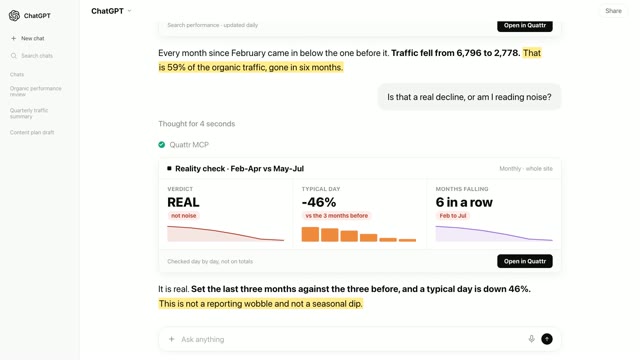 2 min 5 secTraffic more than halved in six months. Nobody could say why.Search Console · Anomaly investigator◐Recreated from an anonymized session
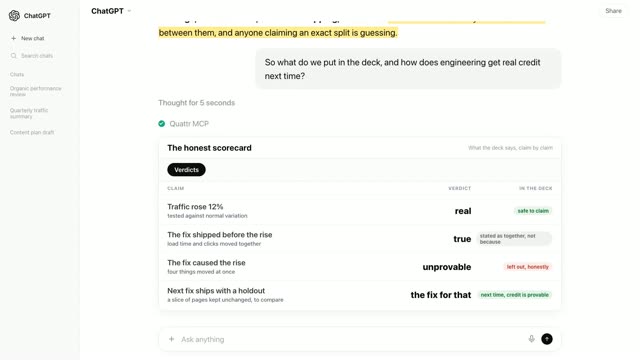 3 min 4 secThe fix shipped. Traffic rose. Now two teams want the credit.Lighthouse + Search Console + Rank tracking · Significance referee · Cross domain correlator◐Recreated from an anonymized session
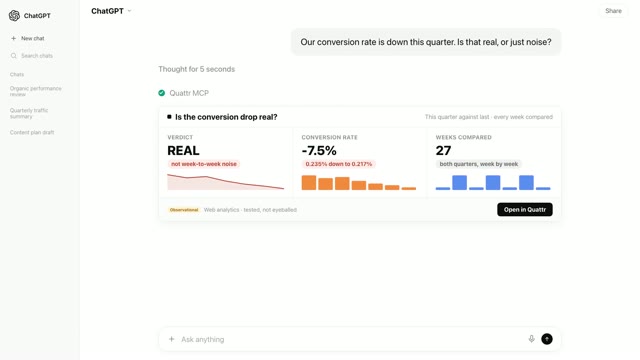 2 min 26 secConversion rate fell 7.5%. The number is real. The panic is not.Web analytics · Significance referee◐Recreated from an anonymized session
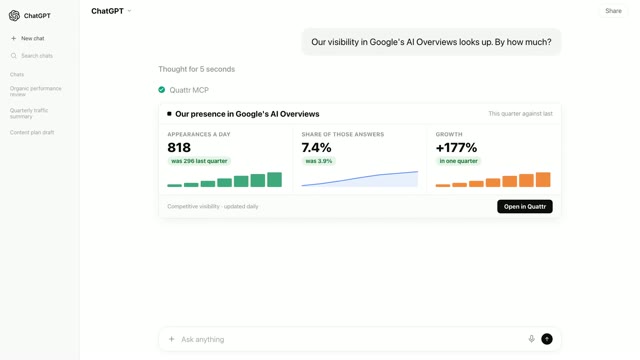 2 min 2 secSomething went right this quarter. Now prove it before you say it out loud.Rank tracking + Search Console · SERP feature watch · Significance referee◐Recreated from an anonymized session
How this entry was verified
Knowing the contents is step one.
Someone still has to assemble it, defend the numbers and present it. Here is the rest of the showcase.