
Ranked-keyword coverage
also called Tracked keywords with a positionrankedKeywordCount
Definition
How many of a segment's tracked keywords your site holds any average position on during the period.
How it's calculated
The count of your own keyword rows whose average rank is greater than zero, taken after the ranking read is split by domain. The greater-than-zero test is load-bearing rather than cosmetic: the semantic layer defaults a keyword with no impressions to rank zero rather than null, so counting rows instead of positions would count absences as coverage. Computed in the MCP from the returned rows, not read as a measure.
Scope, grain and dimensions
- Grain
- One segment × period × medium.
- Dimensions
- device · country · brand
- Required filters
- segment_id · selected_period · source_medium
- Aggregation
- A count over one period's rows; not summable across periods, since the same keyword recurs.
- Metric type
- derived metric · tracked keywords
Data sources
Where you'll see this
Named reports that normally include this metric.
Keyword ranking and movement reportMonthly executive search reportSearch market share reportSERP volatility and algorithm update report
Skills and analyses that use it
Skills carry the judgment; the analysis verbs do the reading.
Analysis verbs
competitive_keyword_ranking
Method rungs and levers
A rung tells you what a movement here can and cannot explain, read the rungs below it first.
Ask Quattr
- "How many tracked keywords do we hold a position on?" Simulate this →
- "Are we appearing on more of the tracked demand than last month?" Simulate this →
How to read it
A coverage read on the consideration-set question: not how well you rank, but on how much of the tracked demand you appear at all. Read it beside the overall average position, coverage growing while the average worsens usually means new, weaker entries rather than a decline.
Caveats, freshness and failure modes
The denominator is the segment's tracked keyword set, so growth can come from tracking more keywords rather than from ranking on more of them.
Rows without a position are excluded, so the count is presence, not entitlement, and the exclusion is what keeps the semantic layer's zero default out of the count.
The rows are drawn from one five-thousand-row read covering every tracked domain in the segment, so on a wide segment the count is bounded by the read rather than by your coverage.
This is computed in the MCP from returned rows and is a different quantity from the deferred per-competitor ranked-keyword measure.
- Freshness
- ~1 day behind, Daily observation, available the following day.
Common failure modes
- Comparing it against a rival's ranked-keyword figure, which comes from a different and currently withheld measure.
- Narrating coverage growth as demand growth.
Not the same as
The confusions that cause the most wrong decisions.
Ranked-keyword coverage Ranked keywords per competitor Compare definitions →
That is a per-competitor measure on the ranking explore, currently withheld pending reconciliation; this is a count the MCP computes from your own returned rows.
Watch this metric read in a real run
All runs →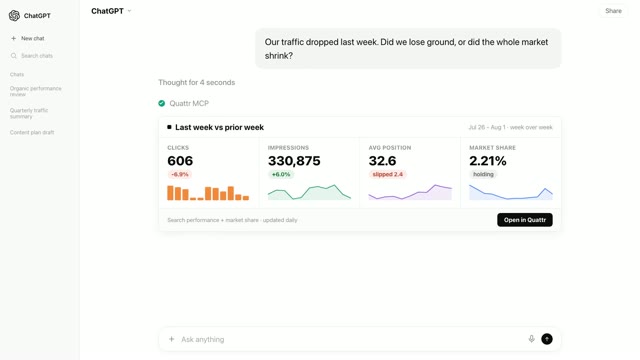
Related metrics and workflows
Verification
A definition is the smallest part of this.
The measurement matters because something acts on it. Here is the rest of the showcase, in the order most people find useful.