
Ranked keywords per competitor
also called Competitor ranked-keyword count
Definition
How many tracked keywords a given domain holds a ranking for, counted per competitor on the rank-tracking dataset.
Scope, grain and dimensions
- Grain
- One domain × segment × period × medium.
- Dimensions
- competitor domain · intent · brand · country · device
- Required filters
- segment_id · selected_period · source_medium
- Aggregation
- Would be a count per domain and period; not summable across domains, since the same keyword is counted for each domain that ranks on it.
- Metric type
- raw measure · tracked keywords
Data sources
Where you'll see this
Named reports that normally include this metric.
Skills and analyses that use it
Skills carry the judgment; the analysis verbs do the reading.
Analysis verbs
competitive_overviewcompetitive_trends
Method rungs and levers
A rung tells you what a movement here can and cannot explain, read the rungs below it first.
Ask Quattr
- "How many tracked keywords does this rival rank for?" Simulate this →
- "Is a competitor's ranked footprint growing faster than ours?" Simulate this →
Caveats, freshness and failure modes
The per-competitor rows were recovered and confirmed live on the rank-tracking dataset, so the data exists; it is the customer-side measure that is unreconciled, and the family is gated in both verbs because of it.
The measure counts DISTINCT keywords on the rank-tracking dataset's rows. The position predicate that would restrict it to keywords actually holding a rank is written into the semantic layer but commented out, so what it counts is row coverage rather than ranked coverage.
The customer-side measure name is carried in the registry as a hypothesis.
A different, verified count of your own ranked keywords is available from the keyword ranking verb, do not treat the two as the same number.
- Freshness
- ~1 day behind, Daily observation, available the following day.
Common failure modes
- Comparing your own computed ranked-keyword coverage against this per-competitor measure as if they shared a definition.
- Reading a larger ranked footprint as a larger share of demand.
Not the same as
The confusions that cause the most wrong decisions.
Ranked keywords per competitor Ranked-keyword coverage Compare definitions →
Coverage is computed in the MCP from your own returned rows and is published; this is a per-competitor measure on the ranking explore that is currently withheld. Same words, different numbers.
Ranked keywords per competitor Ranked pages per competitor Compare definitions →
One counts keywords a domain ranks on, the other counts that domain's ranking URLs; a single page can carry many keywords.
Watch this metric read in a real run
All runs →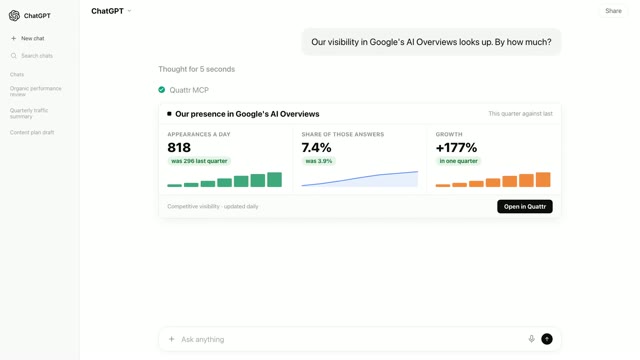
Related metrics and workflows
Verification
A definition is the smallest part of this.
The measurement matters because something acts on it. Here is the rest of the showcase, in the order most people find useful.