
SERP volatility index
also called Volatility indexSERP turbulenceSearch results churn
Definition
A market-level reading of how much the results pages themselves moved across a tracked demand set, the number you check to find out whether a drop was yours or everyone's.
Scope, grain and dimensions
- Grain
- One day and one country, for the demand set the index is built over.
- Dimensions
- date · country · derivation method
- Required filters
- date range
- Aggregation
- A daily market-level reading, averaged across the rows in the period. It is not a per-keyword measure and does not aggregate up from one; averaging days to describe a week flattens exactly the spike the index exists to show.
- Metric type
- score · not established
Data sources
Where you'll see this
Named reports that normally include this metric.
SERP volatility and algorithm update report
Skills and analyses that use it
Skills carry the judgment; the analysis verbs do the reading.
Method rungs and levers
A rung tells you what a movement here can and cannot explain, read the rungs below it first.
levers L2 Demand modeling
Ask Quattr
- "Was that drop us or was it everyone?" Simulate this →
- "How volatile were results this week?" Simulate this →
- "Did something market-wide happen on that date?" Simulate this →
Caveats, freshness and failure modes
Any such index is built over a tracked keyword set, so it describes that market and not the web, an index built on one cohort is not a general web-volatility reading.
A confirmed algorithm-update announcement and a movement in the data are separate facts; a spike in the same window is correlation, and rollouts run for weeks.
There is more than one score. The dataset carries a volatility score, a proxy score and a structure-movement score side by side, plus a dimension naming the derivation method, so "the index" is several readings that must not be compared as one series.
It is keyed by date and country only. There is no platform, content-format or device axis on it, so a cut by those is not something this dataset can answer.
- Freshness
- ~1 day behind, daily observation, available the following day.
Common failure modes
- Quoting a volatility number as though it were an industry-wide index rather than a reading over one tracked set.
- Attributing a movement to a named update because the two share a week.
- Comparing readings produced by different derivation methods as one series.
Not the same as
The confusions that cause the most wrong decisions.
SERP volatility index Ranking movement (gainers and losers) Compare definitions →
Opposite subjects. Ranking movement is your own keywords sorted into gainers and losers, it describes you. A volatility index describes the results pages across a tracked market, including every domain on them. Reading a quiet volatility index as 'we did not move', or a loud one as 'we were hit', inverts what each measures; the pair is only informative read together, which is the whole reason the update question exists.
Watch this metric read in a real run
All runs →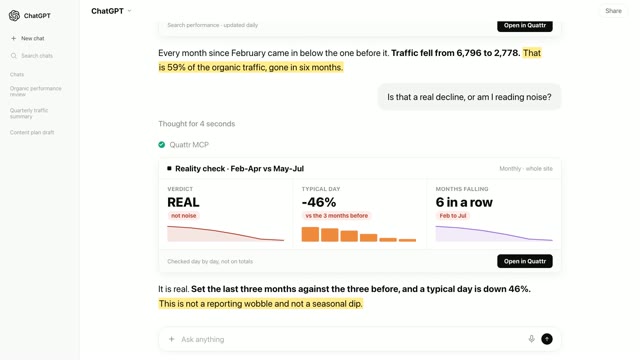 2 min 5 secTraffic more than halved in six months. Nobody could say why.Search Console · Anomaly investigator◐Recreated from an anonymized session
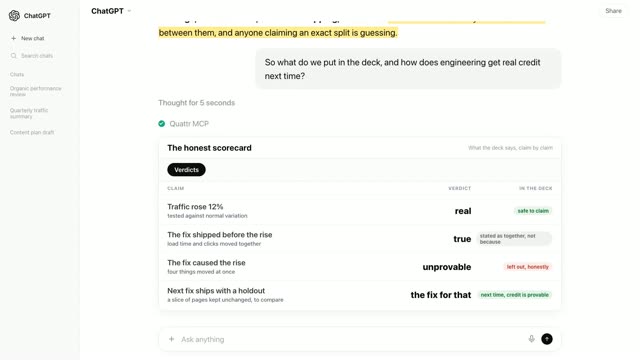 3 min 4 secThe fix shipped. Traffic rose. Now two teams want the credit.Lighthouse + Search Console + Rank tracking · Significance referee · Cross domain correlator◐Recreated from an anonymized session
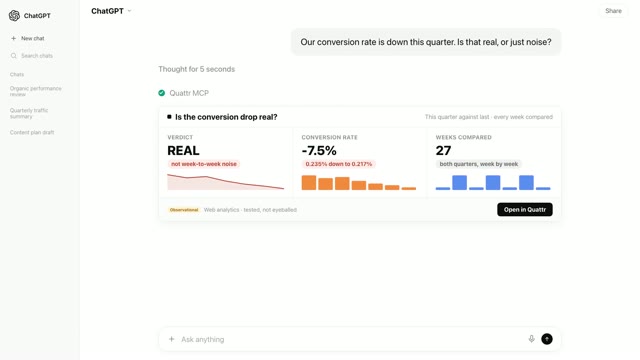 2 min 26 secConversion rate fell 7.5%. The number is real. The panic is not.Web analytics · Significance referee◐Recreated from an anonymized session
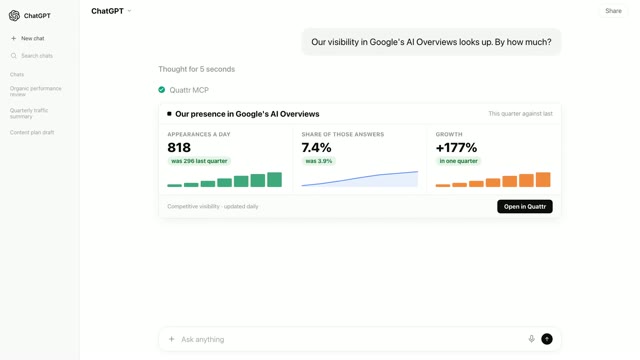 2 min 2 secSomething went right this quarter. Now prove it before you say it out loud.Rank tracking + Search Console · SERP feature watch · Significance referee◐Recreated from an anonymized session
Related metrics and workflows
Verification
A definition is the smallest part of this.
The measurement matters because something acts on it. Here is the rest of the showcase, in the order most people find useful.