
Ranking movement (gainers and losers)
also called MoversGainers and losersMovement report
Definition
The classification of each keyword's period-over-period change into a gainer, a loser or flat, using a fixed relative threshold and the metric's own good direction.
How it's calculated
A row is classified a gainer when its relative change moves at least 10% in the metric's good direction and a loser when it moves at least 10% the other way. Direction is metric-aware: for clicks and impressions a rise is a gain, for average position a FALL is a gain because lower is better. Each side is then sorted on the delta in the metric's own units, signed, not its absolute value, best improvement first for gainers and worst first for losers, and cut to the top 20. Membership is decided on the relative change; the ordering and the cut are decided on the unit change.
Scope, grain and dimensions
- Grain
- One keyword (or the single site row when run at site scope) × the pair of periods.
- Dimensions
- query · page · intent · category
- Required filters
- date range · comparison range
- Aggregation
- Per keyword, from the two-period join. The flat count is whatever is left after the two TRUNCATED lists, rows are excluded from the classification only when their delta is null, so the three numbers add up to the matched rows without describing them: the 21st gainer is counted as flat.
- Metric type
- derived metric · keywords classified as gainers, losers or flat
Data sources
Where you'll see this
Named reports that normally include this metric.
Cannibalization reportContent decay reportKeyword ranking and movement reportSERP volatility and algorithm update reportWeekly search report
Skills and analyses that use it
Skills carry the judgment; the analysis verbs do the reading.
Analysis verbs
seo_ranking_movement_report
Method rungs and levers
A rung tells you what a movement here can and cannot explain, read the rungs below it first.
levers L3 Refresh & content quality
Ask Quattr
- "Which keywords gained the most rankings this month?" Simulate this →
- "What were our biggest click losers versus last month?" Simulate this →
- "Show me gainers and losers by position" Simulate this →
How to read it
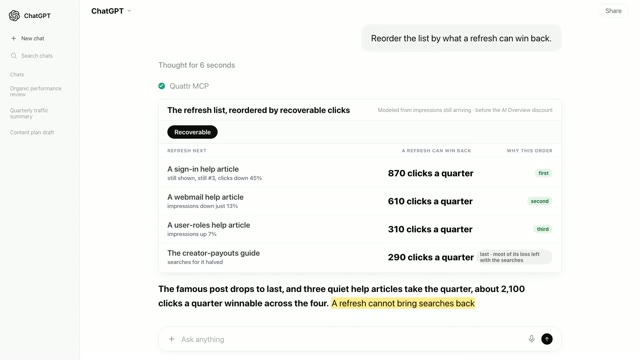
The what-moved table. The ±10% cut is a product convention that keeps the list readable, and the direction handling is what stops a keyword climbing from position 8 to 3 being filed as a loss. Treat the lists as candidates for a cause hunt, not as a set of findings.
Caveats, freshness and failure modes
Flat is not a synonym for did not move. It is the arithmetic remainder after each list is cut to 20, so every mover beyond the twentieth is counted as flat. On a wide keyword set the flat number is mostly movement.
The ±10% threshold is a fixed convention, not a statistical test, a ten percent move on three clicks clears it as readily as one on three thousand.
Keywords present in only one of the two periods carry a null delta and are dropped from the classification entirely, they are in none of the three groups, and only their counts are reported. The response's own unmatched caveat says those deltas are measured against zero; they are not.
The lists are ranked on the unit delta while membership is decided on the relative change, so the ordering is not the ordering of the ±10% test.
At site scope there are no per-keyword rows at all and the single aggregate is labelled as the site total.
- Freshness
- 1 to 2 days behind, Google's own reporting lag. Any answer touching the last 48 hours says so on the card.
Common failure modes
- Narrating the top of the gainers list as an achievement without the significance gate.
- Reading a position gainer as a rise because the delta is negative.
- Quoting the flat count as the number of keywords that held steady.
- Assuming the list covers every keyword rather than the top rows of each side.
Not the same as
The confusions that cause the most wrong decisions.
Ranking movement (gainers and losers) Real, noise or can't-tell Compare definitions →
Movement classification is a fixed ±10% cut on the relative change; a significance verdict is a two-sample test at an alpha. Being a gainer says nothing about whether the change is distinguishable from noise, and no effect size is computed on either side.
Ranking movement (gainers and losers) SERP volatility index Compare definitions →
Opposite subjects. This sorts your own keywords into gainers and losers, it describes you. A volatility index describes how much the results pages moved across a tracked market, including every domain on them. A quiet market with heavy movement on your set means something you did; a loud market with the same movement usually does not. Reading either one alone answers the update question wrongly.
Watch this metric read in a real run
All runs →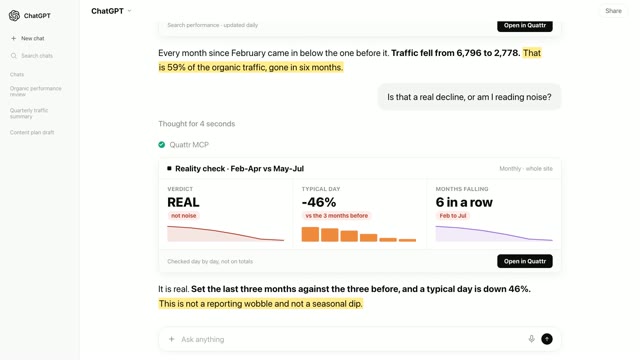
Related metrics and workflows
Verification
A definition is the smallest part of this.
The measurement matters because something acts on it. Here is the rest of the showcase, in the order most people find useful.