
Keyword-page click coverage
also called Keyword-attributed coverageKPR coverage
Definition
The share of whole-site organic clicks that can be attributed to a specific ranked keyword and page, the basis on which site-level average position and every branded or intent rollup is computed.
Scope, grain and dimensions
- Grain
- One date range × the whole site.
- Dimensions
- search type · source medium
- Required filters
- date range
- Aggregation
- Not returned by any verb. It is the implied ratio between the keyword-attributed rows and the whole-site totals for the same window and slice.
- Metric type
- share · % of whole-site organic clicks
Data sources
Where you'll see this
Named reports that normally include this metric.
Cannibalization reportContent performance reportKeyword ranking and movement reportWeekly search report
Skills and analyses that use it
Skills carry the judgment; the analysis verbs do the reading.
Analysis verbs
search_performance
Method rungs and levers
A rung tells you what a movement here can and cannot explain, read the rungs below it first.
levers L2 Demand modeling
Ask Quattr
- "Why is our keyword-level total smaller than our site total?" Simulate this →
- "How much of our traffic can be attributed to specific keywords?" Simulate this →
How to read it
The reason two correct numbers on the same card disagree. Anything computed on ranked keyword rows, site average position, a branded or non-branded rollup, a keyword worklist, describes only the attributable share of the site, while clicks and impressions beside it describe all of it. The gap is anonymized and unranked demand, not loss.
Caveats, freshness and failure modes
No verb computes or returns this ratio; the routing code records an observed range of roughly 64 to 70% of site clicks on the tenants it was checked against, and the underlying formula is not implemented anywhere in this repository.
It varies by tenant, by window and by slice, so a recorded range is a prior and not a value to quote for a specific account.
The keyword-attributed rollup returns its own coverage note on every response that uses it, that note, not this ratio, is what should travel with a number.
- Freshness
- 1 to 2 days behind, Google's own reporting lag. Any answer touching the last 48 hours says so on the card.
Common failure modes
- Treating the gap between a brand rollup and a site total as missing data or a bug.
- Quoting a remembered coverage percentage for a specific account instead of running the two reads.
Watch this metric read in a real run
All runs →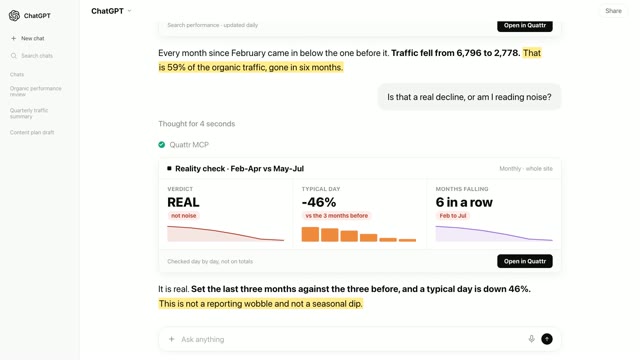
Related metrics and workflows
Verification
A definition is the smallest part of this.
The measurement matters because something acts on it. Here is the rest of the showcase, in the order most people find useful.