
Unique keywords
also called Total keywordsUnique keyword count
Definition
How many distinct keywords produced at least one impression for the site in the period.
How it's calculated
`NULLIF(COUNT(DISTINCT keyword), 0)` on the keyword-and-page combined table.
Scope, grain and dimensions
- Grain
- One date range × the whole site.
- Dimensions
- brand · intent · search type
- Required filters
- date range
- Aggregation
- A distinct count. It never sums, two periods' counts do not add, and the counts of two slices do not add to the count of their union.
- Metric type
- raw measure · distinct keywords
Data sources
Where you'll see this
Named reports that normally include this metric.
Cannibalization reportContent performance reportKeyword ranking and movement reportWeekly search report
Skills and analyses that use it
Skills carry the judgment; the analysis verbs do the reading.
Analysis verbs
search_performance
Method rungs and levers
A rung tells you what a movement here can and cannot explain, read the rungs below it first.
Ask Quattr
- "How many unique keywords do we rank for?" Simulate this →
- "How many non-brand keywords did we appear for last month?" Simulate this →
How to read it
Coverage of the demand pool rather than performance within it, the breadth half of the Retrieved rung. It moves with content footprint and with seasonality of the long tail, so a rise is a coverage signal and not a traffic signal.
Caveats, freshness and failure modes
Only the keyword-and-page combined table serves this correctly. The keyword-only rollup reads a larger keyword universe and over-counts to the point where a non-brand slice exceeded the all-searches total on two live tenants, which is impossible for a subset, so branded and intent slices are deliberately routed to the keyword-and-page table.
It cannot be requested in the same query as clicks, impressions, CTR or position: the count metrics live on a different dataset and the query assembler refuses the mix rather than returning a wrong field.
Privacy-suppressed queries are not counted, so this is distinct keywords that were reported, not distinct keywords that existed.
- Freshness
- 1 to 2 days behind, Google's own reporting lag. Any answer touching the last 48 hours says so on the card.
Common failure modes
- Summing the count across weeks to produce a quarter.
- Comparing a branded and a non-branded count and expecting them to add to the total.
Watch this metric read in a real run
All runs →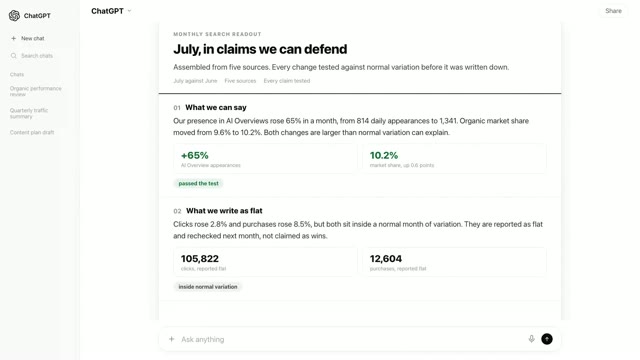 2 min 18 secThe deck is due tomorrow. The numbers live in five places.Search Console + Rank tracking + AI visibility + Web analytics + Google Ads · Monthly exec review◐Recreated from an anonymized session
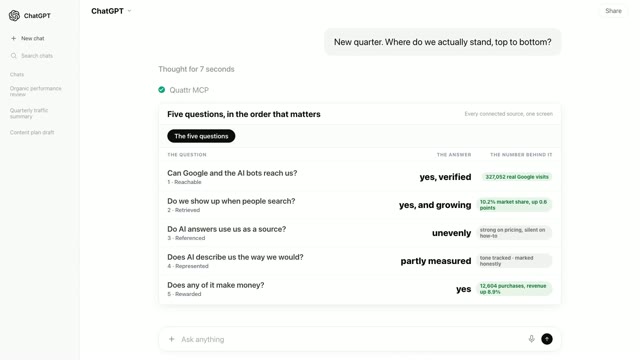 2 min 20 secWhere do we stand? Five questions answer it, in order.Search Console + Rank tracking + AI visibility · Monthly exec review◐Recreated from an anonymized session
Related metrics and workflows
Verification
A definition is the smallest part of this.
The measurement matters because something acts on it. Here is the rest of the showcase, in the order most people find useful.