
Your rank in the standings
also called Position in the standingsWhere we sit vs tracked rivals
Definition
Your ordinal position among the tracked domains of a segment when they are sorted by CTR-modeled search market share, highest first.
How it's calculated
The standings are built by collecting each roster row's share value, dropping the columns that are not finite numbers, sorting descending on the PRECISE value rather than the rounded one, and marking the row the roster flags as yours. Your position is read off that ordered list. The ordering is pinned in code; the ordinal itself is not emitted as its own field, so it is read from the returned standings rather than quoted from the payload.
Scope, grain and dimensions
- Grain
- One segment × period × medium.
- Dimensions
- intent · brand · keyword · page · country · device
- Required filters
- segment_id · selected_period · source_medium
- Aggregation
- Not aggregatable, a position is per period and per slice. Track it as a sequence of positions, never an average position.
- Metric type
- rank · position among tracked domains (1 = highest share)
Data sources
Where you'll see this
Named reports that normally include this metric.
Monthly executive search reportSearch market share report
Skills and analyses that use it
Skills carry the judgment; the analysis verbs do the reading.
Analysis verbs
market_share_overviewmarket_share_query
Method rungs and levers
A rung tells you what a movement here can and cannot explain, read the rungs below it first.
levers L2 Demand modeling
Ask Quattr
- "Where do we sit in the standings for this segment?" Simulate this →
- "Did we move up or down against tracked rivals?" Simulate this →
- "Who is immediately ahead of us?" Simulate this →
How to read it
A coarse read that hides distance: moving from fourth to third can mean a tenth of a share point. Pair it with the leader gap, which carries the magnitude the position discards.
Caveats, freshness and failure modes
The denominator is the tracked roster, not the market, a position of 3 means third among the domains this segment tracks.
The order can disagree with the displayed shares: two domains rounded to the same tenth still hold distinct positions, decided by digits the card does not show.
Roster changes move the position without anything changing in the results pages.
The ordinal is derived from the returned standings; the payload carries the sorted list and your own row, not a rank integer.
- Freshness
- ~1 day behind, Daily observation, available the following day.
Common failure modes
- Narrating a position change as a market move when the roster gained or lost a domain.
- Averaging positions across weeks, which discards the share distances that made them.
Not the same as
The confusions that cause the most wrong decisions.
Your rank in the standings Average SERP rank vs competitors Compare definitions →
That is a search-results position on keywords; this is a position in a share league table. Different explores, different meaning of the number one.
Your rank in the standings Segment leader Compare definitions →
The leader names which domain sits first; this names where you sit in the same ordering.
Watch this metric read in a real run
All runs →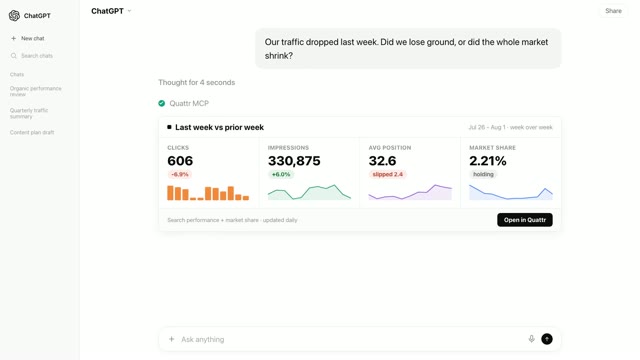 1 min 44 secTraffic just dropped. Is it you, or the market?Search Console + Rank tracking · Market share review◐Recreated from an anonymized session
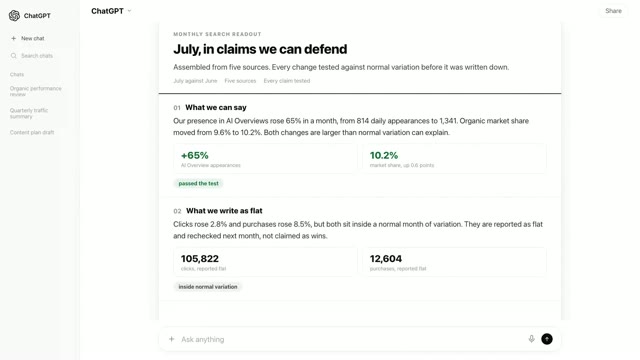 2 min 18 secThe deck is due tomorrow. The numbers live in five places.Search Console + Rank tracking + AI visibility + Web analytics + Google Ads · Monthly exec review◐Recreated from an anonymized session
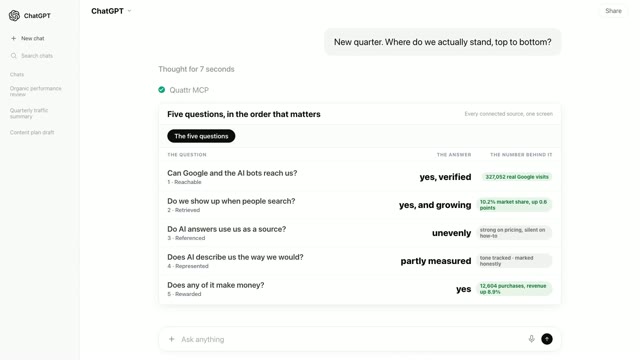 2 min 20 secWhere do we stand? Five questions answer it, in order.Search Console + Rank tracking + AI visibility · Monthly exec review◐Recreated from an anonymized session
Related metrics and workflows
Verification
A definition is the smallest part of this.
The measurement matters because something acts on it. Here is the rest of the showcase, in the order most people find useful.