
Total search share, organic leg
also called Organic search market share input
Definition
The CTR-modeled search market share of tracked demand that total search share uses as its organic input.
How it's calculated
Read from the market-share competitor column that the segment's competitor mapping resolves to your own domain, filtered to the segment, the medium, the date range and your canonical site URL. If the client row cannot be resolved, the leg is null and the response says so.
Scope, grain and dimensions
- Grain
- One number per segment, medium and date range.
- Dimensions
- segment · source_medium
- Required filters
- segment_id · date_range
- Aggregation
- A single-row read for the segment; not summed across segments.
- Metric type
- share · percent of tracked demand (stored 0 to 100)
Data sources
Where you'll see this
Named reports that normally include this metric.
Paid and organic overlap report
Skills and analyses that use it
Skills carry the judgment; the analysis verbs do the reading.
Analysis verbs
total_search_share
Method rungs and levers
A rung tells you what a movement here can and cannot explain, read the rungs below it first.
levers L8 Paid/organic interplay
Ask Quattr
- "What is the organic half of our total search share?" Simulate this →
How to read it
Your organic standing inside a tracked segment, expressed on a 0 to 100 scale, before the paid leg is folded in. It is directional: absolute share levels are approximations by construction, and the gap to the leader is the more reliable read than the level itself.
Caveats, freshness and failure modes
Always CTR-modeled search market share of tracked demand, directional, scoped to the keywords in a tracked segment, and never revenue share.
Stored 0 to 100 while the paid leg is stored 0 to 1; the two are normalised by name before being combined.
Requires a competitor mapping that identifies your own row for the segment and medium; without it the leg is null.
A segment that does not track a competitor cannot see them, so absence from the standings means untracked, not absent.
It ships beside the paid leg under a camel-case payload key the shared format contract cannot classify, so it renders as a bare number with no percent sign and no scale correction.
- Freshness
- ~1 day behind, daily observation, available the following day.
Common failure modes
- Comparing this leg directly against paid impression share without normalising the scales.
- Reading an unresolved client row as zero share.
Not the same as
The confusions that cause the most wrong decisions.
Total search share, organic leg Total search share, paid leg Compare definitions →
The organic leg is a modelled share of tracked demand on a 0 to 100 scale; the paid leg is auction impression share on a 0 to 1 scale. They are not comparable until normalised.
Total search share, organic leg Total search share Compare definitions →
The organic leg is one input to the combination, on its own 0 to 100 scale; the total is the union of both legs and cannot be decomposed back into them.
Watch this metric read in a real run
All runs →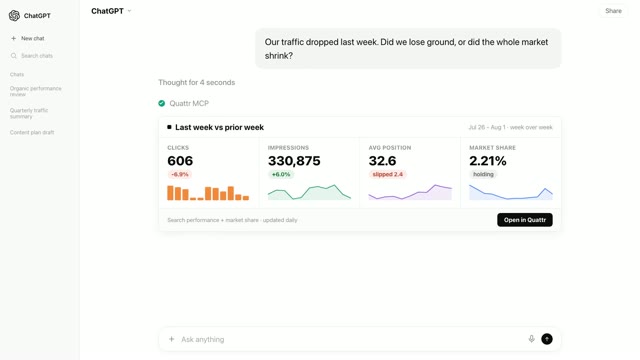
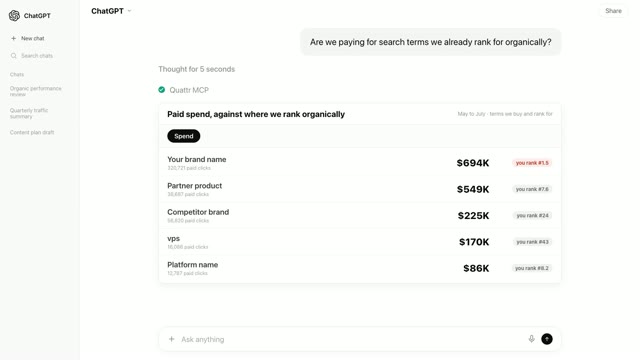
Related metrics and workflows
Verification
A definition is the smallest part of this.
The measurement matters because something acts on it. Here is the rest of the showcase, in the order most people find useful.