
Key Takeaways
- Search Engine Journal analyzed 40,000 AI-generated responses with over 250,000 citations and found that third-party websites were cited more often than brand-owned websites.
- The same study found that user-generated content from Reddit, review platforms, forums and community sites is becoming increasingly important in AI search visibility.
- Brands mentioned across blogs, reviews, podcasts, comparison articles and communities are more likely to appear in AI-generated answers.
- AI systems prefer content that is clear, structured, easy to summarize and backed by real examples or data.
- Brands succeeding in AI search are usually the ones building trust, authority and visibility across the entire internet, not just their own website.
The way people search online is changing quickly and most brands still haven’t fully caught up. People are no longer just searching on Google and clicking links. They are asking ChatGPT, Gemini, Perplexity and other AI tools for direct answers, recommendations and comparisons, then trusting whatever shows up first.
That creates a completely new visibility problem. A brand can still rank well on Google and yet never appear inside AI-generated answers. Meanwhile, smaller brands with strong reviews, Reddit discussions, community mentions and trusted third-party content are getting recommended again and again.
This is why AI visibility is becoming just as important as traditional SEO. AI systems do not only look at your website. They look across the internet to decide which brands seem trustworthy, relevant and worth mentioning. The brands winning in AI search are usually the ones building authority everywhere people talk about them online.
This creates an important question for brands: how do AI systems decide which companies to mention, recommend or cite in their answers?
How AI Search Chooses Brands?
AI-driven search engines use large language models to understand context, intent and relationships between concepts in ways traditional search engines never could. Instead of simply matching keywords, these systems evaluate meaning, credibility and relevance by analyzing information from multiple sources across the web to generate complete answers.
When AI systems crawl and interpret content, they look for clear structure, authoritative information and logical connections between ideas. Unlike traditional search algorithms that relied heavily on backlinks and keyword density, AI search prioritizes content that demonstrates expertise through depth, accuracy and clarity.
Many AI platforms also use Retrieval-Augmented Generation (RAG), which allows them to pull fresh information from live web sources while generating responses. This helps AI systems validate information, compare multiple viewpoints and surface content they consider trustworthy and reliable.
The key to AI visibility is understanding that these systems are designed to deliver complete, credible answers, not just lists of links. Brands that consistently publish accurate, well-structured and trusted content across the web are far more likely to appear in AI-generated answers.
Best Practices to Improve AI Search Visibility
1. Create Content That AI Can Easily Understand
AI systems prefer content that is simple to read, organized and easy to summarize. A page with messy structure, unclear sections or confusing explanations is much harder for AI models to understand properly.
Clear headings, simple paragraph openings and logical content flow help AI systems quickly identify what your page is about. Instead of vague titles, each section should directly explain the topic it covers. Short explanations, step-by-step formats and bite-sized information also improve how AI systems process your content. Quattr's Content AI helps you create and optimize content in line with these rules, and the Quattr Method for AI visibility optimization sets the order: diagnose, act, then measure.
Question-and-answer content works especially well because it matches how people search using AI tools. Adding useful FAQs based on real customer questions can increase your chances of appearing in AI-generated responses.
2. Use Schema Markup to Give AI More Context
Schema markup helps AI systems understand the meaning behind your content, not just the words written on the page. It acts like extra information that explains your business, products, articles, authors and other important details more clearly.
Different schema types help AI platforms interpret content properly. FAQ schema supports question-based pages, Article schema helps identify editorial content and Product schema explains details like pricing, reviews and availability.
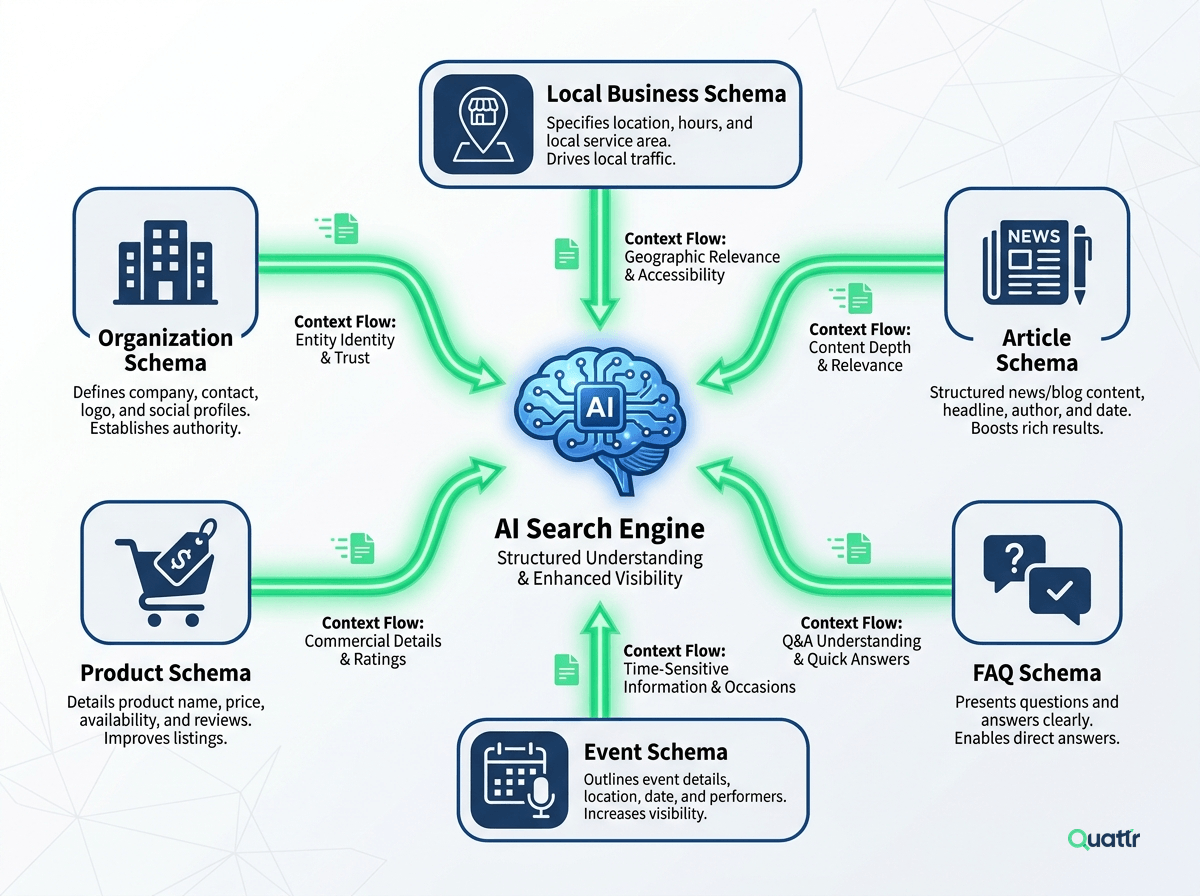
Advanced schema setups can also strengthen authority signals. For example, connecting author schema with organization schema helps AI systems understand expertise and trustworthiness, which can improve citation potential in AI-generated answers.
3. Build Trust With Accurate and Helpful Content
AI platforms try to recommend information they consider reliable and trustworthy. This means content quality matters more than ever.
Your content should include accurate facts, updated information and trustworthy references whenever possible. AI systems often compare information across multiple websites, so outdated or incorrect content can weaken your visibility.
Comprehensive content also performs better than thin pages written only for keywords. Instead of creating shallow articles, focus on fully answering the topic in a useful and easy-to-understand way. Adding expert insights, research, statistics or unique examples can strengthen authority even more.
4. Write Naturally Instead of Stuffing Keywords
AI systems are designed to understand normal human language. Content written naturally usually performs better than pages overloaded with repetitive keywords.
Instead of forcing exact-match phrases everywhere, focus on explaining topics clearly and conversationally. It still helps to check keyword search volume before you write, so you know which topics people actually search for. Use that data to decide what to cover, not which phrases to repeat. AI tools are getting much better at understanding search intent, meaning they care more about context and usefulness than keyword repetition.
Content should also anticipate follow-up questions users may have. The more completely your content answers a topic, the more valuable it becomes for AI-generated search experiences.
5. Improve Technical SEO for Better AI Crawling
Technical SEO still plays a huge role in AI visibility. AI systems need to crawl and process your website efficiently, so technical issues can limit how much of your content gets understood or indexed.
Fast-loading pages, mobile-friendly design and clean website structure all help AI crawlers process your content more effectively. Broken pages, rendering issues or slow websites can reduce visibility in AI search systems.
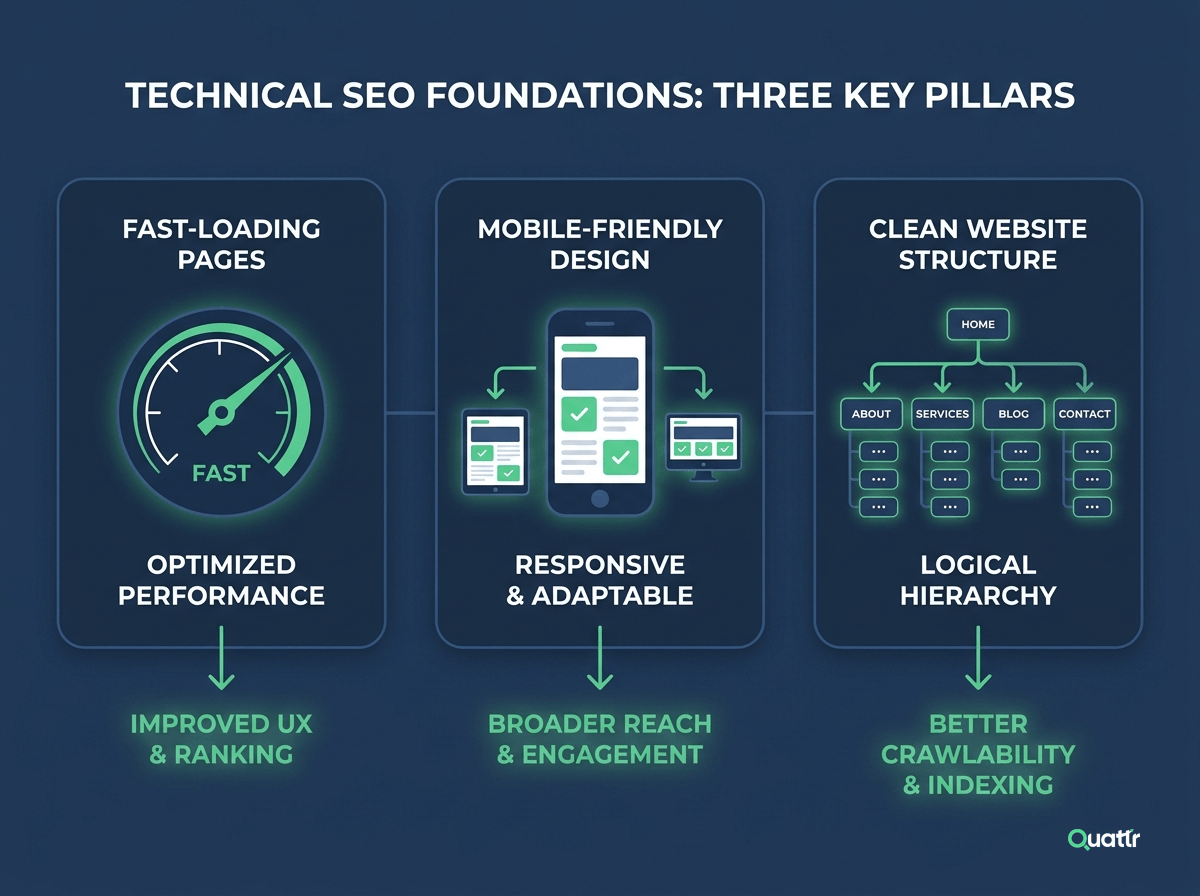
Internal linking is equally important because it helps AI understand relationships between pages and topics. Clean URLs, descriptive anchor text and strong site architecture make it easier for AI systems to recognize your expertise across multiple subjects.
6. Build Strong Entity and Brand Signals
AI systems do not only look at keywords anymore. They also try to understand brands, people, products and topics as connected entities across the internet.
This is why consistent branding matters. Your company name, descriptions, social profiles and business details should stay consistent across your website, directories, review platforms and third-party sites.
Publishing connected content around related topics also helps. Instead of creating isolated keyword pages, building topic clusters helps AI systems recognize your brand as an authority in a larger subject area.
7. Track AI Visibility Instead of Only Rankings
Traditional SEO rankings no longer tell the full story. Brands have to track AI visibility, it’s not an option anymore.
Quattr help brands track important AI visibility metrics such as citations, mentions, share of voice and sentiment across platforms like OpenAI ChatGPT, Anthropic Claude, Google AI Overviews and Google Gemini. The Trends dashboard helps teams monitor visibility changes over time using charts and reports across days, weeks, months or quarters; how citation monitoring works day to day is covered in its own reference.
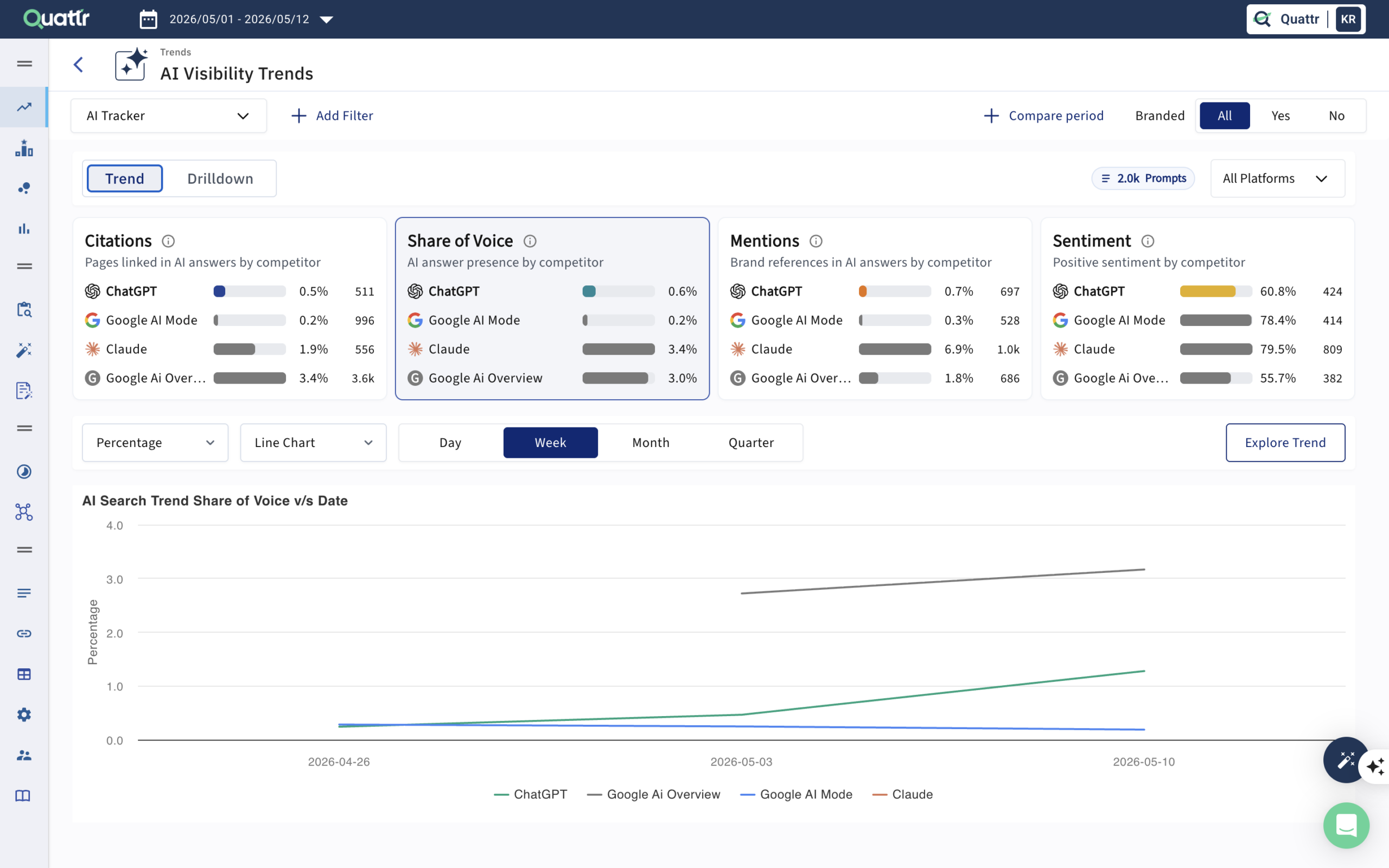
For deeper insights, the Drilldown view lets brands analyze visibility by prompts, competitors, cited URLs, geography and intent. Businesses can also track custom prompts related to their industry to understand which questions trigger visibility and what strategies are actually improving their AI presence over time.
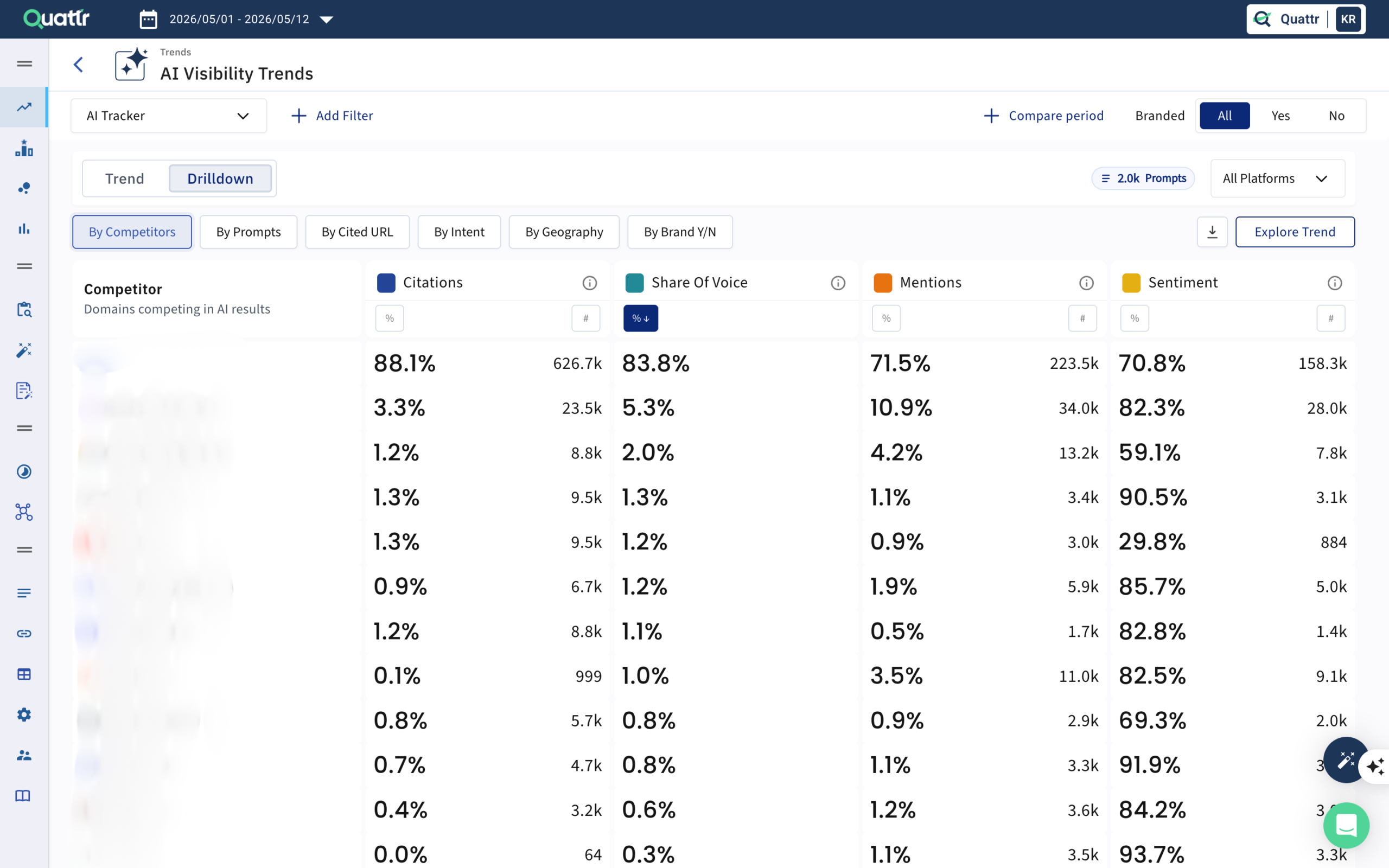
This deeper visibility helps teams understand what is actually working instead of relying only on traditional SEO metrics. Also, it helps brands quickly identify the gaps and mistakes that may be reducing their visibility inside AI-generated search results.
Mistakes That Hurt AI Search Visibility
1. Publishing Generic Content
AI systems are getting better at ignoring content that simply repeats what already exists online. Pages filled with generic advice, rewritten information or keyword-heavy text usually provide very little value in AI-generated search experiences.
Brands tend to gain more AI visibility when they publish original opinions, practical insights, real examples and useful explanations based on actual expertise. Content that genuinely helps users understand a topic performs much better than thin SEO-focused articles.
2. Hiding Important Content Behind Design Elements
Many modern websites hide important information inside tabs, sliders or JavaScript-heavy layouts. While these designs may look visually appealing, AI crawlers often struggle to fully access or understand the hidden content.
Critical information like FAQs, reviews, product comparisons and feature details should remain easily crawlable and visible on the page. If AI systems cannot properly access important content, the chances of being cited or summarized decrease significantly.
3. Depending Only on Your Website
AI systems do not evaluate trust based only on your website. They also analyze how your brand appears across the broader internet.
Discussions on Reddit, mentions in podcasts, reviews, YouTube videos, forums and third-party articles all contribute to how AI systems understand your brand reputation. Brands that are rarely mentioned outside their own website often struggle to gain strong AI visibility.
4. Ignoring Content Freshness
Outdated content can slowly weaken trust signals over time. Old statistics, broken examples, outdated screenshots or abandoned blogs make content appear less reliable to both users and AI systems.
Regularly updating important pages helps maintain accuracy, authority and relevance, especially in industries where information changes quickly.
5. Ignoring Negative Review Patterns
AI systems analyze customer feedback very carefully, and not just star ratings. Repeated complaints about pricing, customer support, onboarding or reliability can influence how AI platforms describe your brand in generated answers.
Reputation management is becoming an important part of AI optimization because AI systems increasingly use review sentiment to evaluate overall trustworthiness.
6. Treating AI Search Like Traditional SEO
AI search works very differently from traditional Google rankings. Instead of simply ranking webpages, AI systems compare multiple sources, evaluate trust, analyze reputation and generate summarized responses.
Because of this, a page ranking highly on Google can still remain completely invisible inside AI-generated answers. As AI search continues evolving, brands will need strategies focused not only on rankings, but also on authority, trust and broader digital visibility.
Plan to Improve AI Search Visibility
Step 1: Fix Technical SEO Issues
Make sure your website is crawlable, fast and mobile-friendly. Add proper schema markup, clean internal linking, XML sitemaps and clear page structure. Keep important content visible instead of hiding it behind tabs or scripts.
Step 2: Improve Existing Content
Update weak pages with better explanations, real examples, FAQs, comparisons and expert insights. Remove generic keyword-heavy content and focus on making pages genuinely useful and easy for AI systems to summarize.
Step 3: Increase Third-Party Mentions
Build visibility outside your website through Reddit discussions, reviews, industry blogs, podcasts, YouTube, communities and comparison sites. AI systems heavily rely on third-party trust signals.
Step 4: Make Websites AI-Agent Friendly
The future of search is moving toward AI agents that can interact with websites on behalf of users. Google’s newer generative AI guidelines are emphasizing on “agentic experiences” and AI agent friendly websites. Brands should start making websites more agent-friendly and machine-readable before this becomes standard.
Step 5: Monitor AI Visibility
Track how often AI platforms mention or cite your brand. Tools like Quattr help monitor citations, mentions, share of voice and sentiment across platforms like OpenAI ChatGPT, Anthropic Claude and Google Gemini.
Step 6: Continuously Refresh and Improve
Regularly update outdated pages, improve underperforming content and track which strategies increase AI visibility over time. AI search changes fast, so ongoing optimization matters.
How Quattr Helps Improve AI Search Visibility?
Most AI visibility tools only show one part of the picture at a time. You may track prompts in one place, citations somewhere else and competitor visibility in another tool. This makes it difficult to understand how your overall AI presence is actually changing.
Quattr brings the entire AI visibility picture together on a single screen. Teams can track how their brand appears across AI platforms without constantly switching between tools or manually testing prompts.
Instead of looking at disconnected metrics, brands can see prompt performance, cited pages, competitor presence, visibility trends and AI response behavior together in one unified view. This makes it much easier to quickly spot what content is improving AI visibility, where competitors are outperforming and which opportunities need attention first.
FAQs
Focus on helpful content, strong reviews, technical SEO, and building brand mentions across trusted websites and communities.
Content with direct answers, FAQs, comparisons, examples, and original insights performs best in AI-generated results.
Yes. AI systems use reviews to understand trust, reputation, and customer experience.
They evaluate content quality, reviews, online mentions, expertise, technical structure, and overall brand trust.
Yes. Smaller brands with strong expertise and active online presence can compete well in AI-generated results.
Consistent trust signals across content, reviews, communities, and third-party websites.

Quattr is an AI-native Search Visibility Platform founded in Palo Alto, California, built for mid-market and enterprise brands competing in the age of generative search. Recently recognized across G2's Spring 2026 reports with #1 rankings in AEO Results, Usability, and Relationship, Quattr helps brands win visibility across traditional search and AI-generated answer surfaces.
Quattr's AI agent, GIGA, evaluates content the way AI systems do, identifying gaps across structure, authority, internal linking, and discoverability to surface the highest-impact fixes. With capabilities like autonomous internal linking, E-E-A-T intelligence, and the new GIGA Landing Page Generator for keyword-matched, AI-search-ready pages, Quattr helps teams move from diagnosis to deployed changes without manual bottlenecks.