

Key Takeaways
- Answer first. Don’t make AI dig for it. Whatever your section is about, say it in the first line.
- AI will not just take your word for it. Show your sources, name your authors, publish original data. Give it a reason to trust you.
- One strong page is not a strategy. Cover your topic properly, link everything together and AI stops seeing you as a one-off and starts seeing you as the source.
- If you are not tracking citations you are guessing. Know which prompts surface your brand, where competitors are showing up instead and what gaps you still need to fill.
The URLs AI cites can change day to day, but the perspective it pulls from stays consistent. And according to Quattr’s analysis of the Ahrefs AI search study, 85% of pages ChatGPT retrieves never make it into the final answer. Getting found is only half the battle. What gets you cited is clarity, authority and structure, which is exactly what this guide has been about.
Here is where to begin.
Core GEO Practices
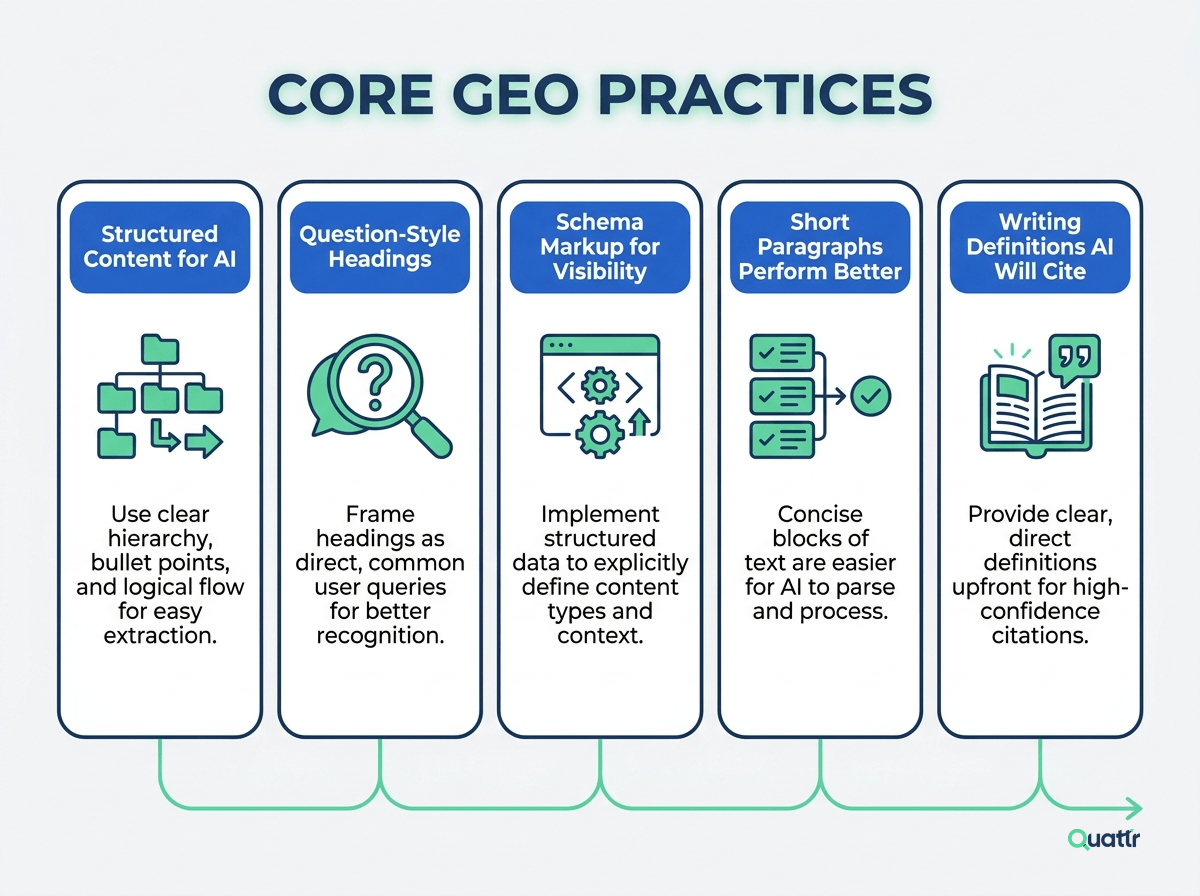
I. How to Structure Content for AI Extraction
Put your answer first. Everything else comes after.
AI engines using retrieval-augmented generation (RAG) and don’t process content the same way humans do. Instead of reading every word sequentially, they evaluate sections for relevance, clarity, and answer potential.
The opening sentences of a section often carry the most weight because they help AI quickly determine what the content is about. If a key answer is buried deep within long introductory text, the content may be less likely to be retrieved.
Do This
- Open every section with a direct, declarative sentence that answers the question.
- Keep paragraphs short, two to three sentences at most.
- Use numbered steps for any process or sequence.
- Use comparison tables for anything involving two or more options.
- Use definition blocks for any new concept you introduce.
Why It Works
Think of it from AI’s perspective. If it can copy your answer directly without having to rephrase or piece things together, it will. The easier you make that job, the more likely your content is the one that gets used.
II. Writing Question-Style Headings That AI Recognises
Before AI reads a single word of your content, it reads the heading.
A heading like “Content Tips” gives AI nothing to work with. It does not know what question you are answering or who it is for. But a heading like “How Should You Format Content for AI Search?” mirrors exactly how someone would type that question. AI recognises it instantly.
Do This
- Open section headings with “How,” “What,” “Why,” or “When” wherever the content answers that type of question.
- Write headings the way your buyer would type the question, not the way your internal team describes the topic.
- Test your headings by asking: if this heading were a search query, would my section be the right result?
Why It Works
The best part is this works for regular SEO too. The same heading that helps AI recognise your content as a direct answer is also how people type into Google.
III. How to Use Schema Markup for AI Visibility
When a page is hard to interpret, AI does not stick around to figure it out. It moves to a cleaner source. The good news is most sites have no schema at all, so even adding the basics puts you ahead of most of your competitors straight away.
Do This
- Add FAQ schema to any section containing questions and direct answers
- Add HowTo schema to any numbered instructional sequence
- Add Article schema to establish your page as an authoritative published piece rather than a randomly structured webpage
- Add Product, Event or Review schema where relevant to your content type
- Validate your markup using Google’s Rich Results Test before publishing
Why It Works
The less AI has to interpret, the more accurately it can represent your content, which is what schema is actually good for. Whether that also improves citation odds isn’t confirmed by Google or any AI vendor, and Ahrefs’ controlled study found no citation lift from adding schema to already-cited pages. Schema is still the clearest signal you can send about what your content is and what question it answers, just don’t treat it as a citation lever.
IV. Why Short Paragraphs Perform Better in AI Search
AI is not sitting there reading your content the way a human does. It is scanning for the answer. And when it hits a long, dense paragraph, it has to figure out which sentence is actually the point and which ones are just background. That is extra work and AI does not do extra work. It just finds a cleaner page.
A short paragraph with one clear idea is easy to lift. A six-sentence block with the answer buried somewhere in the middle is not.
Do This
- Limit every paragraph to two or three sentences.
- Make the first sentence the point, not the background.
- Move background, context and caveats to a separate paragraphs.
- Break any paragraph longer than four lines into two
Why It Works
Shorter paragraphs mean less work for AI to do. And the less work AI has to do, the more likely it is to quote you directly. Keeping it concise is not just good writing. It is how you make your content easy for machines to use.
V. How to Write Definitions AI Will Cite
Definitions are one of the most common things people ask AI. “What is GEO?” “What does retrieval augmented generation mean?” When that question comes in, AI goes looking for a page that answers it in one clean sentence. If your page uses the term but never actually defines it, or tucks the definition inside a long paragraph, AI moves on. Someone else gets the citation.
Do This
- Write a one or two sentence definition for every new concept you introduce, placed immediately after the term appears for the first time.
- Format definitions as their own standalone block and not folded into a longer paragraph.
Why It Works
A clearly written definition sitting in its own block is something AI can lift and use without any extra work. Pages that define their terms get cited for those queries.
Authority & Trust Signals for GEO
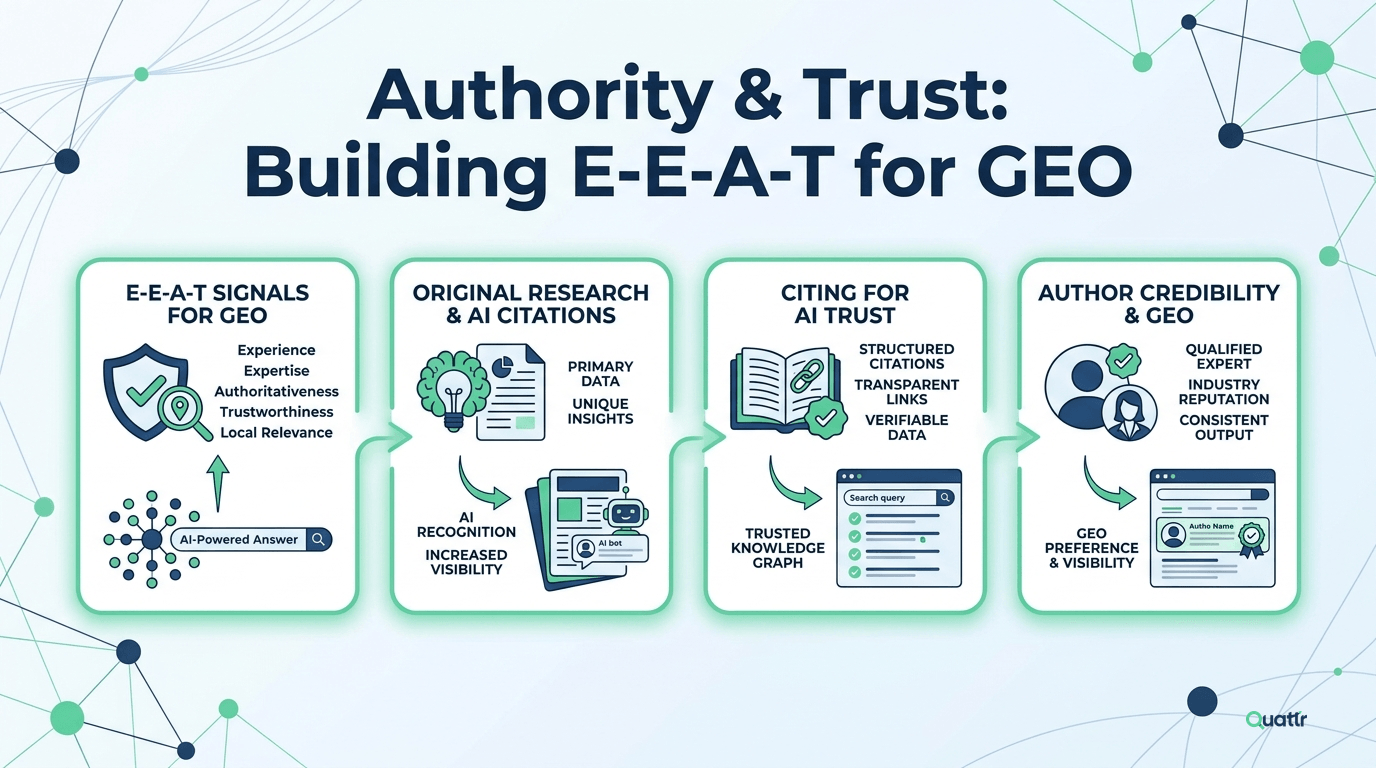
I. Why do E-E-A-T Signals Matter for GEO?
You cannot just claim to be an expert. You have to show it.
Google’s E-E-A-T framework, which stands for Experience, Expertise, Authoritativeness and Trustworthiness is how both search engines and AI systems decide whether your content is worth trusting. A page that shows who wrote it, why they are qualified and what the information is based on reads as credible. A page with no author, no sources and no credentials reads as anonymous. AI treats those two pages very differently when deciding what to cite.
Do This
- Add author bios to every piece that include name, title, company and relevant credentials.
- Back every claim with a named source, original data or a direct citation.
- Include first-hand experience where relevant, not just summarised information.
- Update content regularly and display the last updated date visibly on the page.
Why It Works
Each E-E-A-T signal you add gives AI more reason to trust your content over someone else’s. Getting the structure right tells AI where your answer is. Building authority tells AI whether that answer is actually worth using.
II. Why Original Research Drives More AI Citations?
When the data lives on your site and nowhere else, you become the source. And unlike every other GEO practice in this guide, that is something no competitor can replicate just by publishing similar content.
Do This
- Run original surveys in your industry and publish the findings as a dedicated piece.
- Promote original findings through outreach so other sites cite them, which in turn signals to AI that your site is a primary source.
Why It Works
Original research makes your site the origin point for information AI needs. That is the hardest citation advantage to build and the hardest one for anyone else to take away.
III. How to Cite Sources in a Way AI Trusts
“Experts say” is one of the most common phrases in content and one of the least useful. It tells AI nothing. Which experts? Published where? Based on what?
AI is not going to take your word for it. When it evaluates a claim, it looks for something it can verify. A named researcher, a specific publication, a year. That is what makes information feel real and trustworthy. Vague attribution does not really help.
Do This
- Replace every instance of “experts say” or “research shows” with a named source, publication and year.
- Link directly to the source rather than referencing it in text only.
- Prioritise linking to primary sources over secondary ones wherever possible.
Why It Works
Linked sources give AI something concrete information. Once a claim is verifiable, it becomes trustworthy.
IV. Author Credibility and Why It Matters for GEO
If a page has no author, there is no way to know who wrote it, why they know what they are talking about or whether any of it can be trusted. So AI does the safe thing and skips it. A cybersecurity article written by a named CISO is a completely different story. Same topic, same structure but one has a real person behind it and one does not.
Do This
- Create dedicated author profile pages that list credentials, experience and published work.
- Link author profiles from every article they write.
- Have subject matter experts write or review content in their domain and credit them explicitly.
Why It Works
When AI encounters content from a named expert with a verifiable track record, it has more reason to cite that content than an identical piece with no authorship signal.
The Content Architecture of GEO
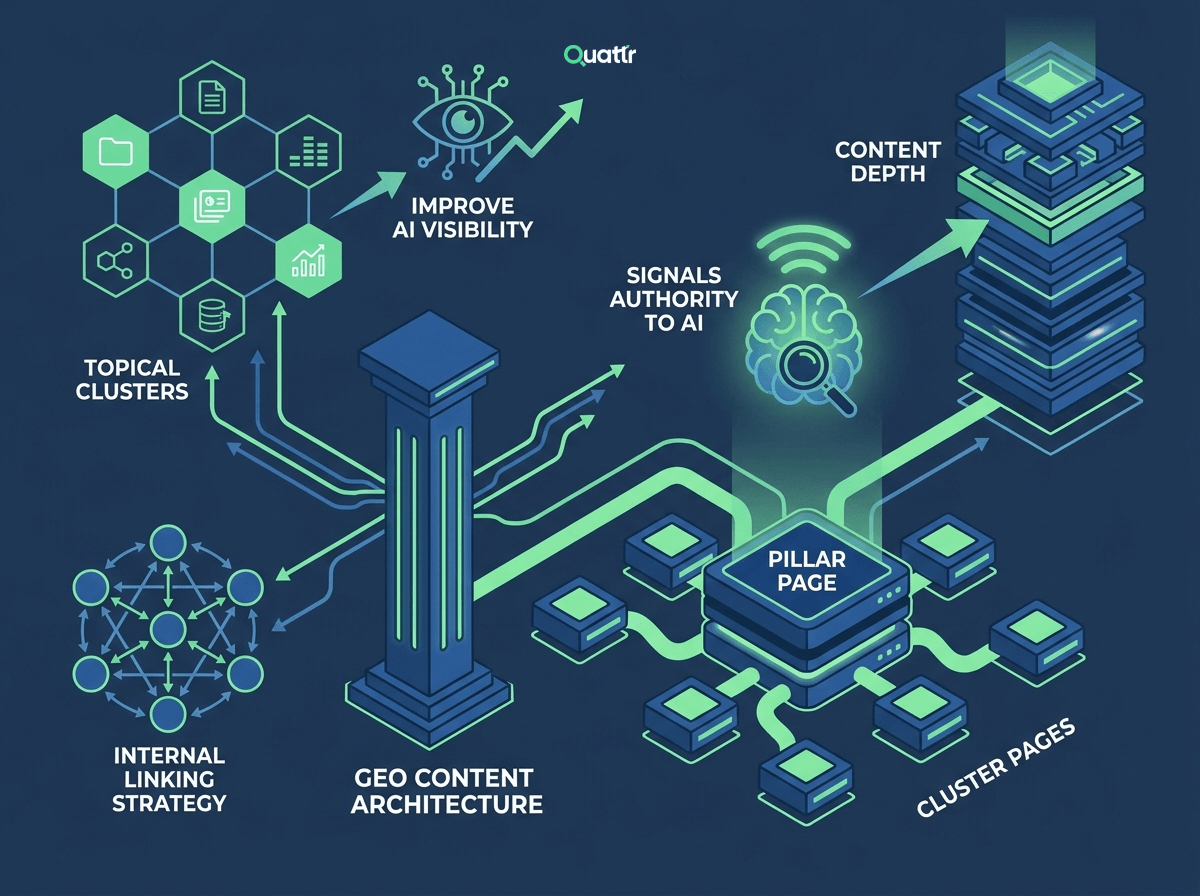
I. How Topical Clusters Improve AI Visibility
One article is not enough. AI looks at your whole site, not just one page. If you have covered a topic properly from every angle, AI sees expertise. If you have one article, it sees a gap. And it fills that gap with someone else.
Do This
- Create cluster pages that go deep on each specific topic with pillar page.
- Map gaps in your cluster by listing every question someone might ask about your core topic and check whether you have content that answers it.
Why It Works
When your site covers a subject from every angle, AI stops seeing you as a page and starts seeing you as the source.
II. Internal Linking Strategy for GEO
You could have the best-written page on the internet and it would not matter if nothing links to it.
Internal linking is not just about helping visitors navigate your site. It is how you tell AI which pages exist, which ones matter and how everything connects. A weaker page that is well connected will consistently outperform a stronger page that is sitting there with no links pointing to it.
Do This
- Use descriptive anchor text that tells AI what the linked page covers, not generic phrases like “click here” or “learn more”.
- Add internal links whenever you publish new content, connecting it to related existing pieces immediately.
If keeping up with this manually feels like a losing battle, Quattr’s AI-powered Internal Linking takes care of it for you. Every time you publish something new, it finds the right connections automatically so your site stays fully linked as it grows.
Why It Works
Internal linking does two things at once. It helps AI crawlers discover and index your content and it signals which pages your site considers most authoritative on a given topic. Both directly affect how often your content gets cited.
III. How Content Depth Signals Authority to AI
AI is not just looking for a page that contains the right words. It is looking for a page that actually knows the subject. A thorough page that covers the topic properly, answers follow-up questions and actually helps the reader reads like expertise.
Do This
- Before publishing, ask what follow-up questions a reader would have after finishing your content and answer them in the same piece.
- Include examples, data points and real-world context rather than abstract explanations.
- Aim for completeness over word count. A thorough 1,200 word piece outperforms a padded 3,000 word one every time.
Why It Works
The more thoroughly you cover a topic, the more AI starts to see your site as the go-to place for it. And once that trust is built, every new page you publish benefits from it automatically.
The Technical Foundation of GEO
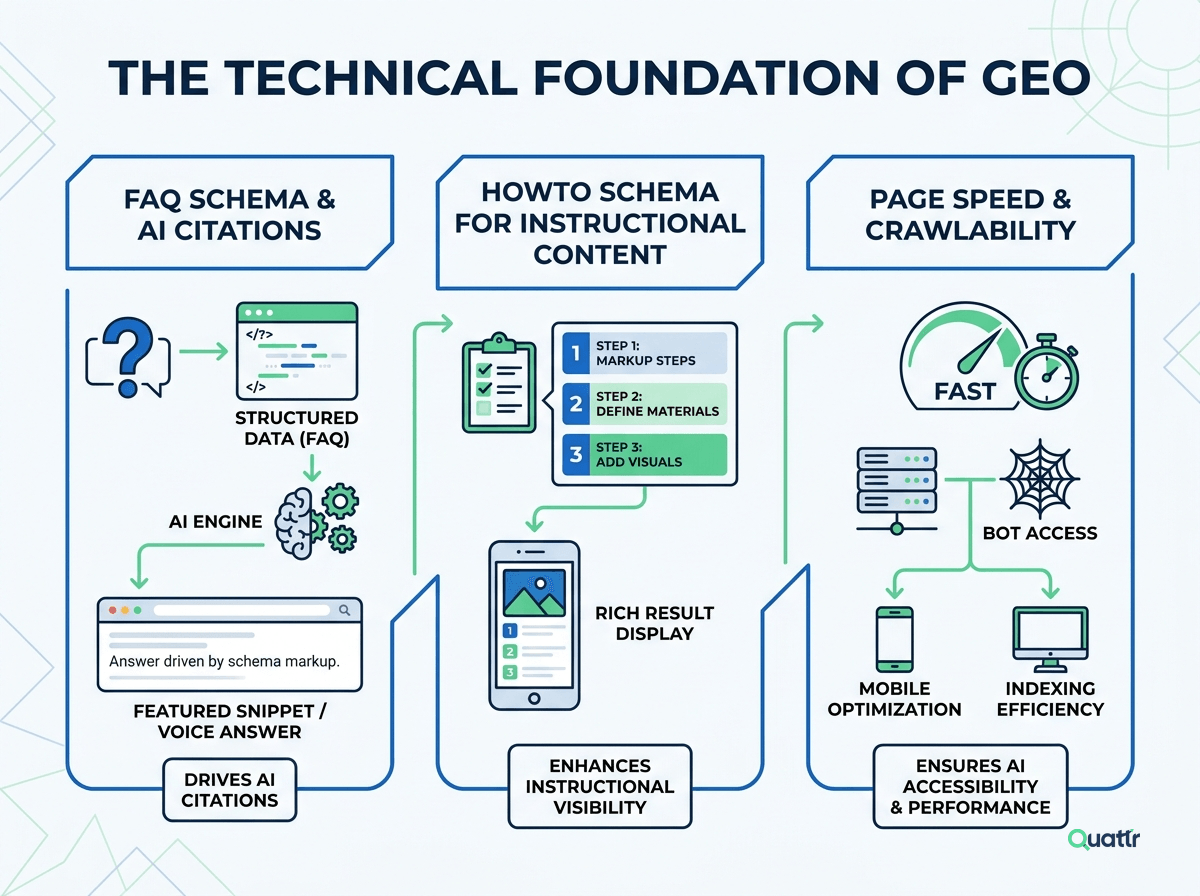
I. FAQ Schema and How It Drives AI Citations
Update (July 2026): The AI-citation claim in this section has not been confirmed by Google or any AI vendor, see our FAQ Schema in 2026 piece. Ahrefs’ controlled study also found no citation lift from adding schema to pages already receiving citations. Schema is still worth using for clarity and structure; treat any AI-citation benefit as unproven, not guaranteed.
FAQ schema makes the question/answer structure explicit for machines. Whether that translates into more AI citations isn’t something Google or any AI vendor has confirmed , Google’s own generative AI guide says no special schema is required for AI Overviews or AI Mode, and Ahrefs’ controlled test found no citation lift from adding it to already-cited pages. What FAQ schema reliably does is make your content easier to parse accurately and support standard rich-result eligibility elsewhere.
One thing worth knowing though. Google no longer shows FAQ dropdowns in search results. But that does not mean FAQ schema is useless. It still tells AI exactly what is a question and what is an answer, and that signal is exactly what AI looks for when generating responses.
Do This
- Add an FAQ section to every page that targets a question-based query and mark it up with FAQ schema.
- Write FAQ answers in one to three sentences.
Why It Works
Clear structure removes ambiguity about what’s a question and what’s an answer, useful for machine parsing. Treat any AI-citation benefit as a possible byproduct, not the reason to do this.
II. HowTo Schema for Instructional Content
If you have a numbered list walking someone through a process, AI does not automatically know that is a complete instructional sequence. It could just be a random list of points. HowTo schema is how you tell it the difference.
Once you declare that your content is a step-by-step guide, AI knows exactly what it is working with. And when someone asks a how-to question, AI is far more likely to pull from a page that is explicitly marked up as an instruction sequence than one it has to guess about.
Google stopped showing HowTo rich results in 2023, so the visual formatting in search is gone. But the schema still works for AI. It tells AI that your content is a proper step-by-step guide, not just a random list and that clarity is what makes AI pick your page for how-to queries.
Do This
- Apply HowTo schema to any content that walks a reader through a process from start to finish
- Mark up each individual step with its own name and description rather than bundling everything into one block
Why It Works
HowTo schema removes the guesswork between your content and a citation. AI does not have to figure out whether your list is a proper guide or just a collection of tips.
III. Page Speed and Crawlability for AI Engines
AI cannot cite a page it cannot find. It really is that simple. It does not matter how good your content is or how much schema you have added. If your pages are slow, blocked or buried under broken redirects, AI crawlers will skip them entirely and move on to something easier to reach.
Do This
- Check your robots.txt file to confirm you are not accidentally blocking AI crawlers from accessing key pages.
- Improve Core Web Vitals scores, particularly Largest Contentful Paint and Cumulative Layout Shift, as page speed matters in crawling.
- Use canonical tags correctly to prevent duplicate content from splitting crawl budget across multiple versions of the same page.
Why It Works
Technical health is the prerequisite that makes every other tactic work. A fast, clean, fully crawlable site ensures that when AI comes looking for content to cite, yours is accessible, indexable and ready to be found.
Measure GEO Performance
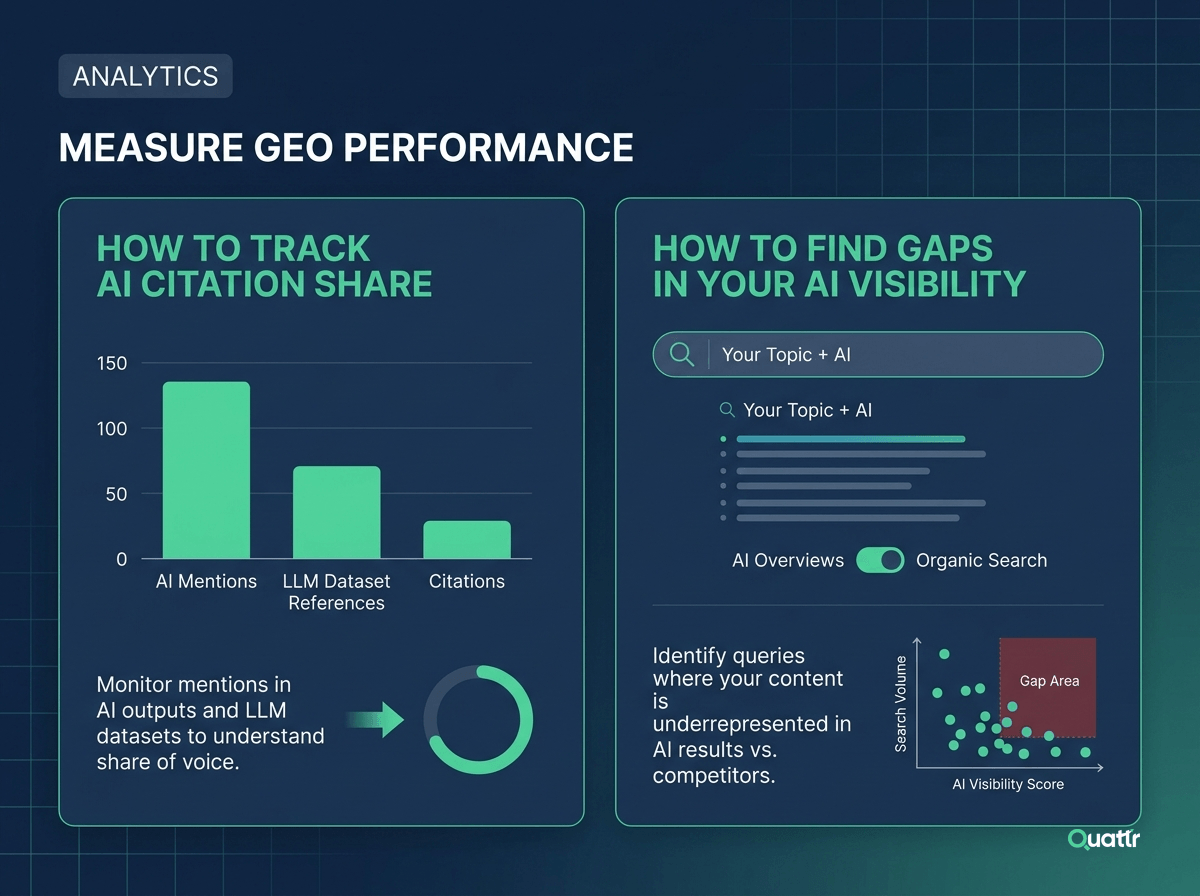
I. How to Track AI Citation Share
Most teams make GEO changes and just hope something works. They publish, tweak and move on with no real way of knowing if any of it made a difference.
Citation share is how you fix that. It tells you how often your content is showing up in AI answers for the queries that matter to you. Without it, every decision you make is just a guess.
Do This
- Define a core set of prompts that represent the questions your buyers are asking and test them weekly across ChatGPT, Perplexity, etc.
- Track changes over time so you can connect specific content updates to real citation improvements.
- Set up brand mention monitoring to catch AI citations that occur outside your tracked prompt set.
Quattr’s AI Visibility Dashboard does all of this in one place. You can see which prompts are surfacing your brand, which pages are getting cited, how you stack up against competitors and how everything shifts over time across models.
Why It Works
It gives you a real feedback loop. You stop guessing and start knowing what is working, what is not and where you are losing to competitors.
II. How to Find Gaps in Your AI Visibility
Every question AI answers without you is a question your competitor is getting credit for.
Most teams are so focused on fixing what they have that they never think about what is missing. But the gaps in your AI visibility are not just keyword opportunities. They are real questions from real buyers being answered by someone else right now.
Do This
- Check each question against your existing content. If you do not have a page that answers it directly, add it to your content plan immediately.
- Audit competitor citations in AI responses to identify which topics they are being credited for that you are not covering.
- Prioritise gaps where query intent is high and competitor content is thin, outdated or poorly structured.
Finding these gaps manually takes forever and you will still miss things. Quattr’s Content Ideas feature does it for you. It looks at what your competitors are covering that you are not and tells you exactly what to write next.
Why It Works
Gap analysis changes how you think about content. Instead of guessing what to write next, you know exactly what questions are out there that you are not answering. Every piece you create from that list is not a shot in the dark. It is going after demand that already exists and is currently going to someone else.
Mistakes to Avoid while Optimizing for Generative Engine
Optimising for One AI Platform Only: What works for Google AI Overviews does not always translate to ChatGPT or Perplexity. Each one works differently. If you are only testing on one, you have no idea what is happening on the others.
Writing Only for AI and Losing the Human Reader: If your content reads like a checklist, it is going to backfire. AI is getting better at spotting content that has no real human behind it.
Not Refreshing Outdated Content: An old page can lose its citation to a newer page covering the same thing. AI prefers the most current source. If your content is sitting there unchanged from three years ago, it is at risk.
How Quattr Helps You Win in AI Search
Knowing what to do is one thing. Actually being able to track it, measure it and improve it over time is where most teams get stuck.
Quattr’s GEO platform is built for exactly that. And what makes it different from other tools is simple. Most tools pull from APIs and show you a version of AI results. Quattr pulls from the real thing, actual responses from ChatGPT, Google AI Overviews, Claude and Perplexity, exactly as your buyers see them. You are not looking at an estimate. You are seeing what is actually happening.
The other thing that makes it different is that it does not just tell you whether you are being cited. It tells you how. Quattr tracks sentiment alongside citations, so you can see whether AI is presenting your brand positively, neutrally or negatively. Most tools stop at showing you a mention. Quattr shows you the full context.
And because it ties everything back to your GA4 and Search Console data, you can see exactly how AI visibility is turning into real traffic and conversions.
If you want to see exactly where your brand stands across every major AI engine right, book a demo now and find out in under 30 minutes.
FAQs
No. The same content qualities that help you rank on Google, clarity, structure and authority, are the same ones that get you cited by AI.
Most teams start seeing changes in AI citations within a few weeks of improving content structure and adding schema markup.
Not on its own. A smaller number of well-structured, authoritative pages will earn more citations than a large volume of thin, generic content.
Each platform has different citation behaviour, so testing across ChatGPT, Perplexity and Google AI Overviews separately is worth doing rather than assuming one approach covers all three.
No. Product pages, landing pages and comparison content can all earn AI citations if they are structured clearly and answer the specific questions buyers are asking at that stage of the funnel.

Quattr is an AI-native Search Visibility Platform founded in Palo Alto, California, built for mid-market and enterprise brands competing in the age of generative search. Recently recognized across G2's Spring 2026 reports with #1 rankings in AEO Results, Usability, and Relationship, Quattr helps brands win visibility across traditional search and AI-generated answer surfaces.
Quattr's AI agent, GIGA, evaluates content the way AI systems do, identifying gaps across structure, authority, internal linking, and discoverability to surface the highest-impact fixes. With capabilities like autonomous internal linking, E-E-A-T intelligence, and the new GIGA Landing Page Generator for keyword-matched, AI-search-ready pages, Quattr helps teams move from diagnosis to deployed changes without manual bottlenecks.