Key Takeaways
- AI citation decay is faster and more mechanical than traditional SEO decay, retrieval systems re-rank sources on every query, and recency acts as a cheap proxy for accuracy, so fresher pages routinely displace older, otherwise-equal ones.
- Content moves through five stages, spike, discovery and growth, peak, decay, and dormancy, with peak citation typically hitting within 30 to 90 days and near-total disappearance by the one-year mark without a refresh.
- Citation half-life varies sharply by platform: ChatGPT churns fastest at roughly 3.4 weeks, Google’s AI surfaces (Overviews, Gemini, AI Mode) cluster around 4.3 to 4.8 weeks, and Perplexity holds longest at roughly 5.7 to 5.8 weeks.
- Detection has to be deliberate, since AI citation doesn’t show up in standard analytics; tracking mentions (brand named) separately from citations (brand linked or attributed) shows whether you’re losing visibility, attribution, or both.
- AI citation behaves more like a paid media channel than classic SEO: it requires continuous, platform-aware investment rather than a one-time publish, which is why teams increasingly lean on unified GEO tracking and execution platforms like Quattr to keep pace.
Traditional SEO taught us that great content is an asset that compounds: publish once, earn backlinks, climb rankings and coast for years. AI search has broken that deal. In 2026, the content that ChatGPT, Perplexity and Google AI Overviews cite is often just weeks old and yesterday’s authoritative source can vanish from AI answers within a month.
This is the content decay cycle for AI citation: the predictable rise and fall of a page’s visibility inside AI generated answers, driven not by backlinks or keyword rankings but by how retrieval systems weigh recency. Understanding this cycle, and building a refresh engine around it, is quickly becoming the difference between brands that show up in AI answers and brands that quietly disappear from them. Platforms built for this shift, like Quattr’s Generative Engine Optimization (GEO) suite, exist precisely because managing this cycle by hand has become nearly impossible at scale.
Why AI Citations Decay Faster Than Search Rankings
Google, ChatGPT, Perplexity and Claude all rely on retrieval-augmented generation (RAG) to ground their answers in real sources. Every time someone asks a question, the system doesn’t reuse a fixed ranking; it re-retrieves and re-ranks candidate sources from scratch. When two pages cover the same topic, the fresher one usually wins the citation slot, because recency acts as a cheap proxy for accuracy.
That single mechanic explains almost everything about how AI citation decay behaves:
- Content updated within the last 30 days earns roughly 3.2x more AI citations than older pages. (Source: Apiserpen)
- About half of all AI cited content is under 13 weeks old. (Source: Salespeack)
- Google AI Overviews, notably, cite content that’s about 16 days older on average than what appears in standard organic results, slightly more forgiving, but still recency driven. (Source: Parse)
Traditional SEO decay is slow: a page might lose rankings gradually over 12 to 24 months as competitors out-earn it on backlinks. AI citation decay is fast and often brutal; visibility can start dropping within 2 to 3 days of publication if there’s no ongoing refresh signal.
The Five Stages of the Cycle
Content moving through AI search visibility follows a recognizable arc, similar to classic content decay but compressed into weeks instead of years.
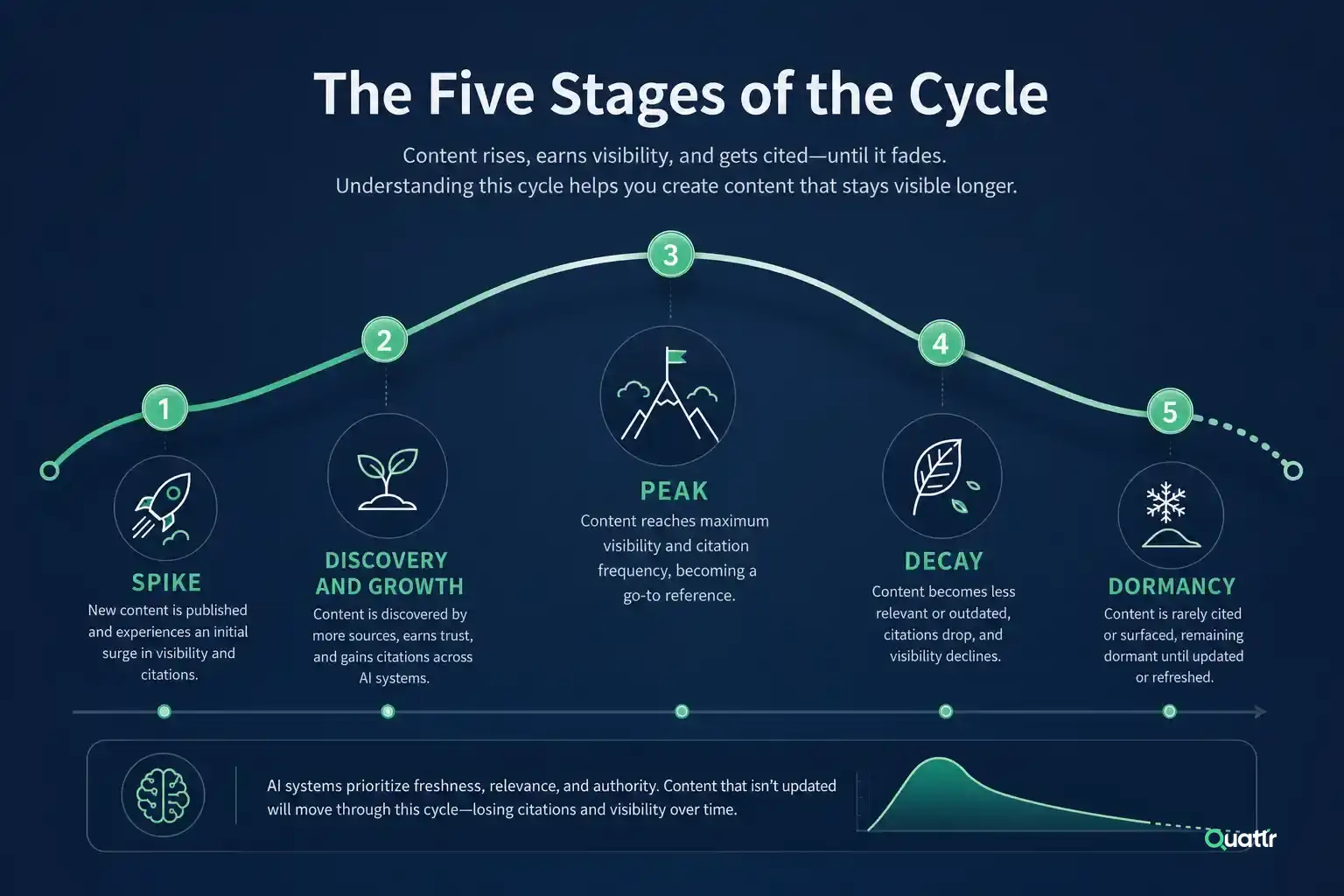
1. Spike. A new page publishes and gets an initial citation burst as AI crawlers and real time retrieval (like ChatGPT’s browsing) pick it up fast, especially if it answers a specific, well structured question.
2. Discovery and growth. Over the following days, the page gets indexed more broadly, picked up by aggregators, and cited across a wider set of queries as retrieval systems build confidence in it.
3. Peak. Citation frequency plateaus at its high point, typically within the first 30 to 90 days of publication, assuming the content stays factually accurate.
4. Decay. Past the 90 to 180 day mark without a substantive update, the page starts losing retrieval priority to newer competitors. A page cited weekly in March can slide to monthly by summer.
5. Dormancy. By six months to a year without updates, the content effectively disappears from AI answers. Each year of age can cut retrieval visibility by roughly 40 to 60%, even if the page still ranks fine in classic Google search.
AI citation is closer to a paid media motion than an SEO one. It requires continuous investment, not a one time push, which is exactly why teams increasingly lean on GEO platforms like Quattr to keep pace with the cycle instead of chasing it manually. That investment isn’t uniform across platforms, though: some decay so fast they demand near-constant attention, and that difference is best measured by citation half-life.
Citation Half-life (By Platform)
Citation half-life is the time it takes for a piece of content’s citation frequency to drop by half from its peak, borrowed directly from the half-life concept in physics.
If a page is cited in 10% of relevant AI answers at its peak, a three-week half-life means that rate falls to roughly 5% three weeks later, then to about 2.5% three weeks after that, and so on. It’s a decay rate, not a hard cutoff: content doesn’t vanish from AI answers on a fixed date, it just keeps losing citation share on a predictable curve until it’s effectively invisible.
The metric matters because it turns “AI visibility fades over time” into something you can actually plan around. A page with a three to four week half-life needs a refresh roughly every month just to hold its position; a page with a ten week half-life can run on a slower, quarterly cadence. Not all AI engines decay content at the same rate:
| Platform | Approximate citation half-life | Notes |
|---|---|---|
| ChatGPT | ~3.4 weeks | Shortest published half-life; heavily rewards very recent content and real time browsing |
| Google AI Overviews | ~4.3 to 4.8 weeks (clusters with Gemini and AI Mode) | Also cites content ~16 days older than standard organic SERPs on average; more forgiving of age than ChatGPT but still recency influenced |
| Gemini | ~4.3 to 4.8 weeks (same Google-surface cluster) | Shows only a mild bias toward current-year content compared with Perplexity, consistent with its mid-range half-life |
| Google AI Mode | ~4.3 to 4.8 weeks (same Google-surface cluster) | Tracks closely with Gemini and AI Overviews rather than behaving like a distinct engine |
| Perplexity | ~5.7 to 5.8 weeks | Most durable half-life measured, roughly 68% longer than ChatGPT’s; weights freshness heavily on the front end, but its proprietary index retains sources longer once cited |
| Microsoft Copilot | No published week-based half-life; retains an estimated ~34% of citations after 4 weeks in a separate retention study | Runs on Bing’s index; average cited-content age sits between ChatGPT’s and Google AI Overviews’ |
| Claude | No published half-life figure | Leans on stable, well-established sources over the freshest option available; freshness acts more as a trust and accuracy signal than a hard ranking lever |
| Grok | No published half-life figure | Heavy reliance on real-time X data gives it a strong practical recency bias, even without a formal half-life study behind it |
Some independent trackers report even shorter windows. One nine week tracking experiment found citations decaying from a 2% hit rate at peak to 0.2% within six months, a 10x drop. Another dataset pegged the shelf life of a typical AI citation at just 11 to 15 days before a fresher source displaced it.
One consistent finding across studies: only about 11% of domains get cited by both ChatGPT and Perplexity, meaning optimizing for one engine doesn’t guarantee visibility on another. The decay cycle has to be managed per platform, which is where a unified tracker that spans Google AI Overviews, ChatGPT, Claude, and Perplexity in one view, like Quattr’s GEO dashboard, earns its keep.
Which platform is citing you is only one variable in that equation, though; where your content actually lives across the web shapes its half-life just as much.
Distribution Changes the Decay Curve
Where content lives matters as much as when it was published. Research comparing standalone domains to publisher networks found content on a single, non networked domain had a citation half-life of about 4.5 weeks, while the same type of content distributed across a connected publisher network held on for nearly 10 weeks. Getting a claim echoed across multiple authoritative domains, not just published once, meaningfully slows decay because retrieval systems see corroboration, not just a single stale source.
How to Detect Decay Before It Costs You Visibility
Because AI citation doesn’t show up in traditional analytics, tracking it requires dedicated tools. Quattr monitors citation frequency, share of voice, and mention-versus-citation rates across ChatGPT, Perplexity, Gemini, Claude, and Google AI Overviews. Two metrics matter most:
- Mentions: when an AI names your brand in its answer, with or without a link.
- Citations: when an AI links to or attributes a specific claim to your URL.
A brand can be mentioned without ever being cited, and a page can be cited without the brand being named. Tracking both shows whether you’re losing visibility, losing attribution, or both.
Understanding why and how content decays is only useful if you can catch it happening to your own pages in time, which is where detection comes in.
How to Fight the Decay Cycle
Fixing decay is less about writing new content and more about keeping what you already have up to date.
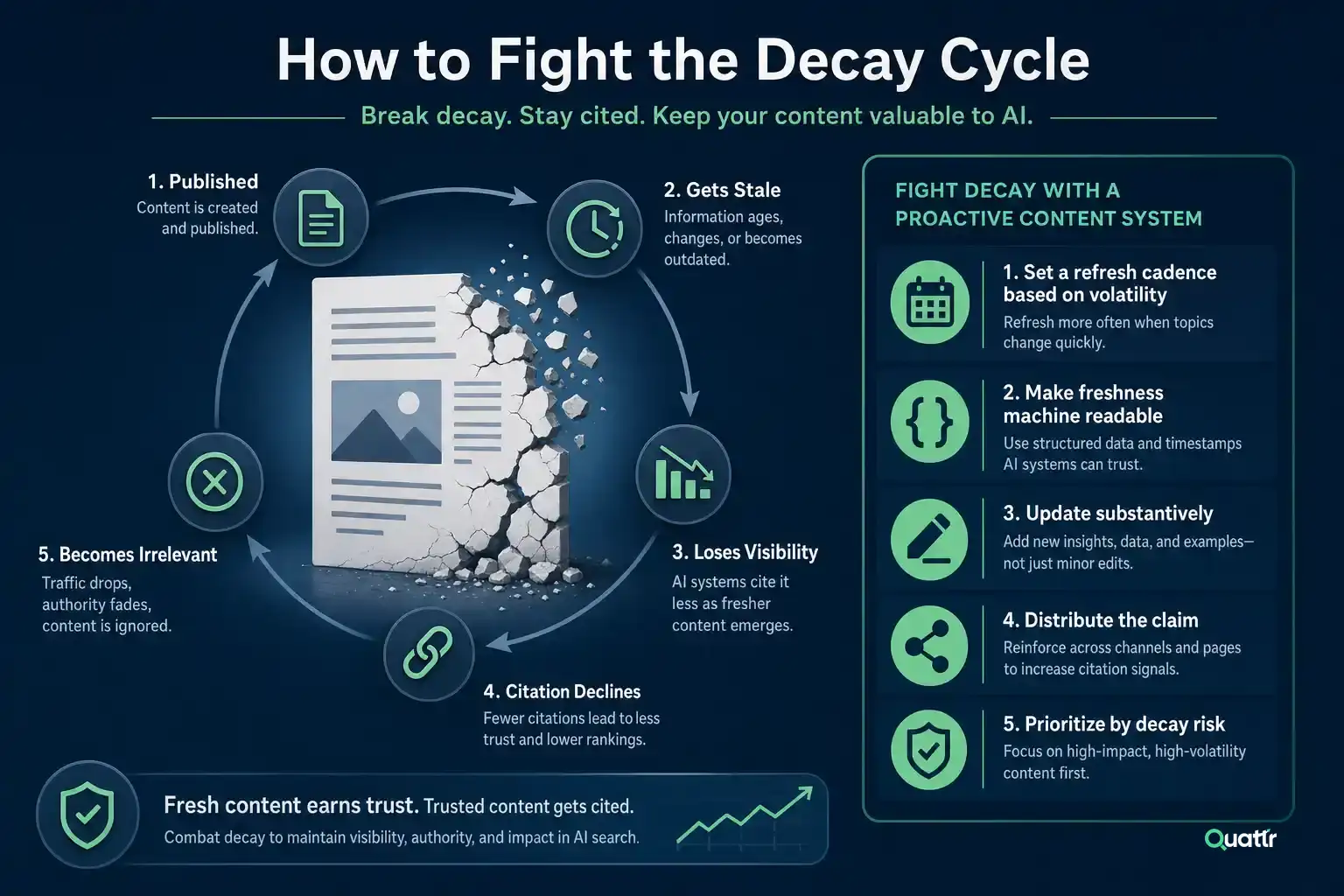
1. Set a Refresh Cadence Based on Volatility
High priority, competitive, or time sensitive pages should get lightweight updates every 2 to 3 days to weeks; core evergreen or pillar content should get a substantive refresh every 90 to 180 days. Quarterly refresh cycles have been shown to outperform annual refreshes by roughly 42% in AI citation retention.
2. Make Freshness Machine Readable
The signal AI systems weigh most heavily is the “dateModified” field in Article schema, followed by a visible “last updated” date on the page, and then the original publish date. A cosmetic update with no schema or visible date change does little for retrieval systems.
3. Update Substantively
Adding a new statistic, example, or perspective, not just changing a date stamp, is what triggers re-retrieval. Systems increasingly discount updates that don’t change the substance of the page. Predictive content tools such as Quattr’s Content AI are built for exactly this: scoring a page’s relevance, coverage, and structure before publishing so a refresh is more likely to earn a citation slot rather than just a new timestamp.
4. Distribute the Claim
Since network effects roughly double citation half-life, pursue earned coverage on other authoritative domains so the same fact or data point is corroborated in multiple places AI systems can retrieve from.
5. Prioritize by Decay Risk
Not everything needs constant refreshing. Rank pages by topic volatility (fast moving categories like pricing, product comparisons, and statistics decay fastest) and treat genuinely evergreen conceptual content on a slower cycle.
Fixing the fundamentals is only half the job, though. SEO and AI search are not a one-time project, they are a moving target. Content ages, competitors publish, models get updated, and a page that earned a citation last month can quietly lose it with no alert to tell you it happened. Knowing where to prioritize only helps if you can actually see the decay happening in real time, which is exactly what a dedicated AI visibility tracker is built for.
Quattr’s AI Visibility Tracker
Most of the tactics above depend on knowing where you currently stand, and that’s the specific gap Quattr’s Generative Engine Optimization platform is built to close. Most tools in this category track your AI visibility; Quattr is built to change it. It’s the platform that unifies SEO, AEO, and GEO into a single end to end workflow rather than bolting AI tracking onto an existing rank tracker, built from the ground up to help brands get cited by AI, not just rank on Google.
Quattr shows exactly where your pages get selected across Google AI Overviews, ChatGPT, Claude, Perplexity, AI Mode, and other answer engines. It captures results directly from real consumer-facing AI responses, not APIs, so you can track citations, brand mentions, share of voice, sentiments, and competitor presence exactly as users see them..
Most teams tracking this today are stitching the picture together by hand: exporting Google Search Console data, running manual AI queries, dropping results into spreadsheets, and layering in a separate rank tracker just to approximate where they stand.
Every handoff between those tools is a place where signal gets lost and action stalls, which is exactly the kind of gap a fast-moving decay cycle punishes. Quattr’s AI Citation Tracking replaces that patchwork with a single dashboard that monitors brand visibility across ChatGPT, Perplexity, Google AI Overviews, and AI Mode at once, grouped by topic cluster rather than raw query, so a team is reading signal instead of noise.
Quattr goes beyond monitoring, too: it tells you where you stand and helps you fix it without leaving the platform. Quattr also ties this visibility data back to GA4 and Search Console, so a team can see not just whether a citation decayed, but whether that decay actually cost them clicks and conversions, closing the loop between AI visibility and measurable growth.
On tracking specifically, Quattr can:
- Track AI visibility across Google AI Overviews, ChatGPT, Claude, Perplexity, Gemini, and Google AI Mode.
- Monitor citation share and brand mentions with competitive context.
- Track competitive share of voice and brand sentiment at the page and topic level.
- Unify SEO and GEO reporting, so a team isn’t switching platforms to see the full picture.
Explore Quattr’s Generative Engine Optimization platform and find out where you stand!
FAQs
It’s the drop in how often AI engines like ChatGPT or Perplexity cite a page over time, driven by retrieval systems favoring fresher sources over older ones covering the same topic.
It depends on the page. High-priority or competitive pages need updates every few weeks; evergreen content can run on a 90 to 180 day cycle.
Most likely a fresher, equally relevant source displaced it. ChatGPT has the shortest citation half-life of the major engines, so it churns sources quickly.
No. AI systems increasingly detect cosmetic changes and discount them. The update needs to change the substance of the page, new stats, examples, or claims.
Related but faster. Traditional SEO decay plays out over months to years; AI citation decay can start within days and follows its own half-life curve per platform.
Yes. A substantive refresh, especially paired with updated schema and a visible “last updated” date, can restore citation share, sometimes within one to two weeks.

Quattr is an AI-native Search Visibility Platform founded in Palo Alto, California, built for mid-market and enterprise brands competing in the age of generative search. Recently recognized across G2's Spring 2026 reports with #1 rankings in AEO Results, Usability, and Relationship, Quattr helps brands win visibility across traditional search and AI-generated answer surfaces.
Quattr's AI agent, GIGA, evaluates content the way AI systems do, identifying gaps across structure, authority, internal linking, and discoverability to surface the highest-impact fixes. With capabilities like autonomous internal linking, E-E-A-T intelligence, and the new GIGA Landing Page Generator for keyword-matched, AI-search-ready pages, Quattr helps teams move from diagnosis to deployed changes without manual bottlenecks.