Key Takeaways
- AI search operates on two clocks: live web retrieval (fast clock, prompt-by-prompt) and internal parametric memory (slow clock, model training runs).
- AI parsers score isolated 120–180 word text blocks; intro “throat-clearing,” ambiguous pronouns, and uncorroborated claims cause RAG layers to skip high-ranking pages.
- Optimize short-term live retrieval with entity-explicit, standalone answer units while building long-term parametric memory through product-led content, entity consensus, and tools like Quattr’s AI Visibility Dashboard and MCP server integrations.
You could rank #1 on Google and never get cited by an LLM. This is usually some version of “AI weighs different signals: freshness, specificity, structure.”
That explanation isn’t wrong, but it’s incomplete, which leads teams to fix the wrong thing.
The real difference isn’t that AI search uses a different scoring formula on the same kind of process Google uses. It’s that AI answers come from two mechanically different systems stacked on top of each other, running on completely different timescales; and Google has no equivalent to one of them at all.
Google Search is one system. AI Search is two.
Google ranking is, structurally, a single continuous process: crawl, index, score against the live index at query time. Everything that determines your position exists in one system, updated on Google’s crawl cycle, queried fresh every time.
AI answers are the output of two separate mechanisms that don’t run on the same clock:
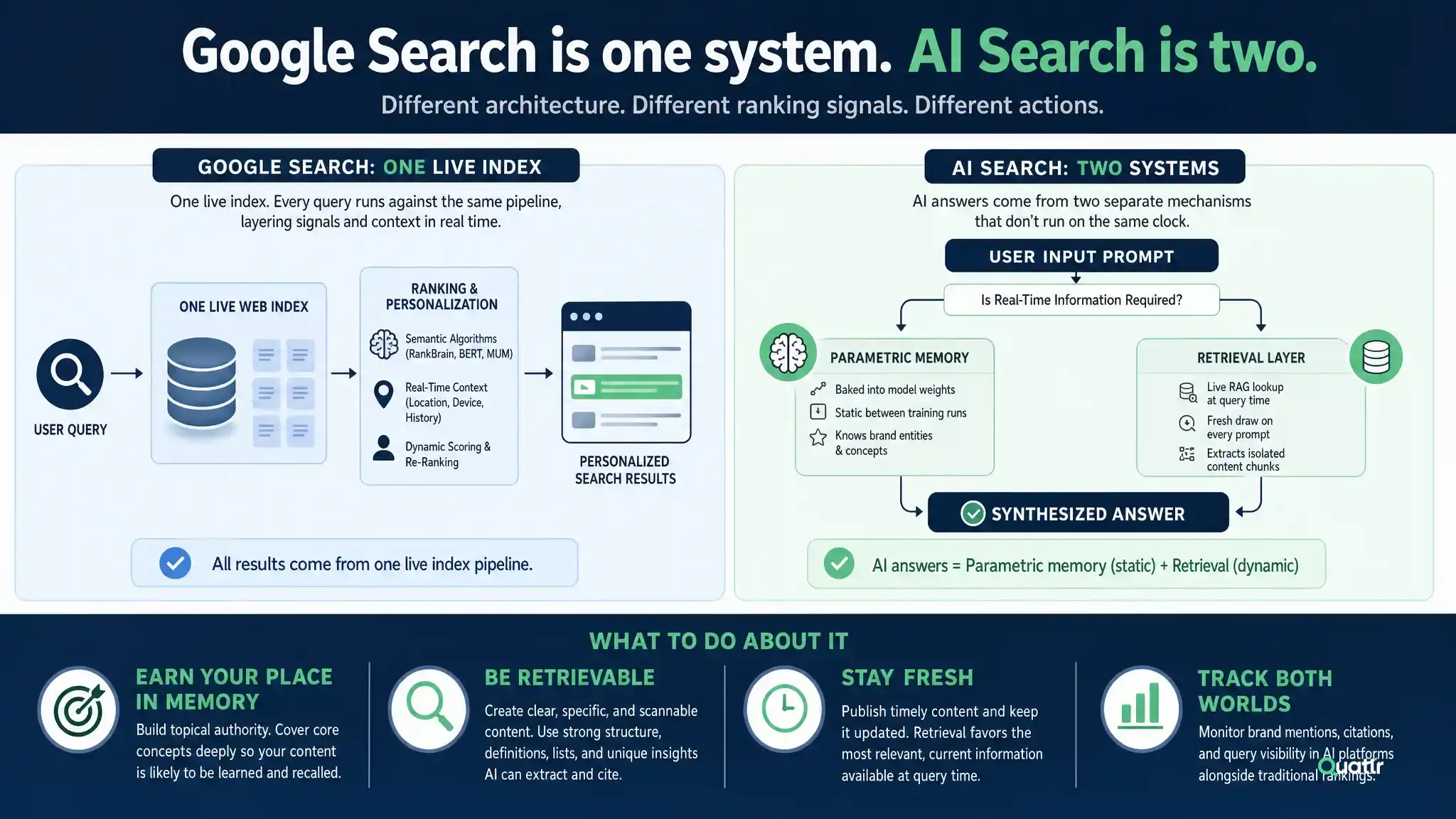
The Parametric Knowledge: Some information is already baked into the model’s weights during training. Think established concepts, entities, relationships, and facts that appeared often enough in its training data to become part of what the model can recall. This knowledge is relatively static between training runs.
Publish a new page today, and the model doesn’t automatically learn from it. If the model answers a question entirely from parametric memory, your new page isn’t part of that answer-generation process at all.
Retrieval-Augmented Generation (RAG): Then there’s retrieval, usually through some form of RAG. Here, the system goes out and fetches information at query time from a search index, vector database, or another retrieval system. The sources can change between queries.
A page you published last month can potentially be retrieved. A page that was irrelevant yesterday can become useful today. And the system can pull specific passages rather than treating your entire page as one ranked result. But there’s an important difference from traditional search.
The goal isn’t necessarily to produce a stable list of ten blue links. The retrieval layer seeks information that can be extracted, grounded, and used to construct an answer.
A generated answer is a blend of both, and which one dominates depends on the query.
Ask about a foundational concept or established entity, and the model may answer entirely from parametric memory with zero retrieval, in which case nothing you published this year matters, only what was true, corroborated, and well-documented when the model was trained.
Ask about a fast-changing topic or a narrow question, and retrieval does most of the work, pulling in live pages the way a search engine does, except scored for extractability and relevance rather than ranked in a stable list.
This is the actual answer to "Why did I rank #1 and get zero citations?" (Google's AI Overviews and answer-engine citations are different surfaces with different denominators: how they differ.) Your page can dominate the retrieval layer completely, and it still won’t matter for the share of queries the model answers from parametric memory, because retrieval never gets invoked, and your page never enters the process at all.
Why this split matters in practice
1. Live retrieval is inherently volatile
Unlike traditional search, where a top-ranking page usually stays on page one for weeks or months, live retrieval in AI engines fluctuates constantly. You can test the same prompt three days in a row and see different cited sources, even when none of those underlying pages changed a single word.
That’s because live retrieval isn’t a stable ranking you earn and lock in. It’s a dynamic sampling process that evaluates context and reranks sources on the fly. Treating an AI citation like a permanent “ranking” is a misunderstanding of how the system operates.
2. No two AI engines evaluate or present retrieved content the same way
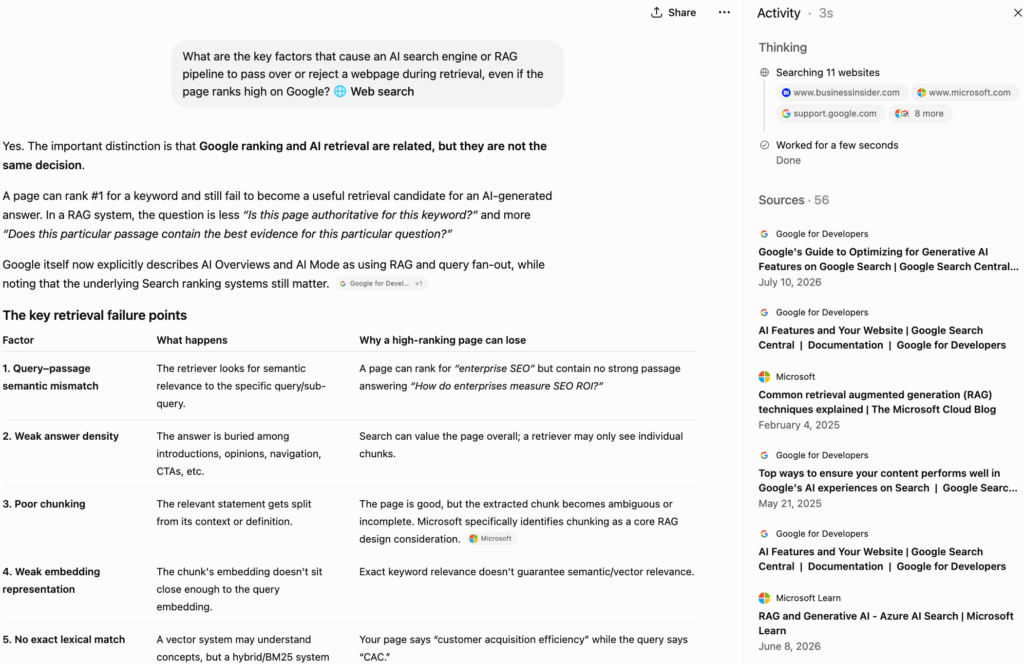
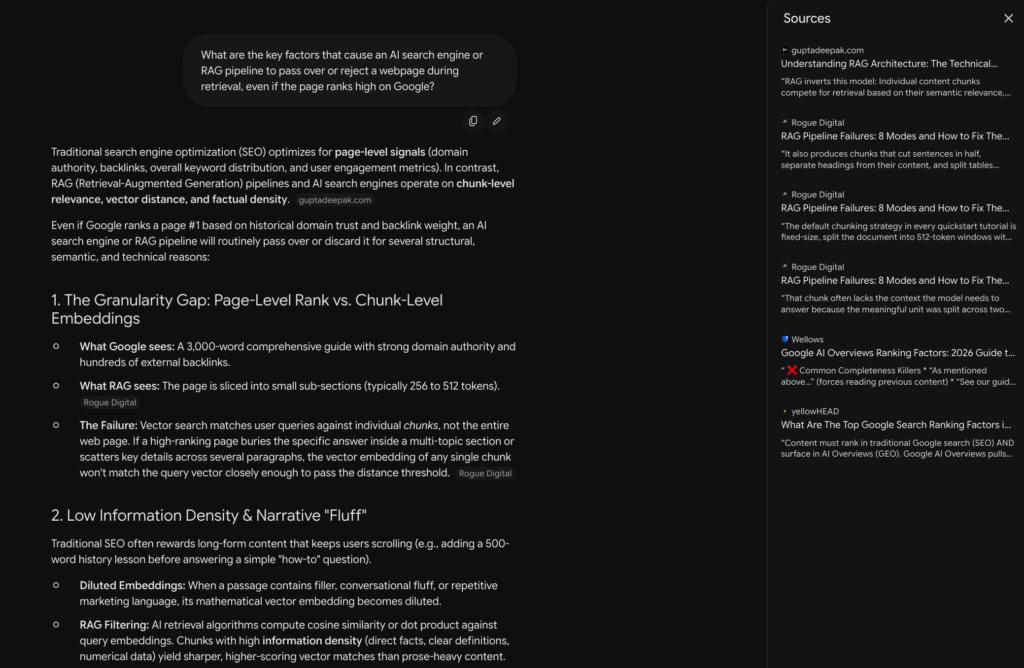
Even when multiple AI platforms run a live retrieval pass for the exact same prompt, they don’t produce uniform results. Each engine uses distinct underlying index sources, vector chunking strategies, and synthesis guidelines:
- Perplexity: Operates primarily as an explicit research engine. It prioritizes high-density, multi-source extraction, breaking queries down aggressively to aggregate footnotes from diverse web sources in real time.
- Gemini: Deeply integrated with Google’s live search graph, it excels at real-time web grounding and freshness, leaning heavily on trusted knowledge-graph entities and fresh structured data.
- ChatGPT (Web Search): Weighs conversational intent and narrative synthesis, pulling candidate sources into its context window and self-contained answer blocks that can be smoothly woven into a direct response.
Because these engines parse, weight, and format information differently, your content might get extracted clean as a bulleted footnote in Perplexity, referenced in Gemini’s panel, and completely bypassed by ChatGPT for the exact same query.
3. Winning the quote without winning the brand
It’s common to see an AI answer synthesize your exact framework, data point, or phrasing almost verbatim, while completely omitting your brand name in the final answer.
The retrieval layer successfully fetched your content, but because the model’s parametric memory doesn’t independently associate that concept with your brand entity, it synthesizes the information without attributing it to you. Winning live retrieval doesn’t automatically build brand recognition within the LLM, yet almost every AEO strategy on the internet today is entirely obsessed with the retrieval side.
Why your top-ranking Google posts get dropped anyway
Even when an AI query does trigger a live web search, traditional #1 pages still get filtered out during extraction. Why? Because Google rewards whole-page authority, while AI models care about paragraph-level clarity.
Here is where traditional SEO habits actively shoot you in the foot:
- Introductory throat-clearing: Traditional SEO taught us to write 150-word narrative intros to boost dwell time. To an AI search engine, that’s just fluff. If a paragraph takes two warm-up sentences to get to the point, its relevance score drops, and the AI moves on to a site that answered the question in sentence one.
- Lazy pronoun usage: We all write like this: we put a big subhead up top (
## Best CRM Features) and then open the paragraph with, “It allows teams to track pipeline…” Human readers get it. But when an AI chops your page into isolated text blocks, that paragraph loses its heading. Now the snippet reads “It allows teams to…” The AI has no idea what “It” refers to, so it tosses the snippet out. - Lacking web-wide consensus: AI engines hate taking risks. If your site makes a unique claim or quotes a statistic that exists only on your domain, the AI treats it with suspicion. If three other industry sites repeat a competitor’s claim, the AI defaults to the consensus view.
How to actually play both games
Since AI search runs on two different clocks, you have to split your strategy accordingly.
1. The Short Game: Optimize for Live Retrieval (Days & Weeks)
This is where you make your content easy for a parser to grab right now.
- Write standalone paragraphs: Assume every sub-section will be read out of context. Explicitly name the tool, company, or concept in the first sentence beneath an H2. Never rely on the heading above to make the paragraph make sense.
- Build off-page consensus: Stop treating off-page work as pure link-building. Get your core claims, data, and brand name mentioned across podcasts, third-party blogs, and industry forums so LLMs run into your facts from multiple angles.
- Expect volatility: Stop treating citation tracking like a quarterly Google audit. Live retrieval changes constantly, so don’t panic over short-term fluctuations.
2. The Long Game: Build Internal Model Memory (Future Training Runs)
This is how you get an AI to actually know who you are without relying on a web search.
At Quattr, early on, when we tested our brand blind in ChatGPT and Claude (with search turned off), we noticed that models increasingly cite us for the free seo tools traffic, of course, since it was and is one of the top assets, but we wanted more.
So, we shifted our strategy to be explicitly product-led and entity-focused. We stopped writing industry guides and started anchoring our content around our actual platform architecture, proprietary frameworks, and real platform use cases. We made sure every piece of documentation, press release, and blog post clearly connected Quattr to specific solutions like AI citation tracking and chunk-level content optimization. The goal wasn’t just to rank for a keyword; it was to ensure that whenever an LLM ingests or retrieves our content, it gets our accurate story every single time.
If you want to build durable model memory for your own brand, follow that same playbook:
Patience: Accept that this work won’t show up on next Tuesday’s marketing dashboard. You’re laying the groundwork for the next generation of models.
Test your brand blind: Turn off web browsing in ChatGPT or Claude, then ask it directly, “What does [My Company] do?” If it gives you a hallucinated mess or a blank stare, your live-search optimizations are just a temporary band-aid.
Feed the future training set: Shift toward product-led, entity-dense content. Focus on places LLMs actually use for pre-training data, keep your entries accurate, secure, and consistent, press coverage, maintain clear product documentation, and ensure your brand facts match across every public directory on the web.
Bringing It All Together With Quattr
If you treat AI search as a single black box with a static rank to track, you’re going to stay frustrated. You’ll watch your live citations spike while your brand awareness stays flat, or see a top-performing post vanish from an LLM prompt overnight for no obvious reason.
They aren’t contradictions. You’re simply playing two different games against two different systems operating on two completely different clocks.
That exact reality is why we evolved Quattr to handle both sides of the modern search equation. Instead of forcing legacy rank-tracking metrics onto an AI-native world, we built a platform designed to solve both mechanisms simultaneously:
- For the Retrieval Layer: Quattr analyzes your content at the paragraph and chunk level, surfacing exact structural gaps, ambiguity traps, and missing sub-queries, enabling you to find and fix E-E-A-T gaps so your highest-value pages get cleanly extracted during live RAG passes.
- For the Parametric & Citation Layer: Our AI Visibility Dashboard gives you real-time intelligence into how your brand, competitors, and core concepts are cited across major LLM surfaces. By tracking sentence-level attribution, sentiment, prompt-level share of voice, and citation stability, you can finally measure your true digital mindshare.
- Seamless Workflow Integration via MCP: We recently launched our MCP, allowing marketing and engineering teams to plug Quattr’s real-time search and citation intelligence directly into their custom LLM workflows, Claude Cowork environments, and internal AI agents. This means you don’t just view citation analytics in a dashboard; you can query, audit, and optimize your content data directly inside the AI tools you already use every day.
Winning the next era of search isn’t about choosing between traditional SEO and AEO. It’s about having the visibility to optimize across the entire system, from Google’s live index all the way to the LLM retrieval layer.

Quattr is an AI-native Search Visibility Platform founded in Palo Alto, California, built for mid-market and enterprise brands competing in the age of generative search. Recently recognized across G2's Spring 2026 reports with #1 rankings in AEO Results, Usability, and Relationship, Quattr helps brands win visibility across traditional search and AI-generated answer surfaces.
Quattr's AI agent, GIGA, evaluates content the way AI systems do, identifying gaps across structure, authority, internal linking, and discoverability to surface the highest-impact fixes. With capabilities like autonomous internal linking, E-E-A-T intelligence, and the new GIGA Landing Page Generator for keyword-matched, AI-search-ready pages, Quattr helps teams move from diagnosis to deployed changes without manual bottlenecks.