

Key Takeaways
- Most AEO evaluations test the wrong things: engine coverage, UI polish, and prompt counts. None of these predict whether the tool will change your traffic or pipeline.
- The single biggest tell is where a vendor’s tracked prompts come from. Guessed lists skew brand-heavy and flatter you with scores, while your real buyer questions go dark.
- Monitoring and execution are different product categories at the same price point. A vendor that finds gaps but can’t tell you what to do next is a reporting tool, not a growth tool.
- Demand proof against a control group, not before-and-after screenshots. If a vendor can’t isolate their impact, you’re paying for correlation.
- If AI visibility lives in a silo away from GSC, GA4, and your revenue data, it won’t get acted on, no matter how good the dashboard looks.
Your AEO vendor sent the quarterly report yesterday. Citation rate is up, share of voice looks healthy, and the trend line points the right way. One question: what did any of it change?
If you can’t answer that, it’s probably not your fault; it’s what you were sold.
Our clients have sat through a lot of AEO tool/platform demos over the past two years, on both sides of the table, and here’s the pattern: every demo shows you the same three charts, and almost none of them can survive five specific questions. No gotcha questions. Basic ones. Where do my tracked prompts come from? What happens after you find a gap? Can you connect a citation to a dollar?
The vendors with real answers welcome these questions. The ones selling a dashboard with a sales team get uncomfortable fast. That discomfort is the most useful signal in your entire evaluation.
In this post, I’m giving you the five questions, in the order that disqualifies fastest, plus what a good answer sounds like and what a red flag sounds like for each. Run this before you sign anything, or before your renewal auto-fires.
Grab the cheat sheet: we’ve packaged all five questions, the 20 follow-up probes, and the exact red-flag answers to listen for into a free you can keep open during the demo. If the rep’s answer matches the red flag column, you have your signal.
Let’s get started.
Question 1: Are the Prompts You Track Based on My Demand, or Someone Else’s?
Ask this one first, because everything else the tool reports sits downstream of it. If the prompt set is wrong, every metric built on it, citation rate, share of voice, and sentiment, is precisely measured noise.
Here’s what most vendors won’t volunteer: many prompt sets are generated by an LLM guessing what people might ask about your category, or copied from a generic industry template. Guessed lists have a predictable bias; they skew branded. “What is [YourBrand]?” “Is [YourBrand] good?”
You’ll score beautifully on those, because of course, you’re cited on questions about yourself. Meanwhile, the unbranded buyer questions where deals actually start, “best [category] for mid-market teams,” “how do I fix [problem your product solves]”, never make it into the tracked set. You get a flattering score and a blind spot exactly where it costs you money.
Ask the vendor:
- How exactly are my prompts generated, from my search demand data or from a template?
- What’s the branded vs. non-branded split in my proposed prompt set?
- Can I see the prompt list before I sign, and can I edit it?
- How do prompts get refreshed as my demand shifts?
A good answer sounds like: “We build your prompt set from your own demand signals, GSC queries, your keyword footprint, buyer-stage questions, and here’s the branded/non-branded split before you commit.”
A red flag sounds like: “Our AI generates the most relevant prompts for your industry.” Translation: someone else’s list, brand-heavy, and you’ll never know what it’s missing.
Do this today: pull your top 50 non-branded queries from GSC. In the demo, ask how many of them map to tracked prompts. Count them. That number is your coverage reality, regardless of what the dashboard says.
Question 2: When You Find a Visibility Gap, What Happens Next?
Every tool on the market can find a gap. That’s the easy half. The question is what the platform does at the moment of discovery, because “you’re not cited for X” is a fact, not a plan.
Watch what the demo does after showing you a gap. If the answer is another chart, an export button, or “your team can take it from here,” you’re looking at a monitoring tool priced like an execution platform. Monitoring isn’t worthless, but it means every insight still needs a strategist to interpret it, a writer to act on it, and a developer to ship it. That’s the invisible headcount cost hiding behind the subscription price.
Ask the vendor:
- Show me, live, what happens after the platform finds a gap. What’s the next click?
- Does it tell me why I’m not cited, content, structure, authority, or just that I’m not?
- Does it generate a specific recommendation tied to a specific page, or a generic best-practice checklist?
- Who on my team is expected to translate insight into action, and how many hours does that take per gap?
A good answer sounds like: “Here’s the gap, here’s the page-level reason, here’s the recommended fix, and here’s where you execute it, without leaving the platform.”
A red flag sounds like: “We surface the insights, and your team acts on them.” That sentence has ended more AEO programs than any algorithm update. Insights without a workflow become a backlog, and backlogs become churn, yours.
| Aspect | Monitoring Tool | AI Search Growth(Execution-led) Platform |
| When it finds a gap | Shows a chart or export | Generates a page-level fix |
| Diagnosis | Tells you that you’re not cited | Tells you why (content, structure, authority) |
| Business impact | Reports citation/visibility metrics | Ties citations to GA4 sessions and pipeline |
| Proof of results | Before-and-after screenshots | Measured against a control group |
| Where it lives | Standalone dashboard, own login | Sits alongside GSC/GA4 in the existing workflow |
Do this today: in every demo, ask the rep to pick one real gap for your domain and walk to the finished action. Time it. If the path dead-ends at a CSV export, you have your answer.
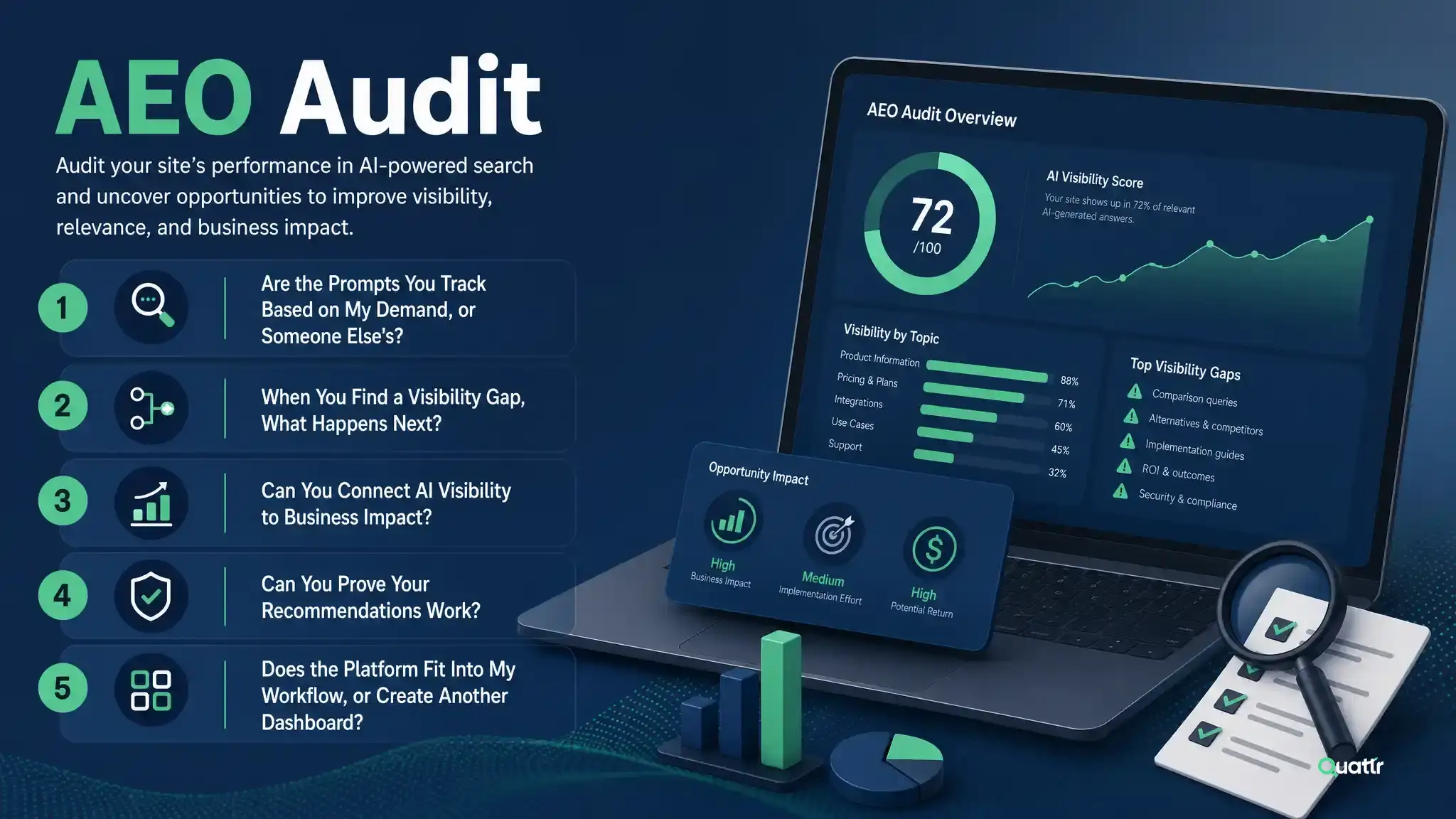
Question 3: Can You Connect AI Visibility to Business Impact?
This is the question your CFO will ask you in month six, so ask the vendor now.
Citation counts are an activity metric. Nobody budgets for activity. Sooner or later, you’ll need to show that AI visibility connects to sessions, pipeline, and revenue, and if your platform can’t draw that line, you’ll be drawing it manually in a spreadsheet, defending numbers you can’t fully stand behind.
The technical bar here is specific: the platform needs first-party integrations, GSC, GA4, ideally your revenue data, not screenshots of AI answers next to a traffic chart.
AI referral traffic is real and measurable, and it converts at a meaningfully higher rate than traditional organic, because the intent behind “asked a chatbot for a recommendation” is about as bottom-of-funnel as it gets. A serious platform should show you exactly which citations and which pages that traffic flows through.
Ask the vendor:
- Which citations influenced traffic, and can you show me the referral path?
- Which cited pages generated pipeline, not category-level, page-level?
- Do you integrate natively with GSC and GA4, or do I export and join the data myself?
- When my citation rate moves, can you show me what moved with it?
A good answer sounds like: “Here’s your cited-URL report joined to your GA4 sessions and conversions, page by page, with AI referral traffic broken out from organic.”
A red flag sounds like: “Visibility is a leading indicator, impact shows up over time.” Sometimes true. Also, exactly what you’d say if your product couldn’t measure impact.
Do this today: ask the vendor to name the three metrics they’d present to your CFO at renewal time. If all three are visibility metrics, the renewal conversation will be about faith, not results.
Question 4: Can You Prove Your Recommendations Work?
Here’s the most uncomfortable one, and the one that separates serious platforms from confident decks.
AI search moves constantly. Models update, retrieval sources shift, competitors publish. If your citation rate went up three weeks after you implemented a vendor’s recommendations, that’s a correlation, one of a dozen things that changed in the same window. The before-and-after screenshot, the favorite artifact of every case study in this category, proves nothing except that time passed.
The honest standard is a control group: changes measured against comparable pages or prompts that didn’t get the treatment. It’s harder to do, which is exactly why so few vendors do it, and why the ones who can are telling you something real about how they operate. A vendor that measures against controls is a vendor confident enough to find out their own recommendation didn’t work.
Ask the vendor:
- How do you isolate the impact of your recommendations from model updates and market movement?
- Can you show me a measurement against a control group, treated pages vs. untreated?
- What’s a recommendation of yours that didn’t work, and how did you catch it?
- What’s your methodology when the same prompt returns different answers day to day?
A good answer sounds like: “We measure treated vs. control, here’s the methodology, and here’s an example where the lift wasn’t significant, so we changed the recommendation.”
A red flag sounds like: a case study with two screenshots and an arrow. If the vendor’s proof standard is before-and-after, your renewal will be justified the same way, and your CFO went to the same schools mine did.
Do this today: ask for the methodology document, not the case study. Vendors with real measurements have one. Vendors without one will send you a PDF of testimonials.
Question 5: Does the Platform Fit Into My Workflow, or Create Another Dashboard?
Last question, and it’s the quiet deal-breaker. Because the answer predicts whether the tool gets used in month four.
Count your stack: GSC, GA4, server logs, your CMS, your revenue data. Your team already context-switches across all of it. A standalone AI visibility dashboard becomes the sixth tab, and the sixth tab has a life cycle. Checked daily for two weeks, weekly for a month, then quietly at renewal time to justify the line item. Data that lives in a silo doesn’t get acted on. It gets reported on, occasionally, by whoever remembers the login.
The workflow question is really a context question. AI visibility data means more when it sits next to the rest of your search reality: a citation gap is more actionable when you can see the page’s organic performance, its crawl status, and its conversion data in the same motion. Separated from that context, you’re still doing the joining yourself, which means the tool bought you data, not time.
Ask the vendor:
- Which of my existing systems do you integrate with natively, GSC, GA4, CMS, logs?
- Where does your data show up in my workflow, versus my team logging into yours?
- Can insights flow into the tools where my team already works, or is your dashboard the destination?
- What does week 12 of usage look like for a team my size, show me, don’t tell me.
A good answer sounds like: “We plug into GSC and GA4 natively, your AI visibility sits alongside your organic data, and actions execute where your team already works.”
A red flag sounds like: “Our dashboard becomes your team’s single source of truth.” You have a single source of truth. It’s the stack you already run. The last thing it needs is a rival.
Do this today: list every tool your search data currently touches. For each vendor, mark integrate / export-only / silo. One column of “silo” answers is a subscription you’ll be canceling in a year, after paying for it.
The Cheat Sheet: Keep It Open During Your Next Demo
Reading five questions is easy. Holding the line in a live demo, while a good salesperson steers you back to the share-of-voice chart, is harder. So we built the thing you actually need in the room:
The free AEO Vendor Red Flags Cheat Sheet gives you:
- All 5 questions with 20 follow-up probes, in disqualification order
- The exact red-flag answer to listen for next to each probe, word for word, because bad answers are surprisingly consistent
- No scoring, no setup. Open it, ask, listen, match.
If the rep’s answer sounds like the red flag column more than twice, you’re not in an evaluation anymore. You’re in a pitch.
What the Right Answer Looks Like
Here’s what I know for sure: the AEO category is going to consolidate hard over the next two years, and the platforms left standing won’t be the ones with the prettiest share-of-voice chart. They’ll be the ones that closed the loop, where you stand, why, what to fix, and whether it worked.
That’s the bar. A platform that tracks prompts built from your demand, turns every gap into a page-level action, ties citations to traffic and pipeline through first-party data, proves lift against controls, and lives inside the workflow you already run.
Most vendors clear one or two of those. Ask all five questions, and you’ll find out exactly which ones, before the invoice does.
Want to see how Quattr answers all five?
FAQs on Auditing AEO Vendor
A monitoring tool tracks where your brand appears in AI answers, citations, share of voice, sentiment, and reports on it. An execution platform does that and closes the loop: it diagnoses why you’re not cited, generates page-level fixes, and measures whether those fixes worked. The practical test is what happens after the tool finds a gap. If the next step is an export or a report, it’s monitoring. If the next step is a recommended action you can execute inside the platform, it’s execution. Both are sold at similar price points, which is exactly why you should know which one you’re buying.
Check two things: provenance and split. Provenance, the prompts should be generated from your own demand data (GSC queries, keyword footprint, buyer-stage questions), not from an industry template or an LLM’s guess at your category. Split, ask for the branded vs. non-branded ratio. A healthy prompt set is dominated by non-branded buyer questions, because that’s where deals start; a guessed list skews branded and inflates your scores. Fastest validation: pull your top 50 non-branded queries from Search Console and count how many map to tracked prompts.
Yes, if the platform has first-party integrations. AI referral traffic is measurable in GA4, and it converts at a meaningfully higher rate than traditional organic because someone asking a chatbot for a recommendation is deep in a buying decision. A platform with native GSC and GA4 connections can show which citations drove sessions and which cited pages generated conversions, page by page. What can’t be tied to revenue is a citation count sitting in a standalone dashboard, that connection only exists when AI visibility data lives alongside your traffic and conversion data.
Don’t evaluate on citation rate, share of voice, or how polished the dashboard looks; those are the easy metrics every vendor can show you. Instead, ask five things: where their tracked prompts actually come from (your demand data or a guessed template), what happens the moment the tool finds a visibility gap, whether it can tie citations to real traffic and pipeline through GSC and GA4, whether its recommendations are measured against a control group instead of before-and-after screenshots, and whether the data lives inside your existing workflow or becomes a standalone silo. A tool that only clears one or two of these is a monitoring dashboard with a sales team behind it, not something that will change your numbers.

Quattr is an AI-native Search Visibility Platform founded in Palo Alto, California, built for mid-market and enterprise brands competing in the age of generative search. Recently recognized across G2's Spring 2026 reports with #1 rankings in AEO Results, Usability, and Relationship, Quattr helps brands win visibility across traditional search and AI-generated answer surfaces.
Quattr's AI agent, GIGA, evaluates content the way AI systems do, identifying gaps across structure, authority, internal linking, and discoverability to surface the highest-impact fixes. With capabilities like autonomous internal linking, E-E-A-T intelligence, and the new GIGA Landing Page Generator for keyword-matched, AI-search-ready pages, Quattr helps teams move from diagnosis to deployed changes without manual bottlenecks.