

Key Takeaways
- YouTube is the single most cited domain inside Google AI Overviews, ahead of every other website, at roughly 29.5% of citations.
- AI platforms don’t reward view counts. Views, likes, and subscribers show no meaningful correlation with how often a video gets cited, extractability and reference value do the deciding.
- Long-form, reference-style videos, mostly 10 to 20 minutes, make up the vast majority of AI citations, at 94%. Short-form content rarely gets pulled into an answer.
- Timestamped chapters are a Google-only advantage right now, showing up in 73% of AI Overview video citations and 27% of AI Mode citations, but zero in ChatGPT, Perplexity, Copilot, or Claude.
- Not every AI tool can even “watch” your video. ChatGPT reads transcripts and metadata. Claude has no direct YouTube access at all, it only knows what’s written about a video elsewhere on the web.
- Nearly half of consumers now say they use platforms like YouTube and TikTok as a search engine, and for Gen Z specifically, video is often the first stop, not the last resort.
For a long time, YouTube sat in a strange spot in most marketing plans. It was where brands posted product demos, testimonials, or the occasional explainer, useful, but treated as a supporting channel next to the “real” work happening on the website and in Google Search.
That framing doesn’t hold up anymore. YouTube is the most cited domain inside Google’s AI Overviews today, ahead of every other single website on the internet. It’s also where a growing share of people, especially younger audiences, start their search in the first place, not just where they end up after finding something on Google.
If your SEO strategy still treats video as a nice-to-have, this is the piece that should change that.
Let’s start with what actually changed.
YouTube as a Search Engine: What Changed
YouTube has technically always been searchable. What’s new is how central it has become to how both people and AI systems actually answer questions.
On the human side, the shift is generational. Around 46% of 18 to 24-year-olds still start an information search on Google, but a meaningful share now start elsewhere first, on TikTok, on YouTube, on social platforms built around video. Roughly 60% of Gen Z say they prefer learning from YouTube specifically, because it feels like a real explanation from a real person instead of dense, text-heavy instructions. Close to half of all consumers now describe using platforms like YouTube as a search engine outright, not as a place they land after searching, but as the search itself.
On the AI side, the shift is even sharper. Google’s AI Overviews pull from YouTube more than from any other single domain on the web, at close to 30% of all citations. When Google needs to answer a question with a demonstration, a process, or a step-by-step walkthrough, video is very often the source it reaches for first.
Put those two things together, and YouTube stops looking like a “content channel.” It starts looking like core search infrastructure, one your brand either shows up in or doesn’t.
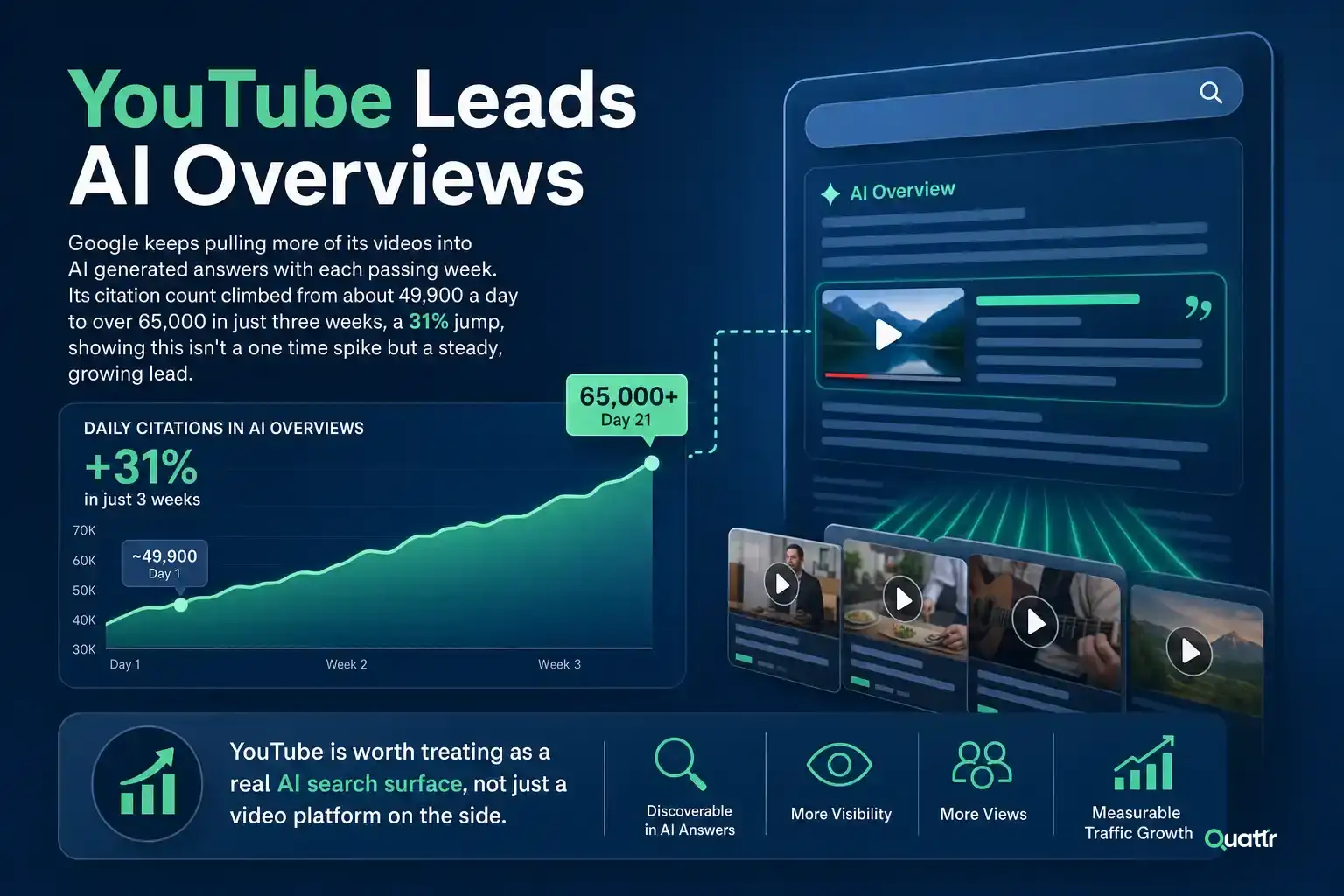
YouTube’s citations inside Google’s AI Overviews climbed from about 49,900 a day to over 65,000 in just three weeks, a 31% jump, showing this shift is steady and still growing, not a one time spike.
The obvious next question is why this is happening now, and what’s actually driving both the human and AI shift at the same time.
Why YouTube is Behaving Like a Search Engine Now
A few things are pushing this shift at the same time.
Video answers demonstration-based questions better than text. For anything involving a process, a physical action, or a visual comparison, a video simply proves the answer in a way a paragraph can’t. AI systems have picked up on this and increasingly treat video as the more trustworthy format for that category of question.
Younger audiences are search-native, not text-native. People who grew up with video as the default format don’t experience typing a query into a search bar as the obvious first move. Watching someone explain or demonstrate something feels more natural, and more credible, than reading about it.
AI systems need extractable, structured answers, and YouTube increasingly provides them. Transcripts, captions, chapters, and structured metadata give AI models something concrete to pull from. As more creators and brands add this structure, YouTube becomes an easier, safer source for AI systems to cite confidently.
Retention and trust signals now shape reach as much as keywords do. YouTube’s own ranking systems are leaning harder on watch time, session behavior, and clear topic focus, the same kind of trust signals that AI search engines look for elsewhere on the web. That alignment makes YouTube content doubly valuable: it’s optimized for YouTube’s own search, and for AI citation, at the same time.
Understanding why this shift is happening is one thing. Knowing how each AI platform actually pulls from YouTube, and where they differ, is what determines what you should optimize for first.
How AI Search Engines Actually Use YouTube
It’s worth understanding that different AI tools access YouTube in very different ways, because this changes what’s actually worth optimizing.
Google AI Overviews and AI Mode pull directly from YouTube constantly, and are the only systems currently using timestamped chapters as citable units. About 73% of AI Overview video citations reference a specific timestamp, and 27% of AI Mode citations do the same.
Perplexity drives the largest share of YouTube citations of any AI platform, at roughly 38.7%, relying on transcripts and metadata to summarize and reference video content.
ChatGPT can read a video’s transcript and metadata, but it cannot actually watch the video. Its citation share of YouTube content is comparatively small, around 4.4%, which makes clean, complete transcripts especially important if you want to show up there.
Claude has no direct access to YouTube at all. It only knows a video exists, and what it’s about, through what other websites and pages say about it. In practice, this means a video’s off-platform footprint, blog posts referencing it, articles embedding it, pages describing it, matters just as much as the video itself if you want Claude to be aware of it.
This is also where schema markup comes in. VideoObject schema is the baseline expectation now. Adding Clip and SeekToAction schema on top gives Google’s systems cleaner, more specific inputs to work with, directly improving the odds of being pulled into AI Overviews and Key Moments.
This platform-by-platform access gap isn’t just a technical detail, it’s reshaping what counts as a “result” in the first place, the same way it already has for text search.
How Zero-Click Search Overlaps With Video Search
If you’ve been following the rise of zero-click search, this will sound familiar, because it’s the same underlying shift, just showing up in video form.
Just like AI Overviews now answer text queries directly on the results page, Google increasingly answers process-based and demonstration-based queries directly with a video clip, a timestamped chapter, or a Key Moment, without the viewer needing to open the full video, let alone visit a website. A user can get their answer from a 20-second segment of your video without ever subscribing, clicking through, or even watching the rest.
That means the same mindset shift applies here. Success on YouTube can no longer be measured only in views and watch time. It also needs to account for how often your video content gets pulled into an AI answer or a Key Moment, whether or not that translates into a traditional view.
Once you accept that framing, the next step is practical: what specifically should you be doing to build videos AI systems can confidently cite?
How to Optimize YouTube for Search and AI Citations
Optimizing for YouTube as a search engine means building videos AI systems can confidently extract from, and building the surrounding structure that helps every platform, not just Google, understand what your video actually contains.
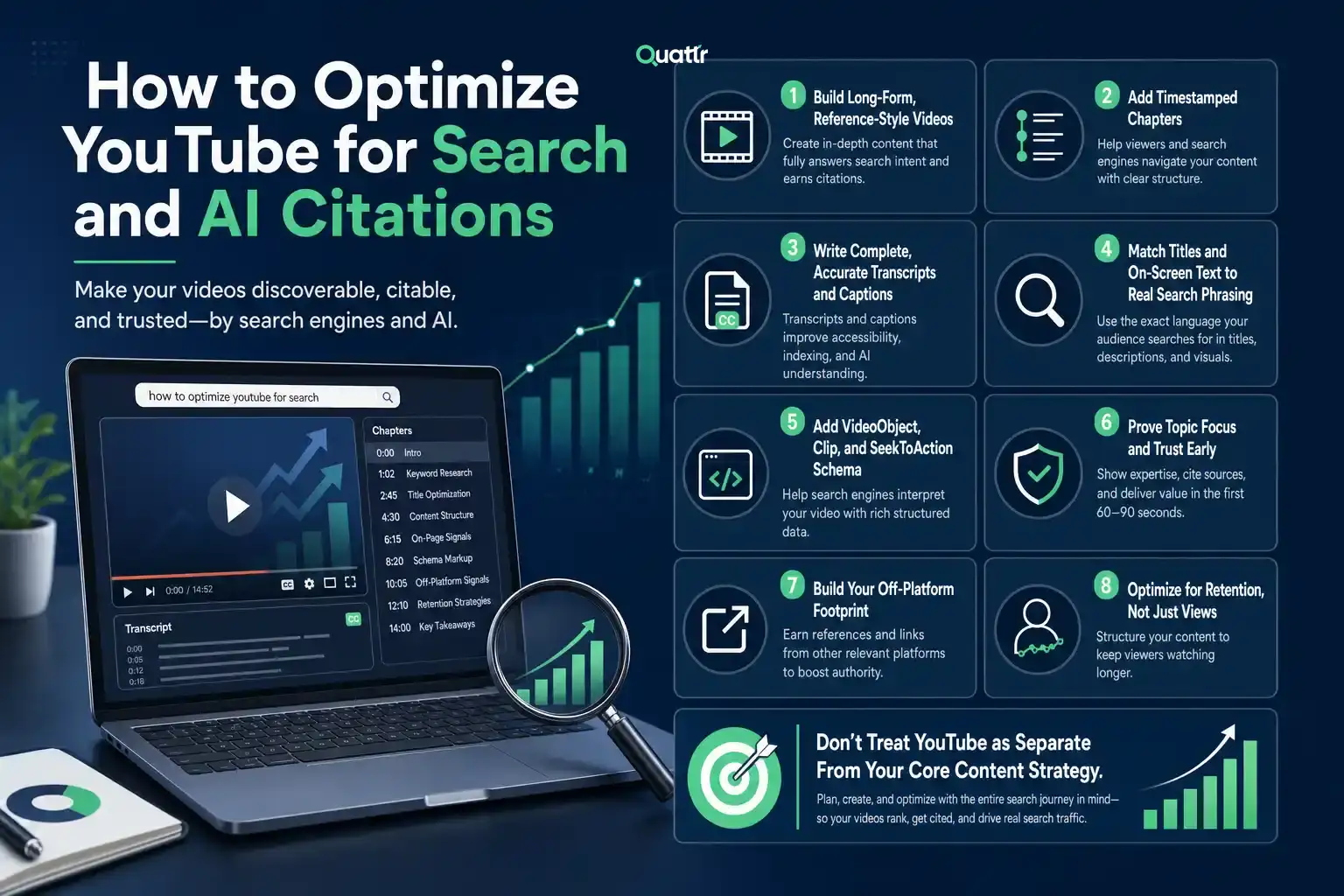
1. Build Long-Form, Reference-Style Videos
Long-form videos make up 94% of AI citations, with the single biggest cluster sitting between 10 and 20 minutes. Short, punchy clips have their place for reach and engagement, but if AI citation is the goal, a properly structured 10 to 20-minute video that thoroughly answers one topic will consistently outperform a string of short clips on the same subject.
2. Add Timestamped Chapters
Since timestamped citations are currently a Google-only advantage, adding clear, well-labeled chapters is one of the highest-leverage things you can do. Structure a single long-form video around clear sub-questions, with a chapter marking each one, so different segments can earn separate citations across related subtopics, instead of the whole video competing as one unit.
3. Write Complete, Accurate Transcripts and Captions
Since ChatGPT and Perplexity both rely on transcripts and metadata rather than watching the video itself, a clean, accurate, keyword-relevant transcript is doing a huge share of the work behind the scenes. Don’t rely on auto-captions alone. Review and correct them, especially for names, numbers, and technical terms.
4. Match Titles and On-Screen Text to Real Search Phrasing
Just like question-style headings help text content get matched to a query, your title, description, and on-screen text should mirror how people actually phrase the question your video answers. Keep the core topic visible in the script, the captions, and the chapters, not just the title.
5. Add VideoObject, Clip, and SeekToAction Schema
VideoObject schema is now the baseline, not an extra. Layering Clip and SeekToAction schema on top gives Google’s systems more precise, structured information to work with, which directly improves your odds of showing up in AI Overviews and Key Moments.
6. Prove Topic Focus and Trust Early
YouTube’s own ranking systems, and AI systems downstream of them, are increasingly rewarding videos with clear E-E-A-T signals, a strong, single topic focus, real examples, and visible proof that the viewer actually got their answer. Open with the core point instead of a long introduction, the same “answer first” principle that works for text content applies here too.
7. Build Your Off-Platform Footprint
Since Claude has no direct access to YouTube at all, it only learns about your video through what’s written about it elsewhere. Reference and embed your videos in blog posts, link to them from relevant pages, and make sure articles describing the video’s content exist across the web. This closes the gap for AI systems that can’t access YouTube directly.
8. Optimize for Retention, Not Just Views
Views, likes, and subscriber counts show no meaningful correlation with how often a video gets cited by AI systems. Retention, satisfaction, and session time matter far more. A shorter, genuinely useful video that keeps people watching and moving into related content will often outperform a longer, weaker one with a bigger view count.
9. Don’t Treat YouTube as Separate From Your Core Content Strategy
Video and written content should be reinforcing each other, not competing for separate budgets. A video that gets cited in an AI Overview and a blog post that gets cited in the same answer both build the same underlying signal: that your brand is a trustworthy, extractable source on that topic.
Putting these changes into practice only matters if you can actually see whether they’re working, which means rethinking how you measure success in the first place.
How to Measure YouTube’s Impact on Search Visibility
Just as with zero-click search on the text side, YouTube performance can no longer be judged by views and watch time alone. A few additional metrics matter now.
AI visibility and citation share track how often your video content, or content referencing your videos, gets pulled into answers from Google AI Overviews, ChatGPT, Perplexity, and Claude. This tells you whether you’re actually part of the answer, not just uploaded and indexed.
Key Moments and timestamp citations are worth tracking specifically within Google’s AI surfaces, since this is where the timestamp advantage currently lives. If your chapters aren’t showing up here, that’s a structural fix, not a content quality one.
Branded search lift is often the earliest sign that video visibility is working. If more people start searching your brand name directly after your videos start appearing in AI answers or Key Moments, that’s real recognition building, even before it shows up as a view.
Off-platform references matter for the same reason Claude’s lack of direct access matters: they’re a proxy for how well AI systems that can’t watch your video will still come to understand it.
Video and text used to sit in separate reporting dashboards, run by separate teams, with separate goals. That divide doesn’t reflect how AI systems actually search anymore. They pull from whichever format, text or video, gives them the clearest, most extractable, most trustworthy answer. Treating YouTube as core search infrastructure, not a side channel, is what closes that gap.
This is also where a tool like Quattr helps. Its AI visibility tracker monitors how your brand and video content show up across Google AI Overviews, AI Mode, ChatGPT, Perplexity, and Claude in real time, so you’re not manually re-running prompts every week to check if you got cited.
Instead of piecing together prompt performance, cited pages, and competitor presence from separate tools, Quattr brings all of it into one view, making it much easier to see what’s actually improving your AI visibility and where to focus next.
FAQs
Functionally, yes. YouTube is the most cited domain inside Google’s AI Overviews, and a growing share of users, especially Gen Z, treat it as a first stop for answers rather than a place they land after a Google search.
Not directly. Views, likes, and subscriber counts show no meaningful correlation with citation frequency. AI systems reward extractability and reference value, not popularity.
It varies. Google AI Overviews and AI Mode pull directly from YouTube, including timestamped chapters. Perplexity and ChatGPT rely on transcripts and metadata. Claude has no direct access at all, and only learns about a video through what’s written about it elsewhere on the web.
Yes, especially for Google. About 73% of AI Overview video citations and 27% of AI Mode citations reference a specific timestamp. That advantage currently doesn’t extend to ChatGPT, Perplexity, Copilot, or Claude.
Long-form. Reference-style videos, especially in the 10 to 20-minute range, make up 94% of AI citations. Short-form content drives reach and engagement, but rarely gets pulled into AI answers.

Quattr is an AI-native Search Visibility Platform founded in Palo Alto, California, built for mid-market and enterprise brands competing in the age of generative search. Recently recognized across G2's Spring 2026 reports with #1 rankings in AEO Results, Usability, and Relationship, Quattr helps brands win visibility across traditional search and AI-generated answer surfaces.
Quattr's AI agent, GIGA, evaluates content the way AI systems do, identifying gaps across structure, authority, internal linking, and discoverability to surface the highest-impact fixes. With capabilities like autonomous internal linking, E-E-A-T intelligence, and the new GIGA Landing Page Generator for keyword-matched, AI-search-ready pages, Quattr helps teams move from diagnosis to deployed changes without manual bottlenecks.