

Key Takeaways
- AI search engines do not read your website the way Google used to. They read your brand as an entity, a distinct, nameable thing with a history, a reputation, and relationships to other entities.
- Entity recognition is now one of the biggest factors in whether AI models cite you, recommend you, or skip past you entirely.
- Keywords still matter, but they are no longer enough on their own. A page can be perfectly optimized and still get ignored if the AI is not sure who is behind it.
- Structured data, consistent brand information, and third party mentions are what teach AI models who you are and whether you can be trusted.
- Small and mid sized brands can build strong entity recognition faster than big, unfocused brands, because clarity and consistency matter more than budget.
Ask ChatGPT or Gemini a question about the best project management tool, the best skincare ingredient, or the safest way to invest a small amount of money, and notice something. The AI does not give you ten blue links. It gives you an answer, and inside that answer it names specific brands, people, and products with confidence.
That confidence is not random. The AI is pulling from what it knows about entities, the people, places, companies, and things it has learned to recognize and trust. If your brand is not a well formed entity in the AI’s mind, you simply will not be part of that answer.
This blog is about what entity recognition actually is, why it has become the backbone of authority in AI search, and what you can do to make sure AI models recognize, understand, and recommend your brand.
What is Entity Recognition and Why should You Care?
Entity recognition comes from a field called Natural Language Processing. In simple terms, it is how a machine identifies and labels the important things inside a piece of text, people, companies, products, places, and events, and understands how they relate to each other.
When AI search engines like ChatGPT, Gemini, Perplexity, and Google AI Overviews read the web, they are not just scanning for keywords anymore. They are building an internal map of entities. Your brand is either a clear, well defined point on that map, or it is a blur that gets skipped. This is also why brand mentions across the web now correlate more strongly with visibility in AI Overviews than backlinks or domain authority ever did.
Here is why this matters so much right now. AI generated answers already show up in a large and fast growing share of Google searches, and that share nearly doubled in just a couple of months in early 2026. People are getting used to asking and receiving an answer, not a list of links. When an AI cannot verify who you are, it will not risk recommending you, even if your content is excellent. It will simply reach for a brand it already recognizes.
This is the shift Quattr has been talking about for a while now. You can read more about how AI models choose sources to cite and how that ties directly into what AI search visibility actually means for a growing brand.
How Entity Recognition is Different from Traditional SEO Signals
Traditional SEO was built around keywords and links. You picked the phrases people searched for, wrote pages around them, and earned backlinks to prove your page deserved to rank. It worked because the system was matching words to words.
Entity recognition works differently. Instead of matching words, AI models are trying to match meaning to a known, trusted source. They ask questions like, is this company real, is it credible, does it actually do what it claims, and have other trustworthy sources talked about it in the same way.
This means a page can be written perfectly, with the right keywords in all the right places, and still lose out to a weaker page, simply because the weaker page belongs to a brand the AI already recognizes as a real, credible entity. A page with strong keyword optimization but weak entity signals often loses out to a page from a recognized brand that has less polish but more trust behind it. In fact, a proper LLM SEO audit usually shows that high domain authority alone does not guarantee citations, topical alignment and entity trust matter far more.
That one shift changes everything about how brands need to think about visibility. It is no longer only about optimizing pages. It is about building a recognizable, consistent identity across the entire internet, so that wherever an AI model encounters your name, it already knows who you are.
What is the Real Goal of Entity Recognition for Your Brand
The real goal is simple to say and hard to achieve. You want AI models to know your brand well enough that when someone asks a relevant question, your name comes up naturally, by itself, without you having to pay for an ad or beg for a mention.
Think about how a person builds a reputation in real life. It is not one good deed, it is a pattern of being reliable, known, and talked about by others in a consistent way over time. AI models are building the exact same kind of reputation profile for your brand, except they are doing it by reading everything, your website, your reviews, your social presence, your press mentions, and every place your name appears alongside a topic.
Once an AI model treats your brand as a confirmed, well understood entity, you start showing up in answers you never even optimized a page for. That is the real prize here, showing up in the moments you cannot directly control, because the AI already trusts you enough to bring you up on its own. This is the same idea behind ranking on ChatGPT, your brand needs to exist as a trusted entity before it can ever be recommended in a conversation.
Best Practices to Build Entity Recognition and Authority in AI Search
Everything below comes back to one idea, making it easy for an AI model to say with confidence, yes, I know this brand, and here is what it is good at.
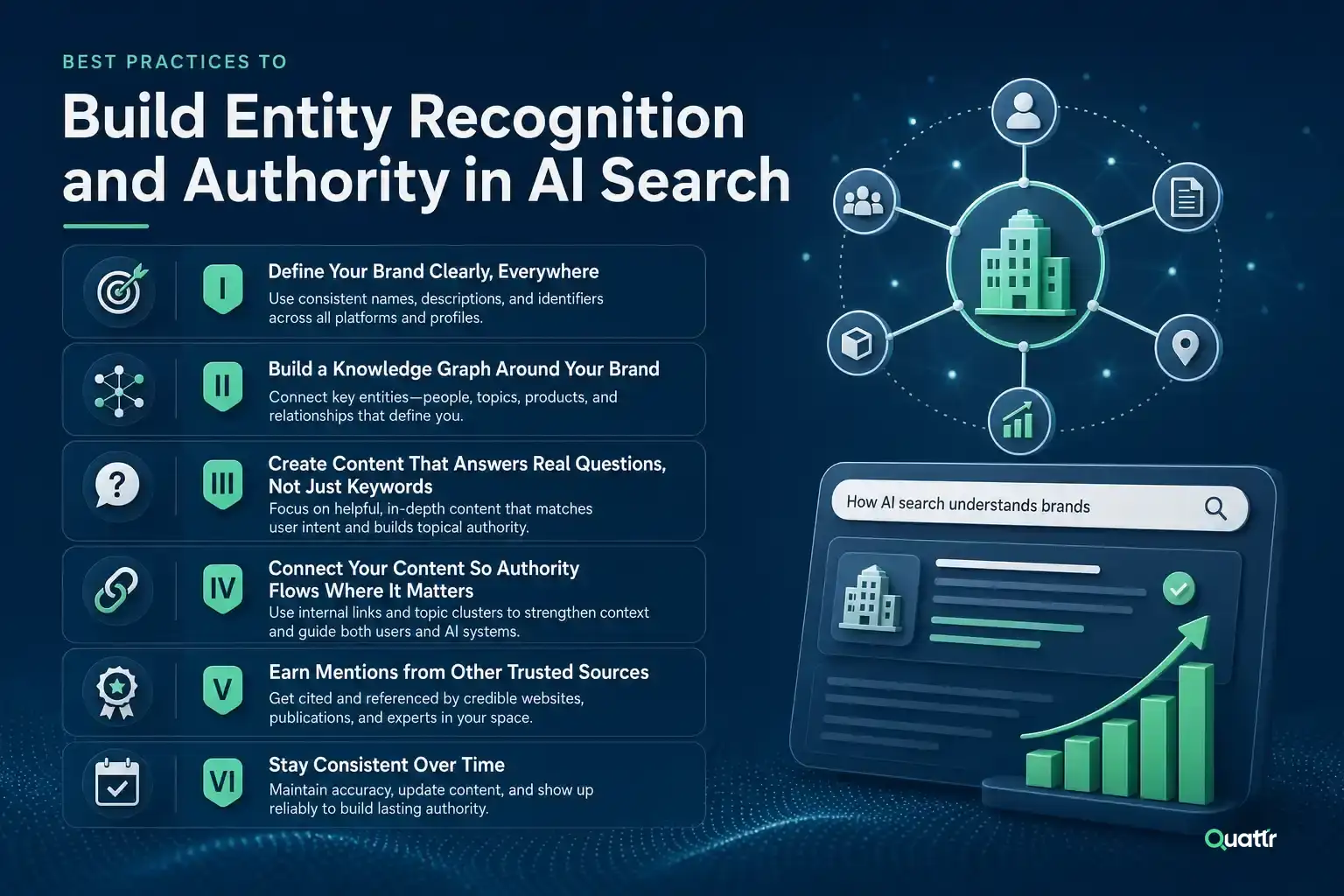
I. Define Your Brand Clearly, Everywhere
AI models rely heavily on structured data to understand entities. Schema markup, especially Organization schema and the sameAs property, tells AI systems exactly who you are and links your brand to other trusted profiles, like your Wikipedia page, your LinkedIn page, or your Crunchbase profile. Clean, consistent structured data across your site is one of the fastest ways to help AI models disambiguate your brand from anyone else with a similar name. If you want to see exactly which tags matter most, this guide on how to get cited by LLMs breaks down the sameAs, about, and mentions properties that anchor your brand as the definitive source on a topic.
Your homepage, your about page, and your key product pages should all say the same clear thing about what you do and who you do it for. Vague, clever marketing language confuses AI the same way it confuses a person reading quickly.
II. Build a Knowledge Graph Around Your Brand
A knowledge graph is essentially a structured map of entities and how they connect to each other. Search engines and AI models already maintain massive knowledge graphs of their own. Your job is to feed that graph clean, consistent signals about your brand, your products, the problems you solve, and the people behind your company.
This is exactly where Quattr’s AI SEO Suite becomes useful. It gives you one place to manage the structured signals, content, and internal connections that shape how AI models perceive your brand as an entity, instead of juggling a separate tool for each piece.
III. Create Content That Answers Real Questions, Not Just Keywords
Entity recognition is strengthened every time you publish content that answers a real, specific question your audience is asking, and answers it clearly enough that an AI model can lift it directly into a response. Scattered, generic content weakens your entity signal. Focused, consistent content around your core topics strengthens it. This is exactly what it means to structure content so AI engines quote you instead of a competitor.
Quattr’s Content AI is built for exactly this, helping you produce content that maps to the real questions your buyers type into AI tools, so every new page adds to your brand’s authority instead of diluting it.
IV. Connect Your Content So Authority Flows Where It Matters
Even the best individual pages will not build strong entity authority if they sit isolated on your site. Internal linking is how you tell both search engines and AI models which pages and topics matter most, and how they relate to each other. It is often the overlooked signal in AI search that decides whether authority actually reaches your most important pages.
Quattr’s Internal Linking AI automates this at scale, using semantic understanding rather than simple keyword matching, so authority flows to your most important pages automatically, and stays updated as you publish new content.
V. Earn Mentions from Other Trusted Sources
AI models do not just trust what you say about yourself. They weigh what other credible sources say about you far more heavily. Reviews on platforms like G2, mentions in industry publications, analyst references, and organic conversations on Reddit or LinkedIn all add up to build the kind of third party trust that AI models are specifically looking for. This guide on how to improve brand mentions in AI walks through exactly where those mentions need to show up. And it helps to know the difference between AI mentions and AI citations, since both play a different role in building your entity profile.
VI. Stay Consistent Over Time
AI models are trained and retrained over time, which means entity recognition is not something you build once and forget. Brands that show up consistently, month after month, across the same set of trusted places, are the ones that end up firmly recognized. Think of it as reputation building, except your audience is a very well read machine with a long memory. These AI visibility optimization best practices are worth revisiting regularly, since what works keeps shifting as AI models get updated.
How to Actually Build a Strong Entity Presence
Knowing the practices is one thing. Actually executing on them consistently is where most brands fall behind. Here is what that looks like in practice.
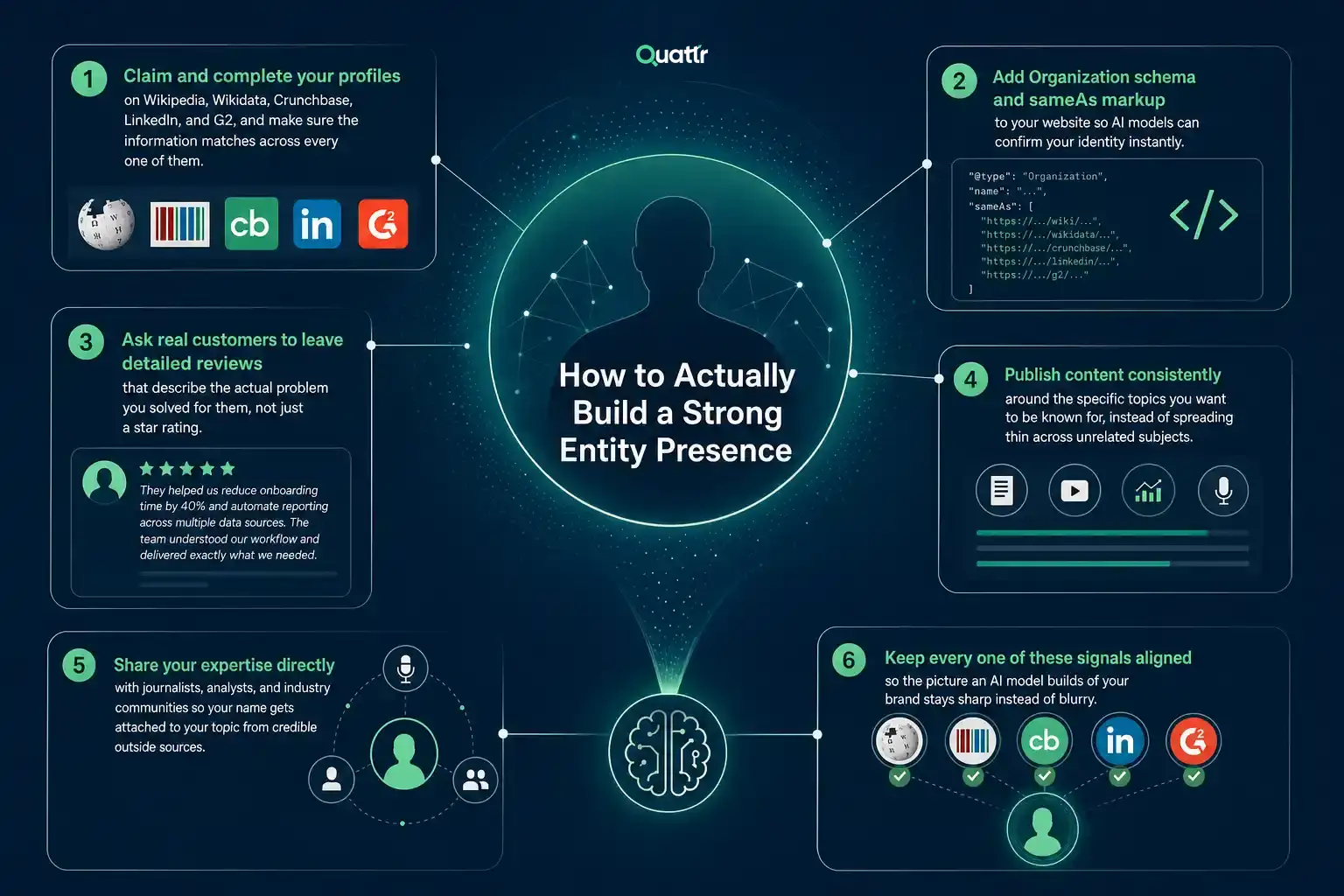
- Claim and complete your profiles on Wikipedia, Wikidata, Crunchbase, LinkedIn, and G2, and make sure the information matches across every one of them.
- Add Organization schema and sameAs markup to your website so AI models can confirm your identity instantly.
- Ask real customers to leave detailed reviews that describe the actual problem you solved for them, not just a star rating.
- Publish content consistently around the specific topics you want to be known for, instead of spreading thin across unrelated subjects.
- Share your expertise directly with journalists, analysts, and industry communities so your name gets attached to your topic from credible outside sources.
- Keep every one of these signals aligned so the picture an AI model builds of your brand stays sharp instead of blurry.
This is a long game, and it rewards brands that stay focused far more than it rewards brands that simply spend more. If you want a structured way to check where you stand today, Quattr’s LLM SEO checklist is a good place to start.
How Quattr Helps Brands Build Entity Authority in AI Search
Building entity recognition is not a one time project. It is an ongoing discipline of showing up clearly, consistently, and credibly across the entire internet, so AI models have no doubt about who you are and what you are good at.
The hard part is knowing whether any of it is actually working. Are AI models picking up your brand correctly? Are they recommending you or a competitor when your exact buyer asks a relevant question? Where are the gaps in your entity signal that are quietly costing you visibility?
This is exactly what Quattr’s AI Search Visibility platform is built to answer. Quattr’s AI visibility tracker monitors how your brand shows up across Google AI Overviews, Google AI Mode, ChatGPT, Gemini, Perplexity, and Claude, all from a single dashboard. It captures brand mentions along with sentiment, benchmarks your share of voice against competitors through Quattr’s Market Share Metric, and pinpoints exactly which queries in your space your brand is missing from entirely, tracked through the same GEO metrics that determine whether AI models see you as an authority.
Beyond tracking, Quattr’s AI agent GIGA turns those insights into action. GIGA evaluates your content the way AI models actually read it, checking structure, authority signals, and internal linking, and then goes ahead and fixes the highest impact gaps for you. Paired with Quattr’s E-E-A-T intelligence, which strengthens the exact trust signals AI models look for, and the GIGA Landing Page Generator, which builds keyword matched, AI ready pages, Quattr covers the full loop from diagnosis to deployed fix, instead of leaving you with a dashboard full of problems and no way to solve them. It is also why Quattr is rated number one for AI visibility reporting in the mid market category.
Brands that treat AI visibility as something to measure and act on, not just watch, are the ones building real entity recognition right now, while their competitors are still trying to figure out why their traffic looks fine but their AI mentions do not exist.
See exactly how AI models currently understand and recognize your brand, and what it will take to change that. Book a demo with Quattr today.
FAQs
It is how AI models identify a specific person, brand, or thing inside text and understand what it is, instead of just reading it as random words.
Because AI search engines need to trust who is behind an answer before they will recommend it, and trust comes from recognizing you as a real, consistent entity, not from keyword density.
An AI visibility tool, like the one built into Quattr, shows you exactly how and where your brand appears across AI search engines, and where it does not.
Yes. Structured data like Organization schema and sameAs links help AI models confirm who you are and connect your website to other trusted profiles about your brand.
Yes. Entity recognition rewards clarity and consistency, not budget, so a smaller brand that stays focused can often build stronger AI trust than a bigger brand with scattered, inconsistent signals.

Quattr is an AI-native Search Visibility Platform founded in Palo Alto, California, built for mid-market and enterprise brands competing in the age of generative search. Recently recognized across G2's Spring 2026 reports with #1 rankings in AEO Results, Usability, and Relationship, Quattr helps brands win visibility across traditional search and AI-generated answer surfaces.
Quattr's AI agent, GIGA, evaluates content the way AI systems do, identifying gaps across structure, authority, internal linking, and discoverability to surface the highest-impact fixes. With capabilities like autonomous internal linking, E-E-A-T intelligence, and the new GIGA Landing Page Generator for keyword-matched, AI-search-ready pages, Quattr helps teams move from diagnosis to deployed changes without manual bottlenecks.