

Key Takeaways
- AI shopping assistants like ChatGPT, Gemini and Perplexity don’t browse your product page the way a person does. They pull out facts, and if those facts are messy or missing, they skip your product and recommend a competitor’s instead.
- Schema markup is no longer a nice-to-have. Product, Offer, AggregateRating, and FAQPage schema are what tell an AI model what it’s looking at.
- The words on your page matter as much as the code behind it. People ask AI tools full questions, like “will this fit a small kitchen” or “is this good for sensitive skin,” so your copy needs to answer those questions directly.
- Consistency is everything. If your page says “in stock” but your feed says otherwise, AI models lose trust in your entire site.
- Small, focused product catalogs can win here just as easily as big ones. What matters is clarity, not size.
A few years ago, if you wanted to buy a blender, you opened ten tabs, skimmed a few reviews, maybe watched a YouTube video, and made up your mind yourself. Today, a growing number of people just ask ChatGPT or Gemini, “what’s a good blender for smoothies that won’t break after a year,” and go with whatever it says.
That’s a big shift, and it changes who gets picked. The AI isn’t reading your page the way a person browses a store. It’s scanning for facts it can trust enough to repeat out loud: the name, the price, whether it’s in stock, who it’s actually good for, and whether other buyers backed that up. If your product page can’t hand over those facts cleanly, the AI moves on to a page that can, even if your product is the better one.
This blog breaks down what actually makes a product page easy for AI models to read, trust, and recommend, without the technical jargon, and with steps you can put to work right away.
What Does “LLM-Friendly” Actually Mean for a Product Page
An LLM-friendly product page is one where an AI model doesn’t have to guess anything. It knows the name of the product, the price, whether it’s available, what it’s made of, who it’s good for, and what real customers think of it, because the page says so clearly and the code behind the page confirms it.
AI answers are quickly becoming the first stop for product research. When a shopper asks an AI assistant “what’s a good budget-friendly air purifier for a small apartment,” the model isn’t ranking pages, it’s picking a small handful of products it feels confident recommending. That confidence is built page by page, fact by fact. That confidence is built page by page, fact by fact, and most product pages simply aren’t built to earn it.
Why Product Pages Struggle in AI Search More Than Other Pages
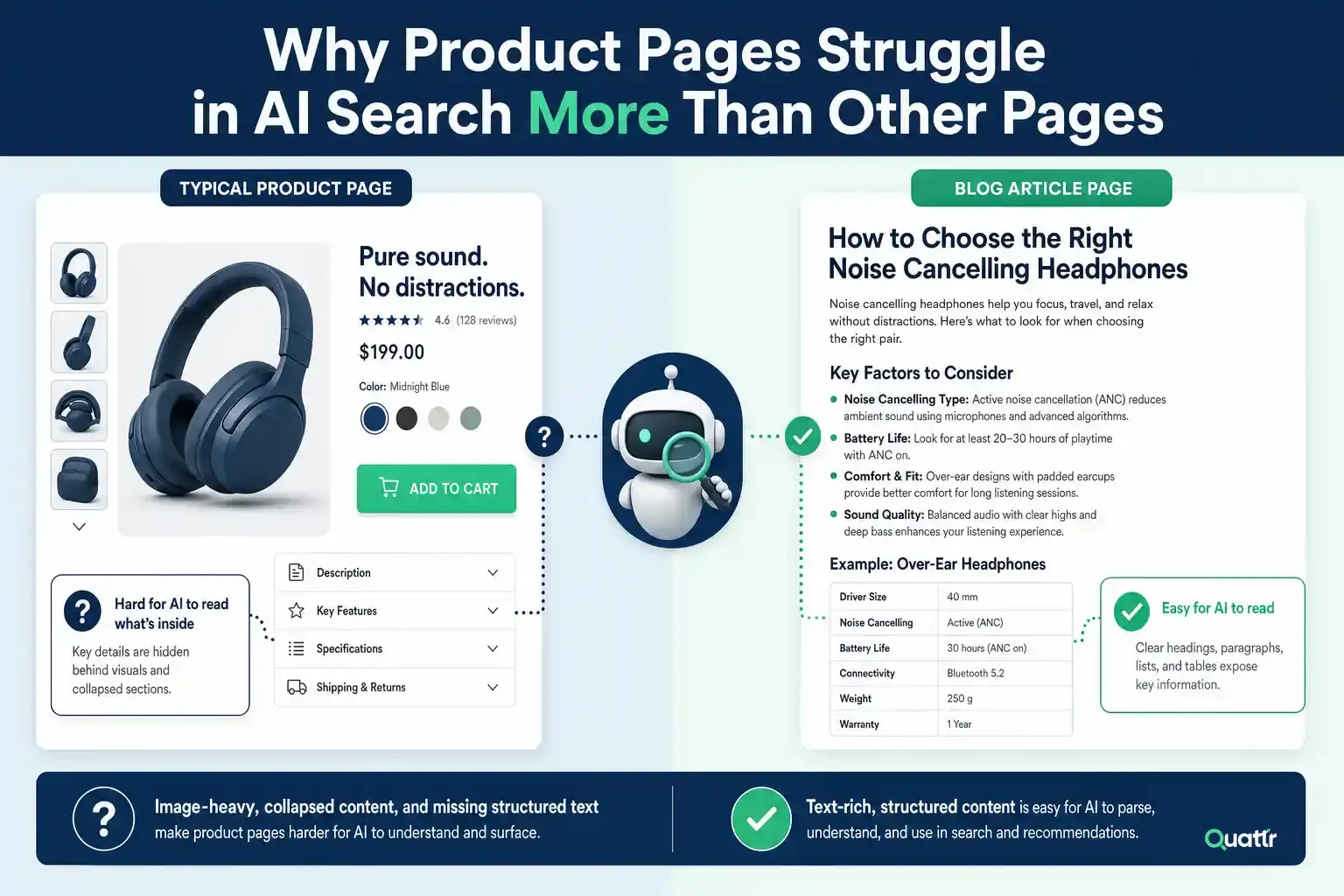
Blog posts have it a little easier. They’re built to answer a question, so it’s natural for them to be structured, clear, and text-heavy. Product pages weren’t built that way. They were built to sell, with big hero images, short punchy taglines, and specs buried in a tab nobody opens.
That’s a problem for AI models, because they need exactly the opposite: complete information sitting in plain sight, not tucked behind a click. A gorgeous product page with three words of marketing copy and no visible specs gives an AI model almost nothing to work with.
There’s also a trust problem unique to ecommerce. AI models know that product pages are trying to sell something, so they lean even harder on outside proof, reviews, ratings, return policies, and whether the page’s claims match what’s actually in stock. A page that oversells or contradicts itself gets quietly dropped from consideration.
Once you see the problem this way, it’s easier to spot exactly what an AI model is scanning for on any given page.
What AI Models Actually Look for on a Product Page
Strip away the jargon, and AI models are checking for the same handful of things, over and over:
- The exact product name, price, and whether it’s currently available.
- Specs that answer real questions, like size, material, battery life, or compatibility.
- Whether the page, the structured data behind it and your product feed all say the same thing.
- Genuine reviews and ratings, not vague claims of quality.
- Plain-language answers to common pre-purchase questions.
- Whether the page is even reachable by AI crawlers in the first place.
If any of these are missing, inconsistent, or hidden behind JavaScript that doesn’t load properly, the AI model has to make a judgment call. And when in doubt, it picks the product it can verify, not the one it has to guess about.
Knowing what AI models check for is half the battle. Fixing each piece is what actually moves the needle, so let’s get into it.
Best Practices to Make Your Product Pages LLM-Friendly
Getting this right matters more than almost anything else on the page. Here’s what it actually takes.
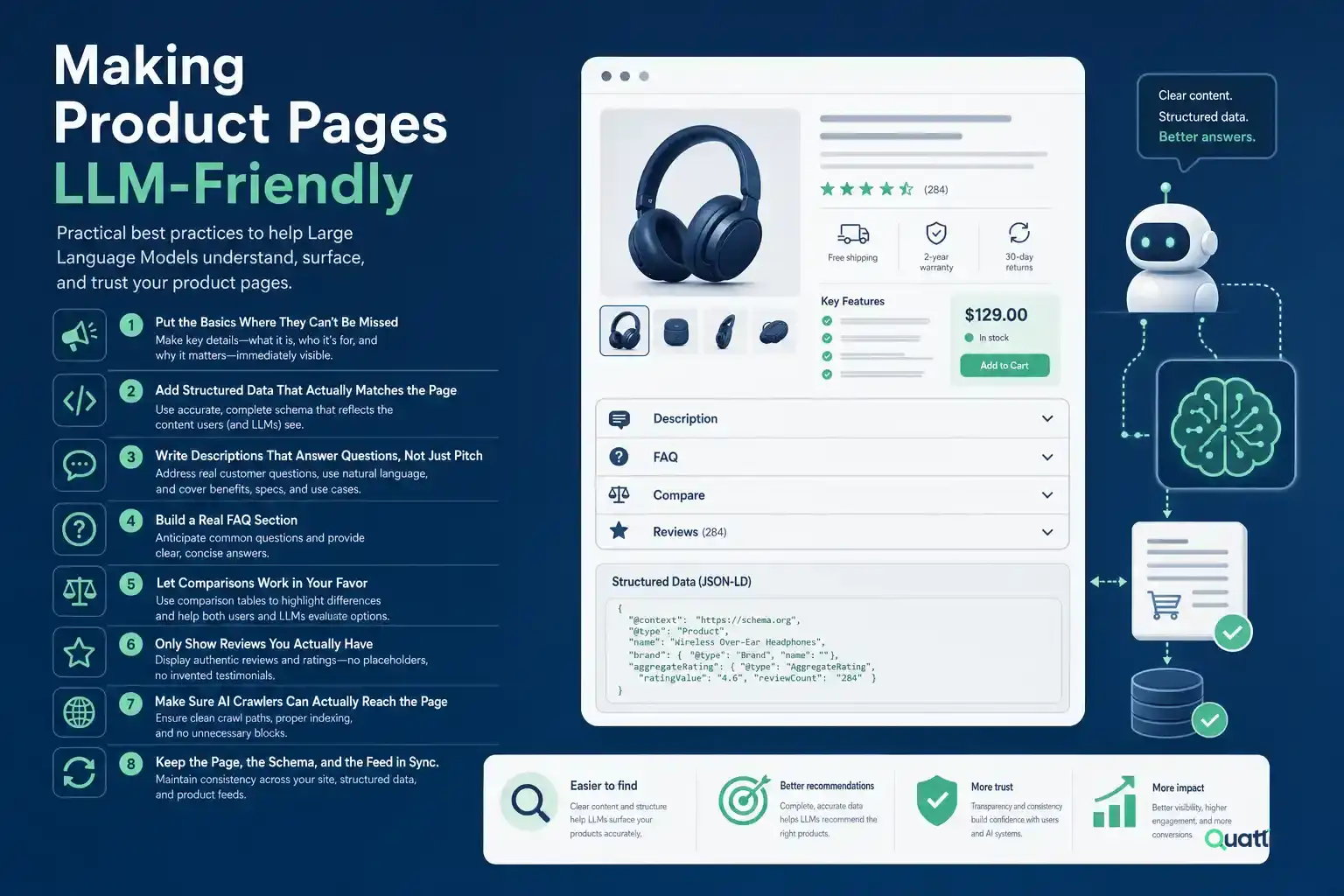
1. Put the Basics Where They Can’t Be Missed
Name, price, and availability should sit near the top of the page, in plain text, not just inside an image or a JavaScript widget. If you sell in variants, size, color, bundle, make sure the variant a person lands on matches exactly what’s in your structured data and your product feed. A page that says “in stock” while the feed says otherwise doesn’t just cost you that one sale, it teaches the AI model not to trust your other pages either.
2. Add Structured Data That Actually Matches the Page
Use JSON-LD to mark up your page with Product schema, including brand, GTIN or MPN, and an Offer with current price, currency, and availability. If you show star ratings, add AggregateRating too, but only if the ratings are genuinely visible on the page. Add your return policy with MerchantReturnPolicy, since AI shopping tools increasingly check this before recommending anything.
Here’s roughly what that looks like:
{
  "@context": "https://schema.org",
  "@type": "Product",
  "name": "Example Running Shoe",
  "brand": "Example Brand",
  "sku": "EX-RUN-BLK-9",
  "offers": {
    "@type": "Offer",
    "price": "79.99",
    "priceCurrency": "USD",
    "availability": "https://schema.org/InStock"
  },
  "aggregateRating": {
    "@type": "AggregateRating",
    "ratingValue": "4.5",
    "reviewCount": "212"
  }
}
Make sure this JSON-LD is rendered on the server, not injected after the page loads with JavaScript. Crawlers like OpenAI’s OAI-SearchBot and Anthropic’s ClaudeBot often can’t run JavaScript the way a browser does, so if your schema only appears after the page finishes loading in a browser, these bots may never see it at all. This one detail on its own can be the difference between a product being cited and being ignored, something Quattr’s LLM SEO audit process catches often when reviewing ecommerce sites.
3. Write Descriptions That Answer Questions, Not Just Pitch
People don’t type “premium ergonomic office chair” into ChatGPT. They ask “what’s a good chair for someone with lower back pain who sits all day.” Your product description should speak that same plain, specific language. Instead of “engineered for ultimate comfort,” say what actually makes it comfortable, the type of lumbar support, the material, the weight limit.
A short “best for” line does a lot of work here too. Something like “Best for small apartments and studio spaces” gives an AI model an easy, quotable fact to work with. This is the same idea behind writing content that gets quoted directly by AI engines, except applied to a product description instead of a blog post.
4. Build a Real FAQ Section
Every product has the same five or six questions buyers ask before checkout. Does it run small? Is it machine washable? Does it work with a specific setup? Answer these directly on the page, mark it up with FAQPage schema, and skip the vague, generic questions nobody actually asks. Google has removed the tracking for FAQ rich results in Search Console, but that doesn’t matter here, because AI assistants still read this text closely to quote it directly in an answer.
5. Let Comparisons Work in Your Favor
Shoppers using AI assistants often ask comparison questions directly, “is this better than X” or “what’s the difference between the two models.” If you sell multiple versions of a product, or compete against a well known alternative, a simple comparison table on the page gives the AI model something concrete to reference instead of guessing. This is a smaller version of the same authority-building idea covered in Quattr’s guide on how AI models choose sources to cite.
6. Only Show Reviews You Actually Have
If your page displays a star rating and review count, mark it up with schema. If it doesn’t, don’t add the markup anyway just to look more credible, it can get your page flagged or ignored entirely. Real, specific reviews, ones that mention an actual use case, are worth far more to an AI model than a generic five-star badge with no detail behind it.
7. Make Sure AI Crawlers Can Actually Reach the Page
None of the above matters if the bots reading the web can’t get to your page. Check your robots.txt file and confirm you’re not accidentally blocking OAI-SearchBot, ClaudeBot, PerplexityBot, or Google-Extended. Many ecommerce platforms block bots by default to save server load, which quietly locks a brand out of AI search without anyone noticing. It’s worth checking this quarterly, since crawler rules and bot names do change.
8. Keep the Page, the Schema, and the Feed in Sync
Set a simple rule internally: whenever price, stock, or specs change, update the visible page, the structured data, and your product feed on the same day. AI models and shopping assistants cross-check these sources against each other, and mismatches erode trust fast. This kind of consistency, repeated across a whole catalog, is exactly what builds the sort of brand-wide trust discussed in Quattr’s piece on what AI search visibility really means.
A Quick Audit You Can Run Today
You don’t need a big project to get started. Pick five of your best-selling products and check the following:
- Does the name, price, and availability match exactly across the page, the JSON-LD, and your feed?
- Is your
Product,Offer, andAggregateRatingschema present, accurate, and rendered server-side? - Does the description answer a real question a buyer would type into an AI tool, or does it just describe features?
- Is there a visible FAQ section marked up with
FAQPageschema? - Are your reviews genuine, visible, and correctly marked up?
- Can AI crawlers actually access the page, based on your robots.txt?
Fix what’s broken, validate your schema with a tool like Google’s Rich Results Test, and republish. Then check back in a few weeks to see whether your visibility in AI answers starts to shift.
That audit works fine for five products. The real challenge shows up when you try to do it for five thousand.
How Quattr Helps Brands Make Product Pages AI-Ready
Fixing an existing page is one thing. Building a brand-new one from scratch, one that’s structured right and ready for AI search from day one, is a different challenge, especially when a new SKU, a seasonal drop, or a fresh campaign keyword needs a page live this week, not next month.
This is what Quattr’s Landing Page Generator, powered by GIGA, is built for. Give it a keyword, and it runs one supervised session that turns that keyword into a live page, built to convert a paid click and earn an AI citation at the same time.
It doesn’t start blank. GIGA first checks how competitor pages perform across Google, ChatGPT, Perplexity, Gemini, Claude, and Bing. Then, using Section DNA, it can clone the structure of any high-performing page, yours or a competitor’s, into your own brand system. The copy stays grounded in your real product docs, not generic AI filler, and every stage needs your sign-off before it goes live.
FAQs
Because ranking and being trusted are two different things. Google is matching your page to a search query. An AI model is deciding whether to stake its answer on your facts. If your price, stock, or specs don’t match across your page, your schema, and your feed, or an AI crawler can’t even reach the page, it gets left out no matter how well you rank.
You need it for both, but for different reasons. Schema gets you rich results on Google. For AI models, it’s more basic than that, it’s how they confirm what your product actually is, what it costs, and whether it’s in stock, instead of guessing from the page text.
Yes, and probably more than before. Google has pulled back on showing FAQ rich results, but AI assistants still read that Q&A text closely and lift it directly into their answers. Just make sure the questions are ones people actually ask, not filler.
Neither, really. Length isn’t what AI models care about. What matters is whether the description answers a real question, like who it’s for or how it holds up, instead of just listing features. A short, specific paragraph beats a long, vague one every time.
Yes, more easily than you’d think. AI models don’t reward size, they reward clarity and consistency. A small store with accurate schema, honest reviews, and a description that actually answers the buyer’s question can get cited over a big retailer running messy, copy-pasted product data.

Quattr is an AI-native Search Visibility Platform founded in Palo Alto, California, built for mid-market and enterprise brands competing in the age of generative search. Recently recognized across G2's Spring 2026 reports with #1 rankings in AEO Results, Usability, and Relationship, Quattr helps brands win visibility across traditional search and AI-generated answer surfaces.
Quattr's AI agent, GIGA, evaluates content the way AI systems do, identifying gaps across structure, authority, internal linking, and discoverability to surface the highest-impact fixes. With capabilities like autonomous internal linking, E-E-A-T intelligence, and the new GIGA Landing Page Generator for keyword-matched, AI-search-ready pages, Quattr helps teams move from diagnosis to deployed changes without manual bottlenecks.