Key Takeaways
- Everyday SEO tasks like keyword research, writing briefs and drafts, internal linking, used to take a person doing it all by hand. Now you just say what you want and Agentic AI handles the rest. That is Agentic SEO.
- “Agentic search optimization” sounds similar but it’s about AI deciding whether to recommend you.
- Not everything needs automation. But regular SEO tasks like research, briefs and drafts, schema, internal linking, and reports do.
- None of this runs alone yet. Bad data breaks it fast. The good setups still have someone checking before anything goes live.
Ask any SEO person what they did last Tuesday. You’ll hear some version of the same list. Pull keyword data. Write a brief. Wait for a draft. Check it against competitors. Fix the schema. Find pages to link it from. Then do it all again for the next page. None of it is hard. It’s just a lot of small steps, and each one used to need a person to push it forward.
That’s changing now. A new kind of tool doesn’t wait for you to ask for each step. You give it a goal, and it works through the whole chain by itself. It only stops when it actually needs you. People call this agentic SEO. Like most new terms, it gets used loosely, so it’s worth being clear about what it means before you build a workflow.
What is Agentic SEO
Agentic SEO is AI software that plans, executes, and adjusts SEO work on its own. It doesn’t wait for a person to ask for each task. The word doing the work here is “agentic” which means the software decides what to do next, inside boundaries you’ve set.
The difference from a regular AI writing tool is simple. A writing tool needs a prompt: “write 500 words about email deliverability.” An agentic SEO system needs a goal: “grow traffic for our email deliverability pages.” It picks the keywords, builds the brief, drafts the piece, adds internal links, and checks what happens after it goes live.
Agentic SEO vs. Agentic Search Optimization
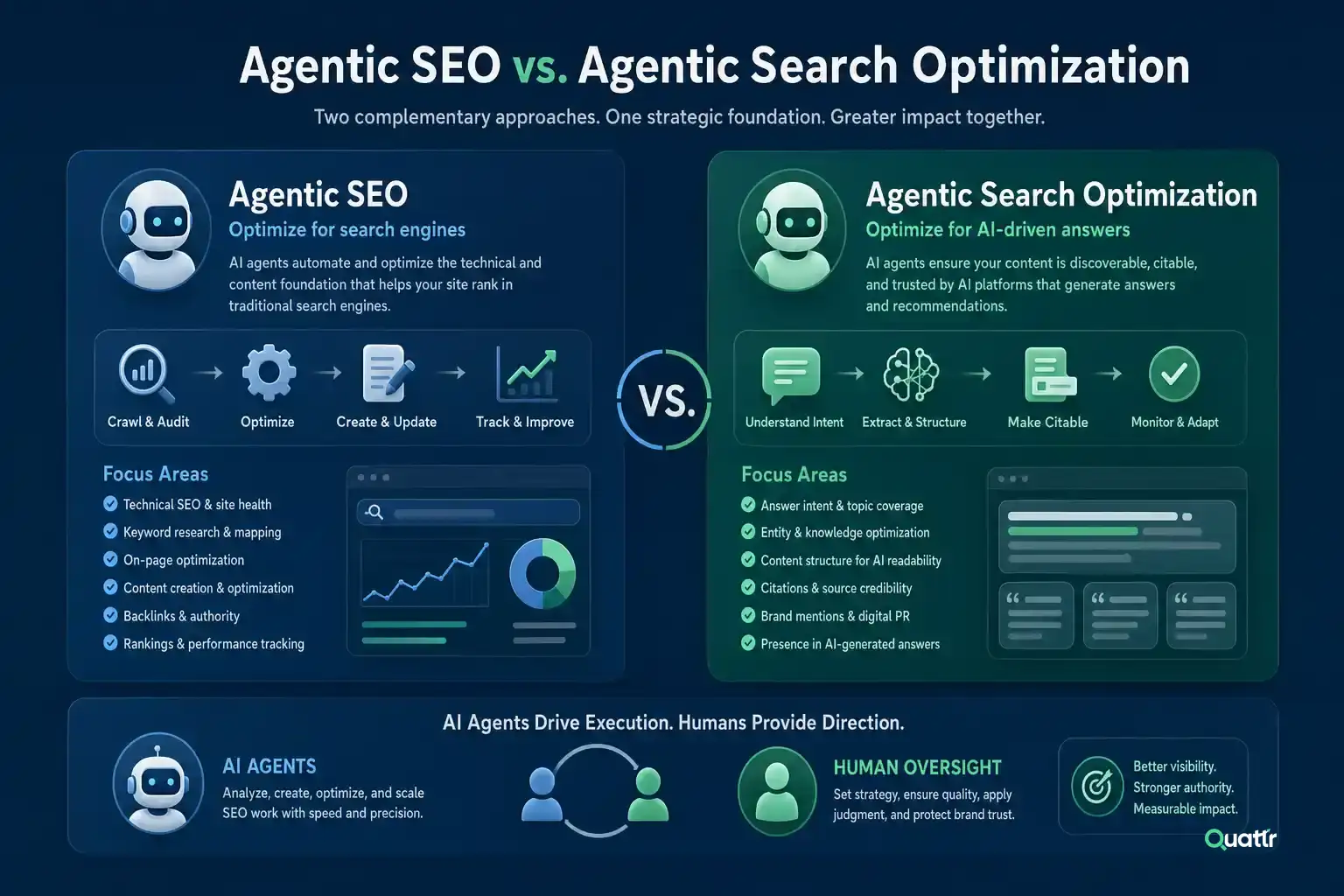
Agentic SEO and Agentic Search Optimization these two terms sound almost the same but it’s not. Let’s understand the difference.
Agentic SEO, the topic of this piece, is about AI agents working for you. The software does your SEO tasks so your team doesn’t have to do each one by hand.
Agentic search optimization is about getting found and picked by an AI agent that’s running an errand for someone else, comparing options, making a shortlist, sometimes even buying something. Here’s the difference laid out side by side:
| Agentic SEO | Agentic Search Optimization (ASO) | |
|---|---|---|
| Who’s using the AI agent | You are | Someone else is, a shopper, a buyer, a researcher |
| What the agent is doing | Running your SEO tasks, keyword research, briefs, drafting, publishing, monitoring | Comparing brands, building a shortlist, sometimes completing a purchase |
| Your role | You’re holding the tool | You’re being evaluated by system |
| The goal | Get your own optimization work done faster | Get found, trusted, and picked |
| Who benefits directly | Your team, less manual work | Your brand, if the agent decides you’re worth recommending |
In short, if you’re setting up the workflow, that’s agentic SEO and if you’re wondering whether a stranger’s AI would even mention your brand, that’s ASO.
The distinction only holds if the tool you’re using is actually agentic in the first place, and a lot of software wearing that label isn’t.
How Do You Know If a Tool is Actually Agentic
A lot of tools call themselves “AI” or “agentic” without really doing anything new. SEO work usually happens in one of three ways.
Sometimes people do all the work themselves, opening a tool, writing a brief by hand, checking everything, publishing it themselves.
Sometimes people do the work but take a little help from AI along the way, asking for keyword ideas, asking it to score a draft, asking it to fix a headline. It only moves when you ask it to, and this is where most teams actually are right now.
Then there’s the real agentic stage, where you give it a goal instead of a task, something like “grow our coverage on this topic.” It figures out the steps, performs all the steps, and only comes back to you when needed. It also checks whether the result actually worked, and tries again if it didn’t.
The real agentic AI is about a tool that checks its own work and decides what to do next, on its own. Very few teams have anything actually running at that stage yet.
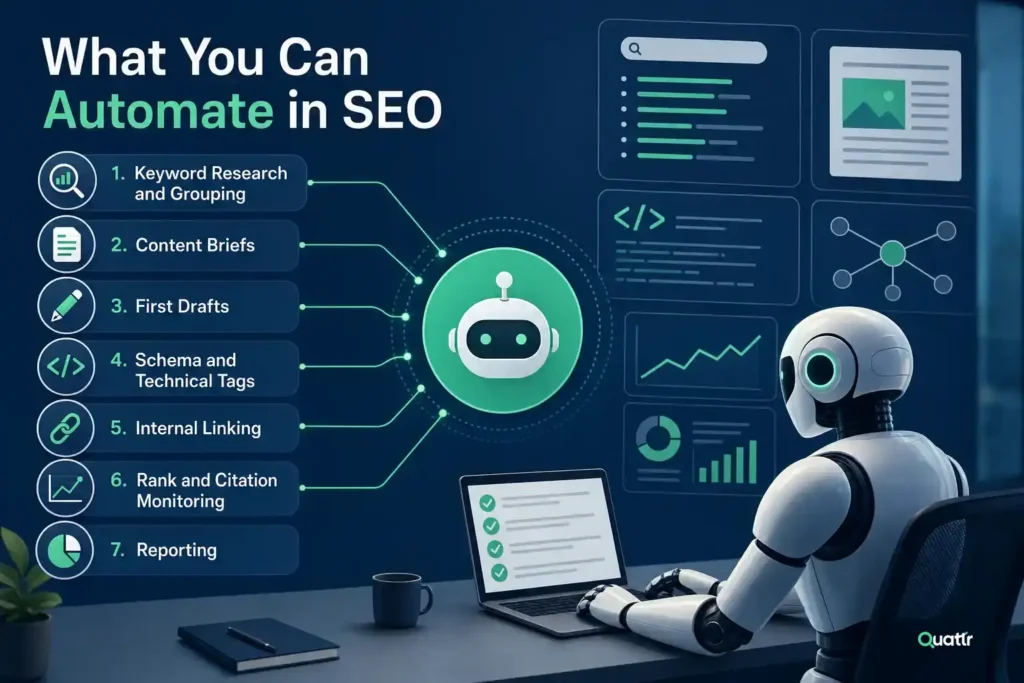
What You Can Automate in SEO
Some SEO tasks are repetitive, data-heavy, and rule-based. These type of tasks can be done well by an agent. Let’s discuss each.
1. Keyword Research and Grouping
The system pulls every term people use to find you or your competitors, and groups them by what someone’s actually looking for. So “cheap flights to Goa” and “budget Goa flight deals” land in the same bucket because they’re clearly the same search. What comes back is a shortlist, ranked by demand and difficulty.
2. Content Briefs
It reads what currently ranking for a keyword group, pulls apart what those pages actually cover, and checks that against what you’ve already published. What lands on your desk is a brief with the gaps competitors missed and which of your own pages should link into the new one.
3. First Drafts
Give it the brief, and it writes the draft too. Feed it enough of your old posts, and it starts sounding like you wrote it. Before you even see it, it checks its own work, catches what’s missing and fixes it.
4. Schema and Technical Tags
It looks at the page, figures out if it’s a product, a recipe, an FAQ, a how-to, and writes the matching structured data on its own. Then it double-checks the parts that actually matter like price, availability, are actually filled in.
5. Internal Linking
It keeps a running map of your whole site, every page, updated as you go. So the moment something new publishes, it already knows which older pages should link to it, no waiting, no manual digging. It links back the other way too, and the anchor text actually reads like part of the sentence.
That’s not theoretical, CloudEagle connected 33 priority pages this way using Quattr’s autonomous internal linking, using the actual search terms buyers typed instead of generic anchors, and saw organic clicks jump 113% in 12 weeks, with AI citation share tripling alongside it.
6. Rank and Citation Monitoring
It checks where pages stand in search and in AI answers daily or weekly, against a baseline you’ve set, and flags anything slipping past a threshold, often with a reason.
7. Reporting
It also handles reporting. All your metrics land in one dashboard, or a short note in your inbox, on whatever schedule you set.
You connect the data, the agent does the boring digging and drafting, and a person still checks it before it goes live. Now the only real decision left is who puts that pattern together for you.
Do You Build This Yourself or Plug Into Something That Already Exists
There are two ways to automate SEO tasks.
One, use a platform built just for SEO, where keyword research, briefs, drafting, linking, and monitoring already work together. You connect your accounts, and it runs on its own.
Two, wire it together yourself using tools like n8n, Zapier, or Make.com. These aren’t made for SEO specifically, they’re made for connecting anything. You can chain the steps together, but you’re the one building and keeping it running.
Which one makes sense depends on what you’ve got. If you want more control and have someone who can build it, general automation works, but it costs you. Someone has to actually build the pipeline, and keep fixing it every time something changes, an API update, a broken connector, whatever. If that’s not your situation, the purpose-built platform is the better call. Anyone on the team can use it without needing an engineering team behind it.
How to Actually Start Using Agentic SEO
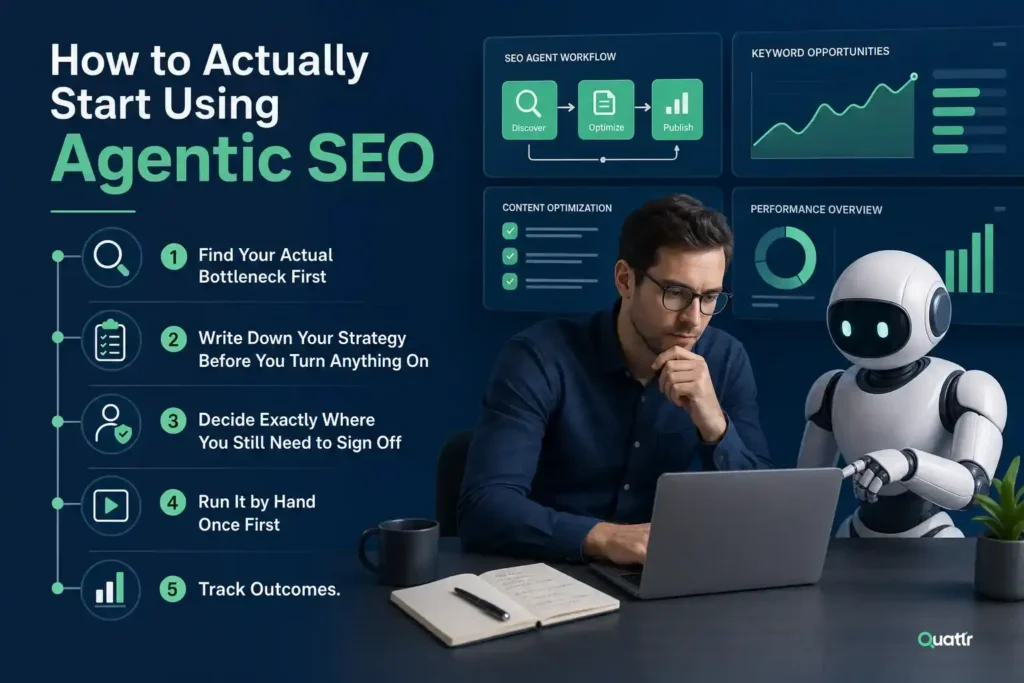
Don’t try to automate everything at once. Work through it in order.
1. Find Your Actual Bottleneck First
Look at where your team’s SEO workflow genuinely slows down. For most teams, it’s brief creation, first drafts, internal linking, or keyword research. Start the agentic layer there, not at the beginning of the process just because that’s where a tutorial tells you to start.
2. Write Down Your Strategy Before You Turn Anything On
An agent executes whatever you’ve decided is worth doing, it doesn’t decide that for you. Before running any agentic workflow, be clear on which topics matter, what your angle is against competitors, and which keywords are actually in scope. Skip this, and you’ll get a lot of content that doesn’t add up to anything.
3. Decide Exactly Where You Still Need to Sign Off
“The agent drafts, I approve before it publishes” is a reasonable starting rule. As you build trust in what it produces, you can loosen that to reviewing a batch once a week instead of checking every single piece.
4. Run It by Hand Once First
Walk through the whole sequence yourself first, using the tools you’re about to hand to an agent. It shows you exactly where a judgment call is needed and where a human checkpoint actually belongs.
5. Track Outcomes
Watch how often a first draft gets approved without major changes, how long it takes from brief to published page, and where your rankings land 30 days later compared to before. If drafts start needing heavy rewrites more often than not, the issue usually isn’t the agent, it’s the strategy or instructions you gave it.
Even with tracking in place, some problems won’t show up in a dashboard until they’ve already cost you something. That’s why it’s important to discuss about risks of Agentic SEO.
The Risks and Challenges Worth Knowing
Nothing here comes free, and it’s worth saying that plainly before anyone gets excited about the upside.
Setup is the first thing that trips people up. An agent is only as good as what you feed it, and that means clean, well-organized data, plus actual technical work wiring it into your CMS and analytics. That part alone can take longer than most teams expect.
Bad data is the real risk here. Give it wrong or missing information, and it won’t know the difference, it’ll just act on it, only faster than a person would. And even with good data, left alone, it can still slip up, write a headline that doesn’t sound like you, or add schema in a way that breaks something nobody notices for weeks. That’s the whole reason to keep a person checking its work. Not fear of the tool, just knowing it can’t judge things the way a person can, not yet.
Then there are the messier questions nobody’s fully answered. If an agent publishes something wrong, whose mistake is that? How much should you actually tell people about AI writing your content? Every team ends up figuring this out for themselves right now, because there isn’t a settled answer yet.
And none of it happens for free upfront. Training it, paying for it, changing how the team actually works day to day, that all costs time before you see anything back.
Still, worth sticking with it. Teams that put in the work to set this up properly do end up seeing it pay off, not just in smoother workflows but in results they can point to
How Quattr Helps You Measure Agentic SEO Outcome
Agents that draft, link, and publish are only half the picture. The other half is knowing if any of it worked, and that’s where agentic setups quietly fall apart. You can automate the output all day, but if nothing’s watching whether it earns a ranking or a citation, you’re just automating guesswork faster.
This is exactly what Quattr’s AI Search Visibility platform is built to answer. Quattr’s AI visibility tracker monitors how your brand shows up across LLM models from a single dashboard, mentions, citations, sentiment, share of voice, and the exact queries you’re missing from, tracked through the same GEO metrics that decide whether AI models see you as an authority.
What’s so unique about Quattr? Well, the answer is simple. Most tools pull data from APIs and show you an estimate. Quattr pulls data from the real thing, actual responses from ChatGPT, Google AI Overviews, Claude, and Perplexity, exactly as your buyers see them. And it doesn’t stop at whether you’re cited, it tracks sentiment too, so you know if AI is talking about you positively, neutrally, or negatively, then ties it all back to your GA4 and Search Console data so you can see what’s actually turning into traffic.
FAQs
No, and that’s the main thing people get wrong about it. ChatGPT answers a prompt you give it once. An agentic SEO tool is handed a goal, like growing visibility for a category, and it decides on its own what keywords to go after, what a brief should cover, where internal links should go, and what to watch afterward. Writing is just one small piece of a much longer chain it’s managing.
No, you still need one. What changes is what they spend their time on. Agentic tools take the repetitive, low-judgment work off their plate, grouping keywords, writing first-draft briefs, placing internal links, so your person can focus on strategy, brand voice, and deciding what actually matters to your buyers. The tools that work best still have a human checking things before they publish.
No, and it’s a genuinely confusing overlap. Agentic SEO is software working for you, running your optimization tasks. Agentic search optimization (ASO) is the opposite: it’s about getting found and picked by an AI agent that’s working for someone else, like a shopper asking an assistant to compare a few options. In one, you’re holding the tool. In the other, the tool is judging you.
You need to check it, at least for now. Agents can miss your tone, get a fact wrong, or chase something that doesn’t actually matter to your audience, and none of that gets caught if nobody looks before it goes live. The agentic tools worth trusting are built with a review step at each major stage, not ones that publish with nobody watching.
Look at results, not output. A tool can look productive just by publishing more pages or building more links, that’s easy to fake. What actually matters is whether your rankings, your AI citations, and your real traffic move because of it. Keep an eye on your AI visibility alongside your regular SEO numbers, that’s the only honest way to know if it’s paying off or just adding to the pile.

Quattr is an AI-native Search Visibility Platform founded in Palo Alto, California, built for mid-market and enterprise brands competing in the age of generative search. Recently recognized across G2's Spring 2026 reports with #1 rankings in AEO Results, Usability, and Relationship, Quattr helps brands win visibility across traditional search and AI-generated answer surfaces.
Quattr's AI agent, GIGA, evaluates content the way AI systems do, identifying gaps across structure, authority, internal linking, and discoverability to surface the highest-impact fixes. With capabilities like autonomous internal linking, E-E-A-T intelligence, and the new GIGA Landing Page Generator for keyword-matched, AI-search-ready pages, Quattr helps teams move from diagnosis to deployed changes without manual bottlenecks.