

Key Takeaways
- AI search retrieves and ranks passages, not whole pages or overall domain authority; ranking #1 no longer guarantees a citation.
- Content needs to answer sub-questions (query fan-out), not just the head keyword.
- Freshness, real citations, and internal linking outweigh length or polish.
- Numbered, ranked-list formats are consistently the most-cited content type across independent studies.
- Authentic community participation (Reddit, forums) now rivals owned content as a source of citations.
Here is something uncomfortable, but the truth: nine out of ten posts of the “AI search optimization” content getting published right now are the same 2019 SEO checklist with “AI Overviews” pasted on top. Add schema. Write long-form. Build backlinks. Great list, but none of that explains why a two-year-old Reddit thread with 40 upvotes outranks your 3,000-word “ultimate guide” inside ChatGPT’s answer.
I run my own GSC data, I have watched which of my posts get cited and which get ignored, and I have read most of the current research on how these systems actually retrieve and rank content.
Before I say anything,
AI search doesn’t care about your exact position on the page; it cares whether a specific chunk of your content answers a specific sub-question better than anyone else’s chunk. Optimize for that.
How I Formed These Recommendations
These recommendations aren’t based on a single study or vendor report. They combine:
- Patterns I’ve observed across my own Google Search Console data and AI citation tracking.
- Independent research from companies and researchers studying AI search, retrieval, and citation behavior.
- Testing how ChatGPT, Google AI Overviews, Perplexity, Gemini, and Claude retrieve and cite content across different query types.
- Established SEO principles that continue to hold up when validated against AI search behavior.
Where the evidence is still evolving, I’ve called out my own observations separately from findings supported by published research.
Here’s my actual opinion on what works, including a few things I think the “content strategy” crowd gets flat wrong.
What Are the Best Content Strategies for Ranking in AI Search?
The strategies that actually move the needle in AI search are: writing from existing topical authority instead of guessing, refreshing content instead of treating it as evergreen, structuring for extraction instead of long-form scrolling, participating in the industry conversation instead of only talking about your own brand, prioritizing internal linking, engaging authentically in communities like Reddit, replacing vague claims with sourced data, building topic clusters instead of scattered posts, using ranked-list formats, and answering the sub-questions AI models generate. Here’s each one, and why most “content strategy” advice gets it wrong.
| Strategy | What Most Teams Do Instead | What To Do |
|---|---|---|
| Write from existing topical authority | Guess new topics from a content calendar | Check GSC/Quattr first, double down on what you already rank for |
| Treat content as living, not evergreen | Publish once and never revisit | Refresh data, add a changelog, republish with a new date |
| Structure for extraction | Bury the answer under a long intro | Say the answer in sentence one; keep chunks self-contained |
| Join the industry conversation | Only write about your own product | React to industry news and trends, not just your own features |
| Prioritize internal linking | Spend all effort on new content | Link every new post to 2–3 older ones, and back-link old posts too |
| Engage authentically in communities | Ignore Reddit and forums entirely | Answer real questions where your buyers already discuss the problem |
| Replace vague claims with data | Write “studies show,” “many believe” | Attach a real number or named source to every claim |
| Build topic clusters | Publish scattered, unrelated posts | Go deep on fewer themes with interlinked supporting content |
| Use ranked-list formats | Default to single-flowing essays | Structure genuinely rankable topics as numbered lists |
| Answer the sub-questions | Optimize only for the head keyword | Add FAQ sections that cover the obvious follow-up questions |
1. Stop Guessing What You’re “About.” GSC Already Told You.
Most brands write blindly; they brainstorm topics in a Notion doc instead of checking what Google has already decided they’re credible on. That’s backward. I open GSC before I open a blank doc, every time, and I write more on whatever I already rank for, even loosely. In my experience, building on topics where you already have topical authority produces citations faster than starting from entirely new subject areas. Most content calendars are built by people who’ve never once looked at their own Search Console data, and it shows in how scattered their sites are.
I usually pull this straight from a Quattr MCP rather than digging through raw GSC exports, same data, less time lost to spreadsheets.
2. “Evergreen Content” Is a Myth AI Search Has Killed
I don’t buy the idea that you write something once, and it just sits there working forever, definitely not in the current AI search space. That belief is why so many “definitive guides” from 2022 are quietly dead right now, still ranking on page one of Google, invisible in every AI answer.
Kevin Indig has repeatedly argued that freshness is becoming more important in AI search because retrieval systems increasingly surface recently updated sources. My own experience refreshing aging content aligns with that observation.
I refresh data, re-verify claims, and add a visible changelog line whenever I touch a post, then republish it with a new date. If your content team isn’t scheduling refreshes the same way they schedule new posts, you’re bleeding citations to competitors who update quarterly.
I find these candidates by running a content decay check every quarter instead of guessing which posts feel stale, the pages that peaked months ago and quietly slid are rarely the ones people remember to touch.
3. Long-Form Is Often the Enemy, Not the Goal
Here’s my most controversial opinion on this list: writing longer does not make you more citable. It makes you less citable if it means burying your best insight under three paragraphs of throat-clearing. AI search retrieves a chunk, not your whole page; it grabs one self-contained passage and hands it to the user. According to the study by Kevin Indig, close to 44% AI citations come from roughly the first third of a page.
If your “hook” is a 200-word intro before you say anything useful, you’re optimizing for a human skimming pattern that doesn’t exist anymore. Say the thing in sentence one.
4. Being “On-Topic” for Your Own Brand Isn’t Enough Anymore
A lot of content strategy still treats a blog like a brochure, writing about your product, your features, and your use cases. That’s not what earns a citation. AI search reaches for whoever is actively part of the industry conversation right now, reacting to what just changed, not whoever has the most polished “About Us” adjacent content.
If your blog only ever talks about itself, you will lose every citation to a trade publication, a competitor, or a random analyst who actually commented on the news.
Here’s what Lily Ray mentioned in her article: “I believe the excessive use of self-promotional listicles will be a common pattern among websites negatively impacted by upcoming Google core updates.”
5. Internal Linking Beats Almost Every Other Tactic on This List, and Nobody Treats It That Way
I’ll die on this hill: most teams spend ten times more effort on new content than on linking their old content together, and it’s the wrong ratio. A page with no internal links pointing to it often doesn’t get reliably crawled; it doesn’t matter how good the writing is if the crawler barely finds it. I link every new post back to 2–3 older posts and add forward links from the old posts, too.
A legal intelligence platform 12% increase in clicks within a week of deploying Quattr’s autonomous internal linking.
If you’ve got an existing “AI Search Best Practices” post sitting on your site, unlinked from anywhere new, that’s not a minor oversight; it’s a pillar page you’re actively starving.
6. Vague Claims Are Now a Credibility Liability, Not Just Weak Writing
“Studies show,” “many experts agree,” “it’s widely known that”, I have zero patience for this kind of writing anymore, and I don’t think you should either. AI systems are increasingly evaluating content on E-E-A-T-style signals: real authorship, original data, verifiable numbers. A vague claim isn’t just bad writing now; it’s a page an AI system has no reason to trust enough to cite. If you can’t attach a number or a name to a claim, cut the sentence.
7. Why We Stopped Ignoring Reddit (and You Probably Should Too)
I used to write off Reddit and forums as low-value, low-effort content. I was wrong, and I think most brand marketers are still wrong about this. Several independent citation studies have found Reddit to be one of the most frequently cited domains across major AI assistants, particularly for experience-based questions. Brands that only publish on their own domain and never show up in the actual discussion are opting out of a huge share of AI-driven discovery, in principle, for no good reason. See the image below, which was taken right after Google’s March core update.
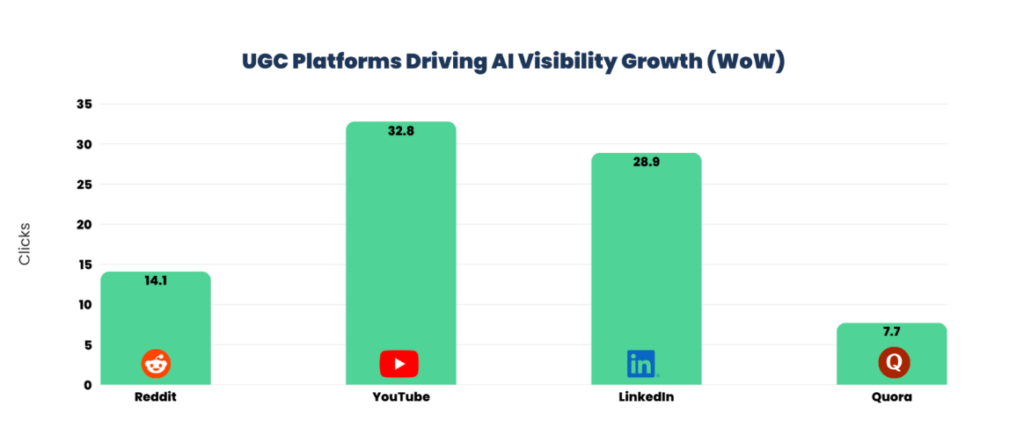
Think about it, there is almost certainly an active thread right now where real people are asking the exact question your product answers. That’s not a distribution channel, it’s a direct line to the people you’re trying to reach, and it’s sitting there ignored while your team schedules another LinkedIn post nobody asked for. Somebody in a niche subreddit is comparing options, hitting the exact problem you solve, and getting an answer from a stranger instead of from you. AI models increasingly prefer strangers’ answers over your marketing copy anyway, because they read as unfiltered in a way self-interested content never does.
I want to be precise about what “showing up” means here, because this is where brands torch their own credibility. It doesn’t mean seeding your product into threads or running an agency that drops your name in fifty comments a month; Reddit’s own detection and rising FTC scrutiny catch that fast, and it poisons the account long before it helps you. It means a real person with actual category knowledge, ideally someone from your team, disclosed as such, spending time in the two or three subreddits where your buyers already hang out, answering the specific question being asked, and only mentioning the product when it’s genuinely the answer, not the lead. Read the room for weeks before you say anything.
I keep an eye on this with a citation attribution report; it’s the only way I’ve found to see which of my own pages are actually getting picked up in AI answers versus which third-party sources are winning those same prompts instead.
8. Publishing More Often Is Not the Same as Building Authority
The “publish 4 blogs a week” advice needs to die. Scattered, unrelated posts don’t build topical authority; clusters do. AI systems reward consistent depth on a single theme, so ten interlinked posts on one topic will outperform forty posts on forty different topics, every time. If your content calendar looks like a grab bag of unrelated keywords, you’re not building a library; you’re building noise. Pick fewer topics and go deeper.
9. Ranked Lists Aren’t a Content Format Choice. They’re a Structural Advantage.
I used to think “Top 10” listicles were a lazy, overused format(also check Lily Ray’s take on self-promotional listicles above, point 4). The data changed my mind: ranked, numbered listicles account for the majority of all citations pulled by major LLMs, and most of those are genuine Top-N formats, not loose roundups. Every numbered item is a clean, self-contained answer that an AI system can lift without needing the rest of the page for context.
If you’re still writing single, flowing essays on topics that could honestly be structured as a ranked list, you’re making your own content harder to retrieve for no stylistic reason that actually matters to the reader.
10. Winning Your Main Keyword and Losing the Real Traffic Are Now the Same Thing
AI models silently break your headline query into smaller sub-questions before generating an answer, called query fan-out, and you can rank #1 for the parent query while a competitor’s FAQ section quietly wins every sub-question underneath it. Chasing your primary keyword while ignoring the obvious follow-up questions is optimizing for a scoreboard nobody’s looking at anymore.
Where All This Land
Most “AI search strategy” content is repackaged 2019 SEO with new vocabulary bolted on. The brands actually winning citations aren’t doing more; they’re doing fewer things, more deliberately: owning fewer topics deeply, refreshing instead of hoarding, structuring for extraction instead of for scrolling, and showing up in the conversation instead of just broadcasting at it. If your content strategy doesn’t force you to cut something, it’s not a strategy; it’s a wishlist.
If you want to see where your own content stands against everything above, what’s actually getting cited, what’s decaying, and where you’re losing sub-questions to competitors, see how Quattr shows you exactly where you stand.
FAQs on AI Search Content Strategy
Less than it used to. AI search retrieves the passage that best answers a specific sub-question, not necessarily the page that ranks highest overall. A page ranking third can still win the citation if its answer to the exact sub-question is clearer and better-sourced.
Every three to six months for anything you want AI systems to keep citing, and sooner for anything with numbers or stats that age quickly. Freshness is a recency signal that AI models weigh directly, especially ChatGPT.
Yes, indirectly but significantly. Pages with few or no internal links pointing to them are less likely to get crawled reliably in the first place, and if a crawler doesn’t reliably reach a page, it can’t be retrieved for any query.
Yes, a citation attribution report will show you which of your pages are getting picked up in AI answers, and which competitor or third-party sources are winning the same prompts instead of you.
It’s when an AI system silently splits your one search query into several smaller related questions before it retrieves any content, then answers each sub-question separately. That’s why FAQ sections and sub-headings targeting obvious follow-up questions outperform pages that only address the main keyword.

Quattr is an AI-native Search Visibility Platform founded in Palo Alto, California, built for mid-market and enterprise brands competing in the age of generative search. Recently recognized across G2's Spring 2026 reports with #1 rankings in AEO Results, Usability, and Relationship, Quattr helps brands win visibility across traditional search and AI-generated answer surfaces.
Quattr's AI agent, GIGA, evaluates content the way AI systems do, identifying gaps across structure, authority, internal linking, and discoverability to surface the highest-impact fixes. With capabilities like autonomous internal linking, E-E-A-T intelligence, and the new GIGA Landing Page Generator for keyword-matched, AI-search-ready pages, Quattr helps teams move from diagnosis to deployed changes without manual bottlenecks.