

Key Takeaways
- Prompt chaining breaks one big AI task into smaller prompts run in sequence, where each output feeds the next, instead of asking for a finished result in one shot.
- The one rule that matters: never let a single prompt carry more than one kind of thinking, like exploring ideas, judging them, and producing a final result.
- Marketers can apply chaining to research-backed content, long-form writing, campaign development, and checking whether AI search engines actually cite the brand.
- Chaining only improves your inputs. It can’t tell you if your brand is actually getting cited in AI answers, that requires dedicated AI visibility tracking.
Think about how a good research analyst actually works. You don’t hand them a vague brief and expect a finished report back in one pass. They gather data first. Then they identify patterns. Then they draft findings. Then they revise based on what the earlier steps turned up.
Most marketers don’t give AI models the same courtesy. They write one dense prompt, ask for a finished blog post, campaign brief, or competitor analysis in a single shot, and then wonder why the output feels shallow or generic.
The better approach borrows directly from how that analyst works. Break the task into steps. Let each step’s output feed the next one. This is prompt chaining, and it’s quietly become one of the most useful skills a marketing team can build.
It matters for another reason too. AI search engines like ChatGPT, Perplexity, and Google AI Overviews use this same process internally to answer questions about your category. Understanding how chaining works isn’t just about writing better prompts. It’s about understanding how these systems decide what to cite, and how your brand can earn a place in that answer.
What is Prompt Chaining?
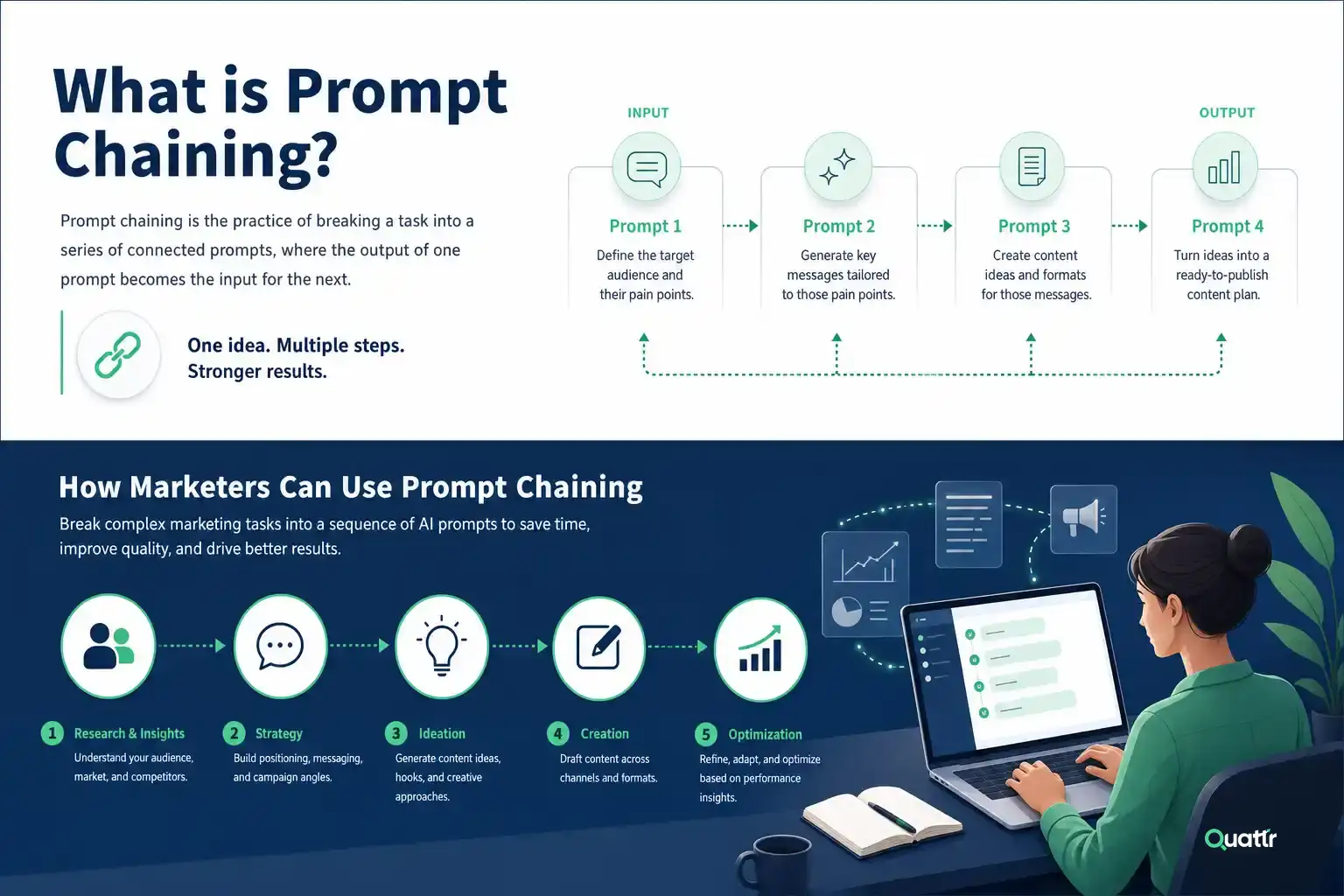
Take one big task and break it into smaller prompts. Run them one at a time, not all at once. Each prompt does one job. Each new prompt picks up whatever the last one gave you and builds on it.
So the output of Prompt 1 becomes part of the input for Prompt 2. The output of Prompt 2 becomes part of the input for Prompt 3. And so on, until the final prompt produces your finished result.
Instead of asking an LLM to research, outline, write, and polish a piece of content in a single instruction, you guide it through the task one deliberate step at a time.
A simple chain might look like this:
- Prompt 1: “List the 10 biggest questions our target customer has about AI Visibility“
- Prompt 2: “Group these 10 questions into 4 logical themes for a content outline.”
- Prompt 3: “Expand theme 1 into a 300-word section with a concrete example.”
- Prompt 4: “Rewrite this section in our brand voice of Quattr.”
Each step builds on the last. The model isn’t juggling research, structure, tone, and length all at once. It’s solving one well-defined problem per call. That tends to produce sharper, more accurate, more usable output.
The tradeoff is speed. Each link in the chain is a separate model call. A five-step chain takes roughly five times longer than one prompt. For most marketing work, that latency is a fair trade for quality and control.
What Prompt Chaining Doesn’t Mean
It’s easy to confuse chaining with a few things it isn’t.
First, it’s not one giant prompt with five instructions stuffed inside it. If you type “research this, then outline it, then write it, then check the tone” all in one message, that’s not a chain. It’s still just one job. The model still has to do everything at the same time, which is the exact problem chaining is supposed to fix.
Second, it’s not the same as casually chatting back and forth. Going back and forth with a model, tweaking as you go, is genuinely useful. But it’s loose. It’s hard to repeat the same way twice. A real chain is planned out ahead of time. Every step has a clear goal and a clear output before you move to the next one.
Third, it’s not about adding steps just to add steps. Chaining doesn’t mean routing a prompt through as many stages as possible. If a step doesn’t bring a different kind of thinking to the table, it’s not helping. It’s just slowing things down.
And finally, it doesn’t take the human out of the loop. A good chain still needs a person deciding what to keep, what to cut, and where to redirect at each step. The model does the heavy lifting. You still make the calls.
The One Rule Every Good Chain Follows
A good chain really comes down to one important rule: never let a single prompt carry more than one kind of thinking. If you’re asking the model to explore ideas, judge them, and produce a final result all at once, stop and break it apart.
So what counts as a different kind of thinking?
- Checking it for weak spots
- Coming up with options
- Ranking or picking between them
- Pulling scattered ideas into one clear thread
- Producing the finished thing
Keep them separate, and the chain works the way it’s supposed to. Here’s what a real chain might look like for a marketing team.
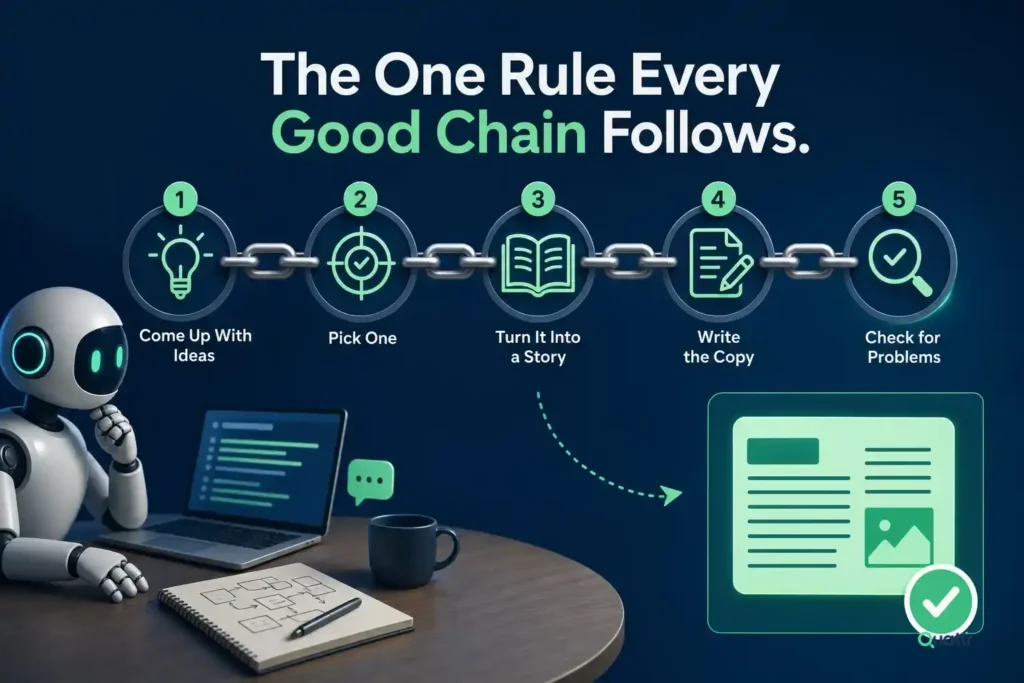
Step 1: Come Up With Ideas
First, just get some options. Ask something like, “Act as a senior marketing strategist. Propose 5 distinct campaign angles for launching a new productivity tool.” Now you have a few directions to look at.
Step 2: Pick One
Next, choose the best option. You can tell, “Compare these angles. Identify strengths, risks, and which is best suited for mid-market buyers.” Now you have a winner, and you know why it won.
Step 3: Turn It Into a Story
An angle is just one line you need a story. For that, you can use something like, “Refine angle #3 into a clear campaign narrative. Focus on core tension and resolution.” Now you have a story.
Step 4: Write the Copy
Now write the actual words. Ask AI tools to build up a story like, “Using the refined narrative, draft homepage headlines and subhead copy. Follow brand constraints.” Now you have copy someone can review.
Step 5: Check for Problems
Last, look for what could go wrong. Ask, “Act as a skeptical buyer. What objections or confusion might this messaging create?” Now you know what to fix before it ships.
Each step does one thing. That’s the whole idea behind a good chain.
Prompt Chaining Techniques
Not every chain looks the same. Here are a few simple patterns that cover most of what marketers need.
Sequential chaining: This is the most common one. In sequential chaining, each prompt runs one after the other, in a straight line, come up with ideas, pick one, turn it into a story, write the copy, check for problems.
Branching chaining: Instead of picking one option early, you carry a few forward at the same time. Say you have three campaign angles worth exploring. You’d turn all three into stories, then compare the results before deciding which one to actually write up.
Iterative refinement chaining: This one loops back on itself instead of moving forward. A draft gets critiqued, then revised, then critiqued again, and so on, until it’s good enough. It’s useful when the first version is never going to be the final one.
Role-switching chaining: Each prompt asks the model to think like a different person. One step it’s a strategist, the next step it’s a skeptical customer, the next it’s an editor. Switching roles between steps helps catch things a single point of view would miss.
Conditional chaining: In conditional chaining, the next step depends on what the last one produced. If a draft passes review, it moves to publishing. If it doesn’t, it loops back for another revision instead. This keeps weak outputs from moving forward just because the chain says so.
Most marketing chains end up mixing a few of these together.
How Marketers Can Use Prompt Chaining
Here’s how marketers can use prompt chaining in the work.
1. Research Before You Write
Say you need a blog brief. Instead of typing “write me a blog post about X” and hoping for the best, break it up. First, ask what your customers’ biggest pain points are around the topic. Then ask what competitors are missing. Then turn all of that into an outline. By the time you get to the outline, it’s built on real groundwork.
2. Writing Long Content Without It Falling Apart
Ask for a whole article at once, and the quality usually drops halfway through. So break it up instead. First, get the outline. Then write one section at a time. Then check the tone. Then clean up the structure, headers, and formatting so it’s easy to scan.
3. Building a Campaign From the Ground Up
A simple campaign chain could go like this: summarize the market, check what competitors are doing, decide on a value proposition, then write messaging for each channel. Each step builds on the last one, so your positioning doesn’t come from nowhere. It comes from the research you just did.
4. Turning One Idea Into a Dozen Assets
Once you’ve nailed down a core message, don’t rewrite it from scratch for every channel. Chain it. Feed that same message into a prompt for a LinkedIn post, then one for email subject lines, then ad copy, then a video script. Because each one is built off the same source, everything stays on message without extra effort.
5. Checking Whether AI Search Actually Mentions You
This is where chaining ties directly into answer engine optimization (AEO) and generative engine optimization (GEO). First, generate the real questions people actually type into ChatGPT or Perplexity about your category. Then check how those tools answer. Then see where your brand shows up and where it doesn’t.
6. Cleaning Up How Your Pages Link to Each Other
Here’s one people don’t think about: chaining can help map your own site. Ask for a list of every page related to a topic. Then ask which of those pages should link to each other. Then ask for the anchor text for each link.
Good internal linking makes it easier for both search crawlers and AI engines to tell which of your pages are the real authority on a topic. It’s a big part of how Quattr approaches internal linking, giving a site’s topic structure enough clarity that both regular search and AI answer engines can find their way around it.
7. Catching Problems Before They Go Out the Door
Always give a chain one last job: check the output against your style guide and flag anything off-brand or unverified. That one extra check, on its own, catches things a single big prompt almost always lets slip through.
Why Prompt Chaining Works Better in 2026
Prompt chaining aligns with how AI systems actually behave. Models respond better to narrow objectives. Constraints compound more effectively across steps. Outputs become easier to evaluate when each one has a single, clear job.
It also aligns with team workflows. Strategists review early steps. Writers work later in the chain. Reviewers assess risks at the end. This makes AI easier to integrate, not harder, because it slots into roles teams already have instead of replacing the whole process at once.
In 2026, chains often span more than a single tool or a single sitting. They span different people, different AI models, and different moments in time. Research might happen in one tool, synthesis in another, and copy generation somewhere else entirely.
Chaining makes this possible because outputs are explicitly staged, not buried in chat history. Anyone picking up the chain at step three can see exactly what came out of steps one and two, without having to scroll back through an entire conversation to reconstruct it.
Where Most Teams Go Wrong With Chaining
Even advanced teams struggle when they chain without locking decisions between steps. They reuse exploratory outputs as final copy instead of treating early steps as raw material. They let later prompts contradict earlier ones because nobody checked consistency along the way. Or they skip evaluation steps entirely to save time, which quietly reintroduces the same quality problems a single mega-prompt has.
Prompt chaining only works when decisions are made between steps, not deferred to the end.
How to Document a Prompt Chain
High-performing teams treat chains like workflows, not one-off prompts. They document the purpose of each step, the expected output, who reviews it, and what gets passed forward to the next step.
This turns prompt chains into reusable systems instead of tribal knowledge that lives in one person’s prompt history.
When Not to Use Prompt Chaining
Not every task needs a chain. Single prompts still work fine for small rewrites, formatting tasks, summarization, and minor variations on existing copy.
Prompt chaining is most valuable when the stakes are high, strategy matters, and consistency is critical, not for quick, low-risk requests where a single well-written prompt already gets the job done.
Knowing when to chain is a process call. It still doesn’t tell you what happened after you hit publish, and that’s the part most teams never actually solve.
The Piece Chaining Alone Can’t Do
You don’t need special tooling to try prompt chaining. It works in the regular ChatGPT or Claude interface by manually copying output from one prompt into the next.
As chains get longer or need to run repeatedly, like a weekly AI visibility prompt audit, it’s worth automating them with a workflow tool built for it.
But chaining better prompts is only half the job. If you never check whether your brand actually shows up when a buyer asks ChatGPT, Perplexity, or Google AI Overviews about your category, you’re refining a process with no way to know if it’s working. Most teams find out where they stand by accident, someone spots a competitor’s name in an AI answer and flags it in Slack.
There’s no point chaining sharper prompts and better content if you can’t track whether any of it moved the needle on actual AI visibility. That’s not something chaining can fix. It’s a measurement problem.
This is where Quattr’s AI visibility tracking comes in. It shows you which prompts your brand wins across ChatGPT, Perplexity, Gemini, and Google AI Overviews, which ones a competitor owns instead, and whether your last content change actually moved your citation rate or did nothing at all. Chaining gets you better inputs. Quattr tells you if they worked.
FAQs
Breaking one AI task into a sequence of smaller prompts, where each prompt’s output feeds directly into the next.
No. Chain of thought asks one model to reason step by step inside a single prompt, while chaining runs separate prompts you can check between steps.
Usually 3 to 5, one for each distinct kind of thinking the task needs. More than that just slows things down without adding value.
Yes. Each step is a separate model call, so a five-step chain takes roughly five times as long as one prompt.
Yes. Once a chain works reliably by hand, it’s worth wiring up in a workflow tool so it runs on its own.

Quattr is an AI-native Search Visibility Platform founded in Palo Alto, California, built for mid-market and enterprise brands competing in the age of generative search. Recently recognized across G2's Spring 2026 reports with #1 rankings in AEO Results, Usability, and Relationship, Quattr helps brands win visibility across traditional search and AI-generated answer surfaces.
Quattr's AI agent, GIGA, evaluates content the way AI systems do, identifying gaps across structure, authority, internal linking, and discoverability to surface the highest-impact fixes. With capabilities like autonomous internal linking, E-E-A-T intelligence, and the new GIGA Landing Page Generator for keyword-matched, AI-search-ready pages, Quattr helps teams move from diagnosis to deployed changes without manual bottlenecks.