Key Takeaways
- AEO builds trust with AI models slowly, it doesn’t produce fast, visible movement like a ranking change.
- Weeks 1-4 show no visible change since the work is all on-site. Weeks 4-12 bring citations that flicker on and off, which is normal churn.
- Content freshness matters here. Most of AI-cited pages for competitive queries were updated in the past year, and stale content is about 3x more likely to lose citations it already earned.
- It’s fair to reconsider only after 6+ months, with fresh content and real off-site effort, if there’s still no movement.
A few months back, a marketing lead at a mid-sized SaaS company killed her AEO budget. Because three months in, the dashboard looked almost exactly like it did on day one. A handful of scattered mentions in ChatGPT, nothing consistent, no real movement.
“We gave it a real shot,” she told me. “It just didn’t work.”
Two months later, I checked back in. Her closest competitor, who’d started around the same time and kept going, was now showing up regularly in AI answers for the exact terms she’d given up on.
Not a coincidence. Not bad luck. Just how AEO actually behaves, and almost nobody explains that clearly before people start.
Answer Engine Optimization (AEO) is the practice of structuring and strengthening content and brand signals so AI systems like ChatGPT, Perplexity, Google AI Overviews, and Claude cite or reference your brand directly in their answers, rather than just ranking a page in a list of blue links.
What’s the Difference Between AEO and SEO
That definition is also where AEO splits from SEO. Search engine optimization is for a page to rank in a list of results, competing for clicks against ten other blue links. Answer engine optimization is the practice of strengthening your content and brand signals so a model cites you directly inside a single generated answer, where there’s often only room for a handful of sources, not ten.
The inputs overlap, both care about clear, authoritative content, but the success metric doesn’t. SEO’s success metric is ranking position and traffic. AEO’s is whether a model trusts you enough to quote you at all, which depends less on your own page and more on what other sites, forums, and reviews say about you across the web.
Why Doesn’t AEO Work Like a Light Switch
AEO doesn’t work like a switch. You don’t flip it on and watch a number move.
Most people come into it expecting the opposite. Make a change, see movement within a few weeks. AEO isn’t built that way, and it can’t be, because you’re not trying to rank a page. You’re trying to convince a language model that your brand is worth quoting, the core idea behind generative engine optimization.
That kind of trust doesn’t come from a schema tag or a rewritten headline. It builds slowly, from things like:
How often other sites mention your brand
Whether your content stays accurate and current
Whether the model has seen you cited enough times to treat you as reliable, not a coin flip, which comes down to E-E-A-T signals more than any single page tweak
That process starts slow. It stays slow for a while. Then, if the underlying work is real, it picks up speed.
The problem is almost everyone quits during the slow part, because the slow part looks exactly like failure
What Do the First Few Months of AEO Actually Look Like

Here’s roughly how it plays out, stage by stage.
Weeks 1-4: The Fixes Go Live, Nothing Visible Happens
Most of the early work sits on your own site, like structure, clearer answers, maybe schema markup. From the outside, nothing changes. This is usually where doubt creeps in.
Weeks 4-12: Small, Unstable Signs of Life
A citation shows up in Perplexity one week, then vanishes the next. Easy to read that as the strategy failing. It’s actually normal churn. AI Overview citations change about 1.3x faster than a typical Google top-10 ranking, so early wins often look like they disappeared simply because the system hasn’t settled yet.
Months 3-6: Things Start to Firm Up
If outside signals were being built alongside the on-site work, citations that used to flicker start sticking around. This is usually the first point where a team feels like something real is happening.
Month 6+: Growth Compounds Instead of Crawling
Brands that started early end up with roughly 3.4x more AI visibility than brands that started late. Once trust gets built with these models, it tends to keep paying off.
Almost every team that quits does it somewhere before month three. And almost every team that eventually sees results is one that pushed through that exact stretch instead of walking away from it.
How Do I Know If AEO is Working
You know AEO is working when your brand shows up as an actual cited source in AI-generated answers, featured snippets, and Google AI Overviews, not just mentioned in passing. Success looks like a rising citation rate across ChatGPT, Perplexity, and Gemini, paired with more direct brand mentions and more people searching your brand name on Google afterward.
This is different from how SEO gets measured. SEO tracks fixed keyword rankings and click-through traffic. AEO tracks something less fixed: how often a probabilistic AI model chooses to name you at all.
A few signs to watch for:
Higher citation rates: A growing share of your core industry questions result in an AI tool linking straight to your domain as a source.
More branded search: People start typing your company name into Google after an AI assistant recommends you, instead of finding you cold.
Positive AI sentiment: When AI platforms mention your brand, the descriptions and comparisons are accurate and put you in a good light, not neutral or wrong.
Steady presence in “People Also Ask” and snippets: These traditional search features often feed directly into how AI models reason through an answer, so holding ground here tends to show up in AI answers too.
If none of these are moving after months of steady work, that’s a real sign to rethink your approach. But if you simply can’t tell either way, that’s not AEO failing. That just means you’re not tracking it properly.
Why Does AEO Feel Broken Even When It Isn’t
A few things make the early phase feel more discouraging than it should.
1. You’re Probably Optimizing the Smaller Half of the Problem
Your own website likely accounts for only 5-10% of what AI models reference when forming an opinion about your brand. The other 90% is what everyone else says about you, across forums, review sites, press, and YouTube, the entity signals that tell a model who you actually are. If your team only touched your own pages, and hasn’t gone back to optimize the content itself for AI search, you’ve barely moved the part that actually decides whether you get cited.
2. The Churn Itself is Misleading
AI answers aren’t static. A model can drop a citation not because your content got worse, but because it re-ran retrieval and pulled a slightly different source that day. Watching that happen without knowing why is what makes people think the whole thing collapsed, when it just wobbled.
What Separates Teams That Stick With AEO From Teams That Quit
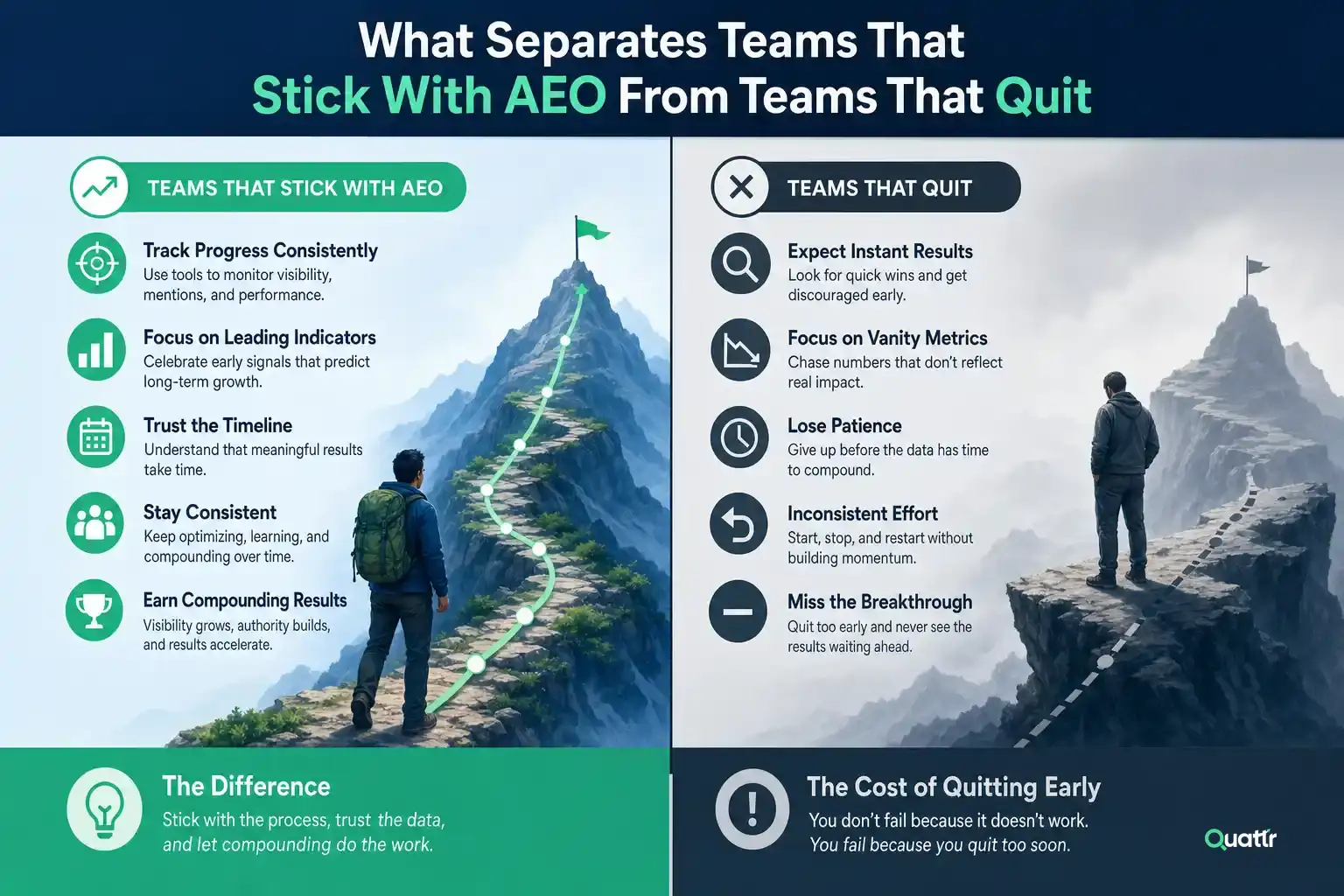
The difference usually isn’t patience. It’s what teams kept doing during the quiet months.
Teams that quit early tend to:
- Treat AEO as a one-time project
- Fix the site once, then wait
- See nothing after 6-8 weeks, and pull the budget
Teams that see it through tend to:
- Keep the on-site fixes running
- Actively work on getting mentioned elsewhere
- Keep content current instead of letting it sit
That last point matters more than people expect. For competitive, high-intent queries, 83% of pages AI models cited had been updated within the past year, and over 60% had been touched in just the last six months. Content left untouched for a full quarter is about 3x more likely to lose the citations it already earned.
AEO isn’t something you finish. It’s something you maintain, closer to fitness than to a home renovation, which is why using the right AEO tools to keep watch matters as much as the initial work.
| Quit Early (under 3 months) | Stick With It (6+ months) | |
|---|---|---|
| On-site fixes | Done once, then abandoned | Done, then kept up |
| Earned mentions / PR | Rarely built | Actively built over time |
| Content freshness | Goes stale | Refreshed regularly |
| Citation pattern | Flat, sporadic, then gone | Unstable at first, then stabilizes |
| AI visibility trend | Flat or declining | Compounds upward |
Tracking that trend properly usually means using one of the dedicated AI visibility tools built for this, rather than eyeballing a dashboard once a month.
When is Quitting AEO Actually the Right Call
Not every stall means keep going forever. There’s a real difference between “still building” and “genuinely not working.”
Probably too early to quit if:
- You’re inside the first 3 months
- Most effort went into your own site, not earned mentions elsewhere
- Content hasn’t been refreshed recently
- Citations are popping up and disappearing
Fair to reconsider if:
- You’re 6+ months in with no movement
- Content is genuinely fresh and well-structured
- You’ve made real efforts to get mentioned elsewhere, and there’s still nothing to show
- You have no real way of knowing what’s actually happening
That last one is more common than people admit. A lot of teams don’t quit because AEO failed. They quit because they were guessing the whole time and eventually ran out of patience for guessing.
Why Isn’t Just Waiting It Out the Real Fix
Sitting quietly for six months hoping something changes is how a lot of good AEO efforts die anyway, even the ones that would’ve worked.
The difference for teams that make it through isn’t blind faith. It’s that they can actually tell which stage they’re in. Weeks 1–4 flat and quiet, weeks 4-12 unstable but alive, month six genuinely stalled, these all look the same from a gut-feel dashboard check. They don’t look the same when you can actually see the data behind them.
That’s the real problem with waiting it out blind: you can’t tell “still early” from “actually stalled” without something watching the timeline for you.
How Does Quattr Help Teams Win Visibility in AI Search
Remember the marketing lead from earlier, the one who killed her AEO budget three months in because the dashboard looked flat? She didn’t quit because AEO had actually failed. She quit because nobody on her team could answer “where do we actually stand right now” with anything more solid than a gut feeling. Her competitor kept going with the same uncertainty, just longer.
Quattr exists so that call doesn’t have to come down to who has more nerve.
Quattr’s AI Search Visibility platform tracks how your brand actually shows up across ChatGPT, Perplexity, Claude, and Google AI Overviews, pulled from real responses instead of an API estimate, the same way your buyers would actually see them. It follows mentions and citations over time, so the churn you’d expect in that weeks 4–12 window shows up on a chart as churn, not as silence in a spreadsheet that looks like failure.
Alongside that, it tracks sentiment, so you know whether AI models are talking about you well, staying neutral, or quietly steering people toward someone else. It also maps share of voice against competitors and flags the exact queries where you’re still invisible, tracked through the same GEO metrics that decide whether AI models treat you as an authority in the first place, so the next round of content or outreach has somewhere specific to aim.
The part that matters most for a stalled-feeling month three or four is that none of this sits in isolation.
Quattr ties the citation and mention data back to your actual GA4 and Search Console numbers, so instead of arguing over whether a flat quarter means the strategy failed, you can check whether it’s starting to translate into traffic yet, and make the call from there instead of walking away on a hunch.
FAQs
Usually three to six months. Weeks 1-4 are invisible on-site work. Weeks 4-12 bring flickering citations. Real, compounding visibility shows up after month three.
Models re-run retrieval and can pull a different source each time. AI Overview citations change about 1.3x faster than a typical Google ranking, so this is normal churn, not failure.
Yes. Early work is structural and happens on your own site, so nothing shows up externally yet.
Your site is only 5-10% of what AI models reference. The other 90% is forums, reviews, press, and YouTube.
Around 6+ months in, with fresh content, real off-site effort, and still no movement.
Track citation frequency, sentiment, and share of voice across AI platforms over time, not a single dashboard check. If citations are stabilizing and traffic from AI answers is climbing, it’s working.
Any place outside your own site that references your brand, like forums, review sites, press coverage, YouTube, or third-party articles, that AI models can pull from to judge credibility.
At least every quarter for high-intent pages. Most AI-cited pages were updated within the last six to twelve months, and untouched content loses citations faster.

Quattr is an AI-native Search Visibility Platform founded in Palo Alto, California, built for mid-market and enterprise brands competing in the age of generative search. Recently recognized across G2's Spring 2026 reports with #1 rankings in AEO Results, Usability, and Relationship, Quattr helps brands win visibility across traditional search and AI-generated answer surfaces.
Quattr's AI agent, GIGA, evaluates content the way AI systems do, identifying gaps across structure, authority, internal linking, and discoverability to surface the highest-impact fixes. With capabilities like autonomous internal linking, E-E-A-T intelligence, and the new GIGA Landing Page Generator for keyword-matched, AI-search-ready pages, Quattr helps teams move from diagnosis to deployed changes without manual bottlenecks.