Key Takeaways
- AI models don’t update themselves the moment your brand changes. Outdated facts can sit in circulation for months after you’ve already corrected them.
- The first sign of a problem is almost never a dashboard. It’s a customer repeating something wrong back to you.
- Roughly 90% of what shapes an AI’s opinion of your brand lives outside your own website, on review sites, forums, and old press coverage, not on your homepage.
- A comparison of 29 large language models found hallucination rates ranging from 15% to 52%, even in top systems like GPT-5, Gemini, and Claude.
- Real corrections (schema, fixed sources, fresh mentions) typically take weeks to months to show up in AI answers. It’s only fair to call it a lost cause after 3-6 months of real, active correction with nothing changing.
A few months back, a customer walked into a small skincare store and asked the owner why she’d discontinued her bestselling moisturizer. The owner had no idea what he was talking about. It was sitting right there on the shelf, restocked that same week.
Turns out the customer had asked ChatGPT what the brand still sold before visiting. ChatGPT confidently said the moisturizer had been discontinued, pulling that idea from an old blog post the brand had since rewritten twice.
The owner went home and updated her website that same night. Three weeks later, she asked ChatGPT the same question. It gave her the exact same wrong answer.
That’s not a glitch. That’s just how these systems behave by default, and almost nobody explains that before a brand runs headfirst into it.
What’s the Difference Between an AI Hallucination and Outdated Information
When people say “AI has outdated facts about my brand,” they’re usually describing one of two different problems, and the fix for each is slightly different.
AI hallucinations are when a model confidently states something that was never true, the wrong founder, a fabricated feature, an address that doesn’t exist. It’s not repeating old data. It’s filling a gap with a plausible-sounding guess.
Outdated information is when the model is technically repeating something that used to be true. Your old pricing, a product you retired, a former executive, and it just hasn’t caught up with where you are now.
Both land the same way for the person reading the answer: they walk away with the wrong idea about your brand, from a source that sounds completely sure of itself.
Why Doesn’t AI Update Itself the Moment Your Brand Changes
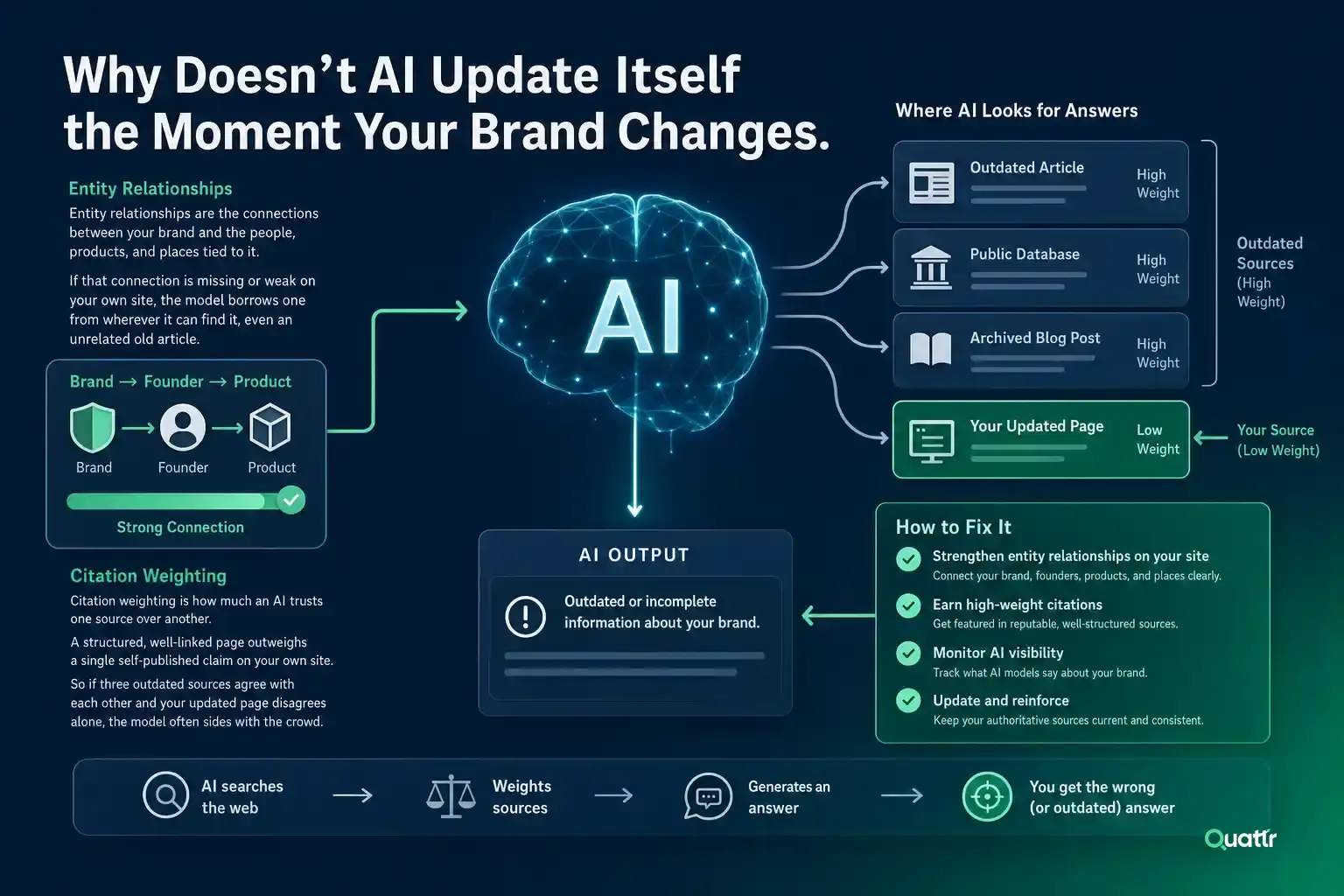
Because AI models don’t “know” your brand. They approximate it, built from patterns across whatever they were trained on, plus, for some tools, whatever they can pull from the live web at the moment someone asks.
Two mechanics decide what an AI ends up saying about you.
Entity relationships are the connections between your brand and the people, products, and places tied to it, “Brand → Founder → Product.” If that connection is missing or weak on your own site, the model borrows one from wherever it can find it, even an unrelated old article.
Citation weighting is how much an AI trusts one source over another. A structured, well-linked page (think Wikipedia, a government database, a heavily-cited news article) outweighs a single self-published claim on your own site. So if three outdated sources agree with each other and your updated page disagrees alone, the model often sides with the crowd.
This isn’t a small-scale problem. A recent comparison of 29 large language models found hallucination rates between 15% and 52%, even in leading systems like GPT-5, Gemini, and Claude. Getting something wrong isn’t the exception. It’s built into how these systems work.
What Do the First Signs of a Brand Problem Actually Look Like
Here’s roughly how a factual error about your brand tends to spread, stage by stage.
Stage 1: One wrong answer, nobody notices
A model gives one incorrect answer to one prompt. It looks like a fluke. Most brands never even see it happen.
Stage 2: It gets repeated across tools
Ask the same question on a different platform, and if the underlying source is the same (an old review, a stale directory listing), you’ll often get the same wrong answer from ChatGPT, Gemini, and Perplexity alike.
Stage 3: It gets picked up and reinforced
A blog post, a roundup article, or a forum thread repeats what the AI said, without checking it. Now there’s a second source agreeing with the first, and the error looks more “true” than before.
Stage 4: It becomes the default answer
At this point, correcting your own website barely moves the needle. The wrong version has enough independent-looking sources backing it that a single accurate page can’t outweigh it alone.
Almost every brand that catches this problem does it around Stage 1 or 2, from a confused customer or a strange support ticket. Almost every brand that struggles to fix it waited until Stage 3 or 4 to start looking.
How Do I Know If AI Has Outdated Facts About My Brand
You’ll know AI has outdated facts about your brand when you ask it direct questions, “who founded us,” “what do we sell,” “what do we cost”, and the answers don’t match reality. The earlier you catch this, the cheaper it is to fix.
A few signs to watch for:
Direct factual errors: Ask ChatGPT, Gemini, Claude, and Perplexity the same basic questions about your brand and compare the answers line by line against your actual website.
Customers repeating the wrong thing back to you: If someone mentions a product, price, or policy you don’t recognize, ask where they heard it. It’s often an AI tool, not a competitor or old flyer.
Outdated details in AI Overviews or chatbot summaries: Search your brand name and read the AI-generated summary carefully, not just the first line.
Wrong attribution: Features or pricing that actually belong to a competitor showing up attached to your brand, usually a sign your company gets lumped into “Brand A vs. Brand B” comparison content.
If you’re seeing two or more of these consistently across different tools, it’s not a one-off glitch. It’s a pattern worth tracing back to its source.
Why Does This Feel Impossible to Fix
A couple of things make this feel more hopeless than it actually is.
1. You’re Probably Fixing the 10%, Not the 90%
Your own website is only a small slice of what an AI references when it forms an opinion about your brand, generally the smaller half. The rest comes from review sites, forums, press coverage, and comparison articles you don’t control. If your team only updated your own pages and never touched the third-party sources repeating the error, you’ve fixed the part that was never carrying most of the weight.
2. Corrections Don’t Overwrite Old Sources Instantly
Even after you fix the actual source of an error, the correction has to get crawled, weighed against everything else already published, and eventually favored over the old version. That doesn’t happen the moment you hit publish. It happens gradually, and unevenly, across different AI platforms.
What Separates Brands That Fix This From Brands That Don’t
The difference usually isn’t luck. It’s what a brand keeps doing after the first fix.
Brands that never see it improve tend to:
- Update their own website once, then stop
- Never contact the third-party sites repeating the error
- Check in once, see no change, and assume nothing works
Brands that actually turn it around tend to:
- Fix their own site, then go after the outside sources too
- Keep checking multiple AI tools on a regular cadence, not just once
- Build new, accurate mentions to outweigh the old ones instead of just correcting in place
| Fix Once and Stop | Actively Correct It | |
|---|---|---|
| Own-site updates | Done once, left alone | Done, then kept current |
| Third-party source corrections | Rarely attempted | Actively pursued |
| Monitoring | One-time check | Ongoing, across platforms |
| New accurate mentions | None | Built up over time |
| Outcome | Error persists or resurfaces | Gradually crowded out |
When is It Actually a Losing Battle
Not every stubborn error means you should give up. There’s a real difference between “still propagating” and “genuinely stuck.”
Probably too early to write it off if:
- It’s been less than 3 months since you started correcting things
- You’ve only fixed your own website, not the outside sources
- You haven’t checked more than one or two AI tools
- You’re only checking once and calling it done
Fair to escalate or bring in outside help if:
- You’re 6+ months in with real, consistent correction effort
- You’ve contacted third-party sources and some have actually updated
- You’re tracking multiple platforms regularly, not guessing
- The same wrong answer keeps surfacing anyway
That last one is the real test. A lot of brands don’t actually know which situation they’re in, because they were never tracking it consistently enough to tell.
Why isn’t Just Waiting It Out the Real Fix
Sitting back and hoping an AI model eventually “figures it out” on its own is how a lot of fixable problems turn into permanent ones.
Waiting doesn’t correct the third-party page an AI is still citing. It doesn’t add the schema markup that gives models a clear fact to point to instead of a guess. It doesn’t build the new, accurate mentions that eventually outweigh the old, wrong ones.
The brands that get this resolved aren’t the patient ones. They’re the ones who can tell “this is still propagating through the web” apart from “this specific source is still live and still wrong,” because they’re actually checking, not assuming.
How to Actually Track and Fix This
Treat it like an ongoing audit, not a one-time cleanup.
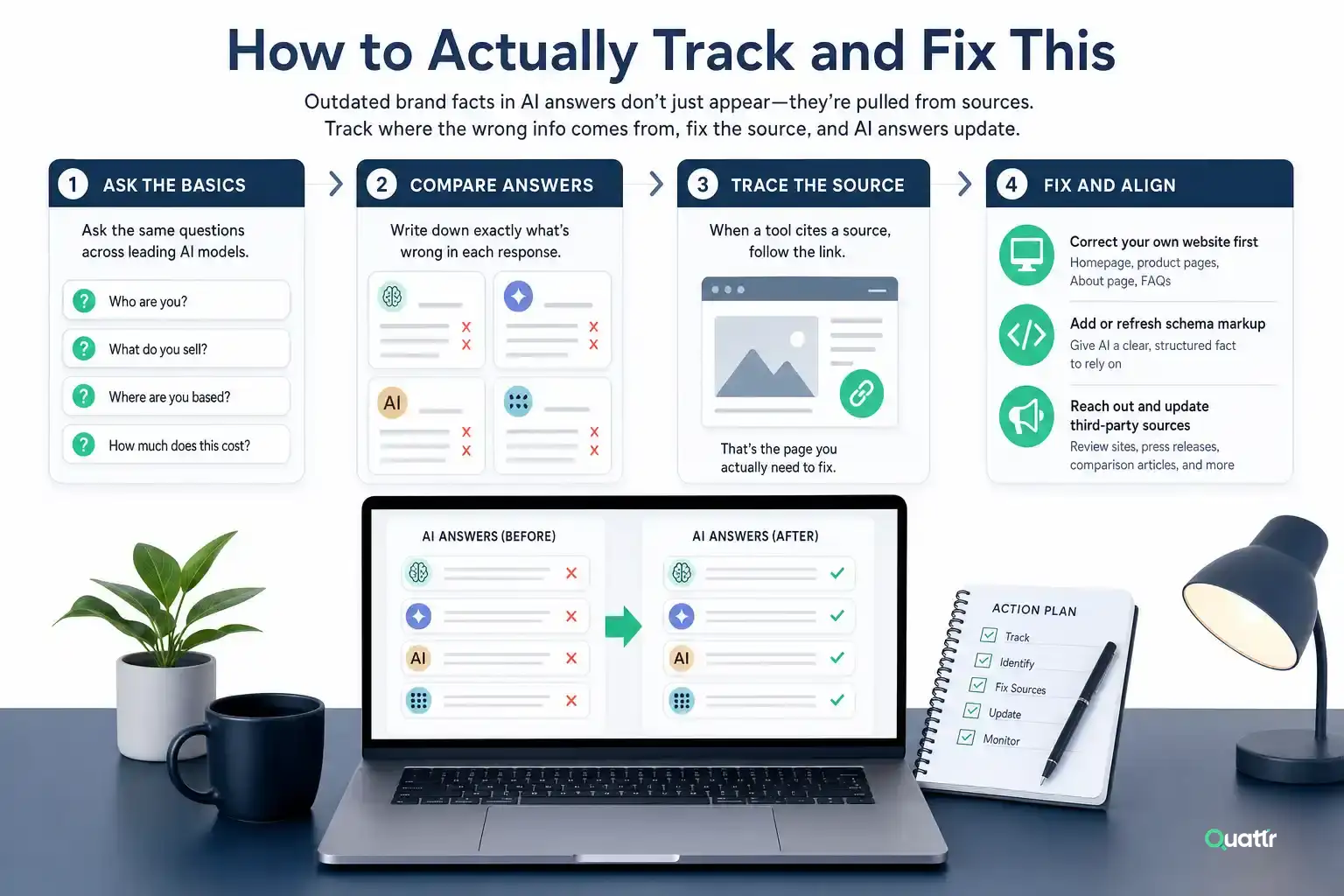
Start by asking the same set of basic questions (“who are you,” “what do you sell,” “where are you based,” “how much does this cost”) across ChatGPT, Gemini, Claude, and Perplexity, and write down exactly what’s wrong. When a tool cites a source, follow that link. That’s the page you actually need to fix, not just your own site.
From there: correct your own website first (homepage, product pages, About page, FAQs), add or refresh schema markup so AI has a clear fact to point to instead of a gap to guess at, and reach out to the third-party pages spreading the wrong version, review sites, old press releases, comparison articles, and ask for an update.
Then keep checking. AI visibility monitoring tools built for this can track this across platforms automatically, so you’re not relying on a monthly gut-check to know whether the correction actually stuck.
How Quattr Helps You Track and Fix This Faster
Remember the skincare store owner from earlier, the one who fixed her website the same night and still got the same wrong answer three weeks later? She wasn’t wrong to fix her site. She just had no way to see whether the correction was actually sinking in anywhere else, so she was stuck guessing.
That’s the part manual checking can’t really solve. You can ask ChatGPT the same question every few weeks, but you won’t catch it the moment a new AI tool picks up the error, or know for sure whether last month’s outreach to a review site actually changed anything.
Quattr’s AI Search Visibility platform tracks how your brand is actually described across ChatGPT, Perplexity, Claude, and Google AI Overviews, pulled from real responses instead of a guess, so you can see exactly where the outdated version is still showing up. It also tracks sentiment, so you know whether AI models are describing you accurately or still leaning on the old, wrong story. Alongside that, you can track citation share, map share of voice against competitors, and flag the exact queries where you’re still invisible, using the same GEO metrics that decide whether AI models see you as credible.
Instead of re-asking the same prompts by hand every few weeks and hoping you remember what changed, you get one place that shows whether a correction actually stuck, or whether it’s time to go fix another source.
FAQs
Usually a few weeks to a few months. Tools with live web retrieval, like Perplexity, tend to catch up faster than tools relying mostly on frozen training data.
Because your website is only a small part of what the AI is weighing. If the outdated version is still live on a review site, forum, or old article, the model can keep citing that instead.
Yes. Different models train on different data and weigh sources differently, so ChatGPT, Gemini, and Perplexity can genuinely disagree about the same brand at the same time.
Prioritize whatever the AI tools actually cite when you ask. Chasing every stray mention isn’t realistic; fixing the sources that keep showing up as citations is what actually moves the needle.
After 3-6 months of genuinely correcting sources (not just your own site) and consistently tracking multiple AI tools, if the same wrong answer is still the default, it’s fair to escalate or bring in outside help.
Correcting the third-party source the AI is actually citing. Fixing your own website matters, but it rarely outweighs an outdated page elsewhere that the model already trusts more.

Quattr is an AI-native Search Visibility Platform founded in Palo Alto, California, built for mid-market and enterprise brands competing in the age of generative search. Recently recognized across G2's Spring 2026 reports with #1 rankings in AEO Results, Usability, and Relationship, Quattr helps brands win visibility across traditional search and AI-generated answer surfaces.
Quattr's AI agent, GIGA, evaluates content the way AI systems do, identifying gaps across structure, authority, internal linking, and discoverability to surface the highest-impact fixes. With capabilities like autonomous internal linking, E-E-A-T intelligence, and the new GIGA Landing Page Generator for keyword-matched, AI-search-ready pages, Quattr helps teams move from diagnosis to deployed changes without manual bottlenecks.