Key Takeaways
- Winning at AI search takes tracking, content built to be quoted, earned coverage, and strong SEO fundamentals working together.
- LLM citations are growing fast, but a citation doesn’t always come with a click. AI answers often satisfy users before they visit your site.
- AI referral traffic is small in volume but converts far better than regular organic traffic, especially in B2B SaaS and other high-consideration industries.
- E-commerce results are mixed and depend heavily on how considered the purchase is.
- Most AI citations come from earned media, not your own website, so PR and third-party coverage matter more than publishing alone.
- Citation count on its own is a vanity metric. It only becomes meaningful when you connect it to actual traffic and revenue.
Every marketing team on LinkedIn is celebrating the same win right now: “we got cited by ChatGPT.” Screenshots of AI Overviews and Perplexity answers get passed around like trophies. But ask the same team one follow-up question, “did that citation bring in any traffic or revenue,” and the room usually goes quiet.
That’s the real problem with AI citations today. They’re easy to see and hard to prove. Google Analytics still doesn’t tag AI referrals cleanly, agencies selling GEO services love to report citation growth, and nobody wants to be the person in the budget meeting asking whether any of it actually sold anything.
So instead of another dashboard screenshot, here’s the question worth answering properly: do LLM citations actually turn into traffic and revenue, or are we all just tracking a number that looks good in a slide and means nothing on the P&L?
We pulled data from multiple 2026 studies to find out. Here’s what it actually shows.
What is LLM Citation
An LLM citation is when an AI tool like ChatGPT, Claude, or Perplexity mentions or links to a website while answering a question. It’s the AI’s way of saying “here’s where I got this.” That link gives people a way to click through and read more if they want.
The catch: a citation doesn’t always come with a click. Sometimes the AI just answers the question directly, and the user never visits your site at all.
What Does the Data Say About LLM Citations
Citations are growing fast, and the numbers back it up:
- Citations in US ChatGPT prompts jumped from about 1.6% in June 2025 to roughly 6.8% by May 2026. That’s more than four times higher in under a year.
- Google AI Overviews now show up on 48% of all search queries as of March 2026.
- Pages that include citations, quotes, and statistics see visibility jump by more than 40% across various AI search queries, compared to pages without them.
- A 1,200-prompt study across ChatGPT, Claude, Gemini, and Perplexity found citation rates vary a lot by industry. How often you get cited depends heavily on the space you’re in.
Citations are becoming a bigger part of how people find brands. That growth alone is why so many teams are chasing them. But growth in citations doesn’t automatically mean growth in traffic.
Do LLM Citations Actually Send Traffic to Your Site
Sometimes yes, sometimes no. This is where it gets nuanced.
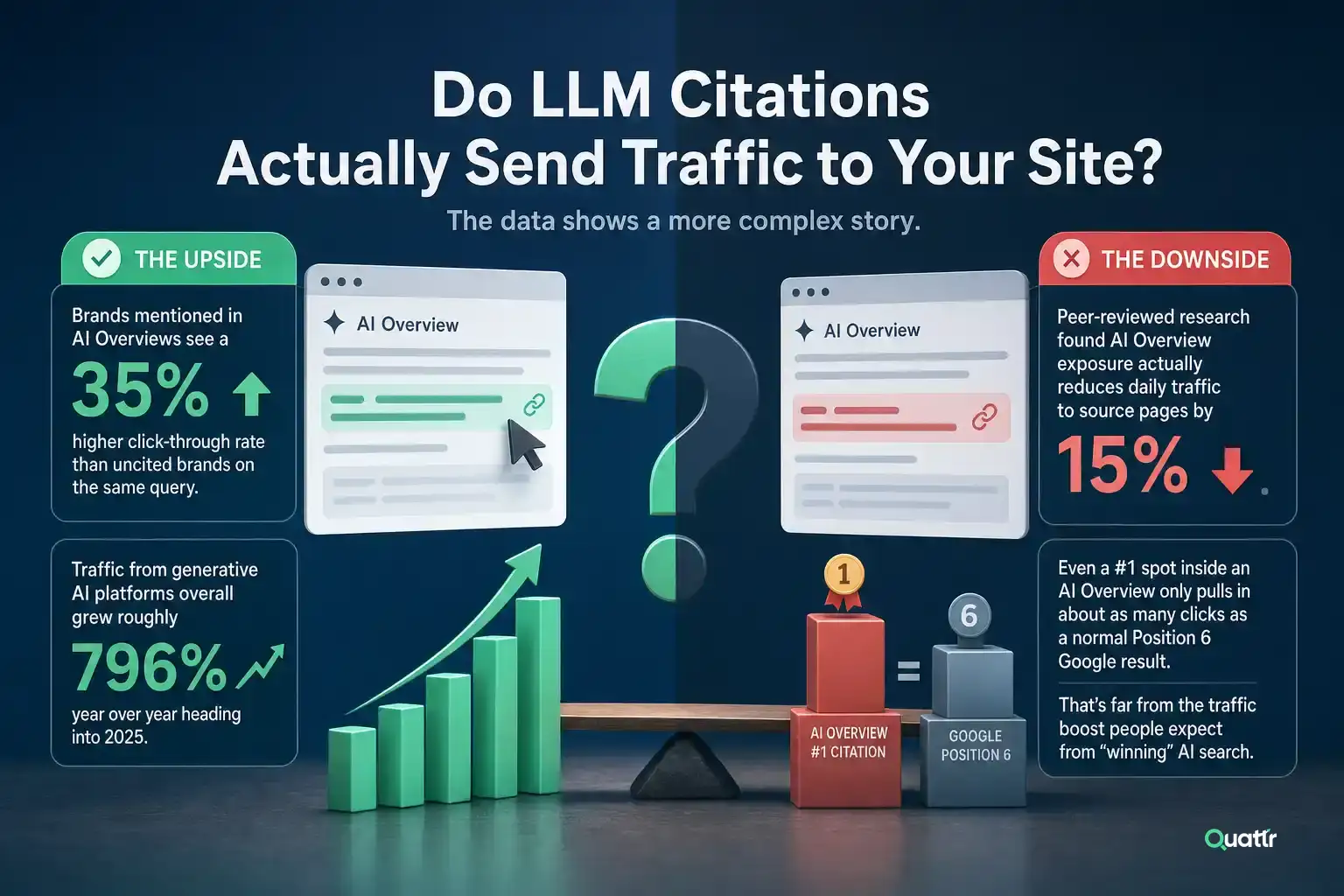
On one hand, brands mentioned in Google AI Overviews see a 35% higher click-through rate than uncited brands on the same query. Traffic from generative AI platforms overall grew roughly 796% year over year heading into 2025.
On the other hand, peer-reviewed research found AI Overview exposure actually reduces daily traffic to source pages by about 15%. Even a #1 spot inside an AI Overview only pulls in about as many clicks as a normal Position 6 Google result. That’s far from the traffic boost people expect from “winning” AI search.
In reality, citations can lift your click-through rate compared to uncited competitors, but they don’t replace the traffic volume that classic organic search used to deliver. AI answers often satisfy the user before they ever click through.
Is AI Traffic Small But Mighty
This is the part most teams miss. AI referral traffic is still tiny in volume, about 1.08% of all website visits across industries. But the visitors who do click through are far more valuable.
Across multiple 2026 studies:
- AI-referred visitors convert 4 to 5 times higher than standard organic traffic on average, with B2B SaaS seeing up to 23x (Pixis, Emarketed).
- AI-referred visitors spend 48-68% longer on site.
- Sign-up conversion rates hit 1.66% from visible AI traffic versus 0.15% from organic search.
The pattern is simple. Fewer visitors, but each one is much closer to a buying decision. AI users tend to arrive after they’ve already done their research through the chatbot, so they’re warmer leads.
Does this Hold Up for E-Commerce Too
This is where the data gets messy, and it’s worth being upfront about it.
One analysis of 973 e-commerce sites found ChatGPT referral traffic actually converted worse than Google search, email, and affiliate links . But a separate, more recent study found ChatGPT traffic converting at 1.81% versus 1.39% for non-branded organic search. That’s 31% higher.
Two studies, two different answers. The likely explanation is that e-commerce results depend heavily on the product category, the brand’s existing reputation, and how “considered” the purchase is. Low-consideration purchases, like a $15 phone case, don’t benefit much from AI chat. High-consideration purchases, like software or a big-ticket item, do.
Which Content and Industries Convert Best
Not every citation is worth the same amount. Some industries and content types turn citations into real traffic and revenue far more often than others.
Industries that see the biggest lift:
- B2B SaaS and professional services see the strongest gains, with some studies showing 6 to 27x higher conversion from AI traffic compared to regular channels.
- High-consideration purchases do well overall. Software, financial services, healthcare, and big-ticket B2B products all benefit because buyers ask AI tools detailed questions before they buy.
- Review and comparison sites, like Trustpilot or G2-style platforms, get cited often and see strong click-through because AI tools trust them as neutral sources.
Industries that see less benefit:
- Low-consideration e-commerce, like cheap everyday products, sees little to no lift. People don’t research a $15 item through a chatbot.
- Purely local or transactional businesses see less AI referral traffic overall, since people still use maps and local search for these.
Content types that convert best:
- Content with real data, statistics, and named sources gets cited and clicked more often. AI tools favor content that looks credible and easy to quote.
- Comparison pages and “best X for Y” style content perform well, since these match how people phrase questions to AI tools.
- Third-party reviews and press coverage convert better than a brand’s own product pages, since AI tools treat outside sources as more trustworthy.
- Deep, evaluative content built for people still doing research (not just looking for a quick fact) tends to hold the reader’s attention long enough to click through.
The short version: if your buyers ask detailed, evaluative questions before they spend money, LLM citations are worth chasing hard. If your product is a low-cost, low-thought purchase, don’t expect citations to move much revenue.
What Should You Do to Turn AI Citations Into Traffic and Revenue
Getting cited is only step one. Here’s what actually helps turn that citation into a visit and a sale.
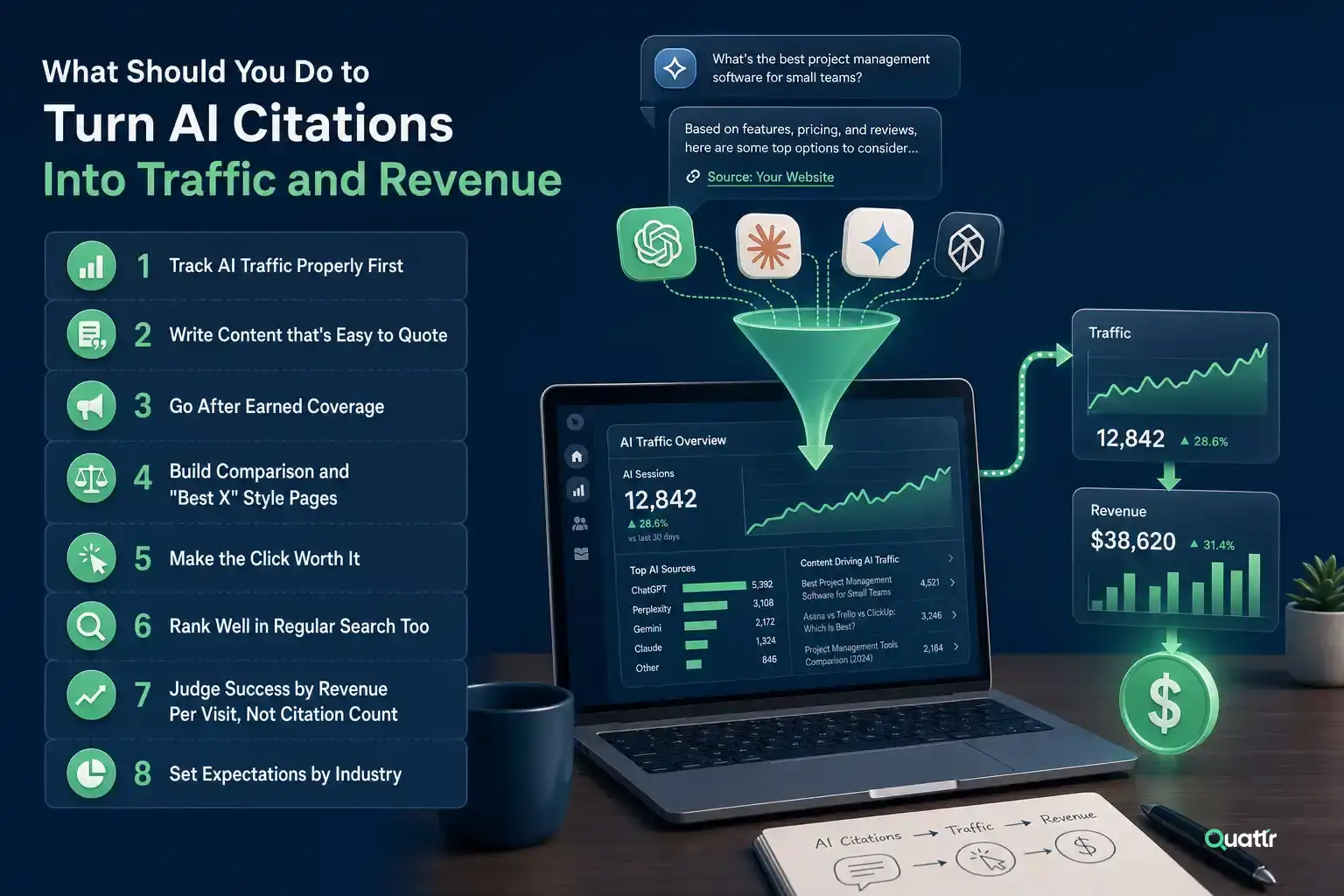
1. Track AI Traffic Properly First
Most Google Analytics setups still lump AI referrals into “direct traffic” or miss them completely. Set up proper referral tracking for ChatGPT, Perplexity, Gemini, and Claude before you do anything else. You can’t improve what you can’t see.
2. Write Content that’s Easy to Quote
AI tools pull sentences, stats, and definitions, not vague marketing copy. Use clear, direct answers near the top of the page, back claims with real numbers, and name your sources. Content with data and citations gets picked up more than opinion pieces.
3. Go After Earned Coverage
Since most AI citations come from third-party sites, reviews, press, and forums, your own website alone won’t get you far. Pitch journalists, get listed on comparison and review sites, and show up in places AI tools already trust.
4. Build Comparison Content, But Not About Yourself.
“Best X” content matches how people ask AI tools questions. But ranking your own company #1 on your own blog is now risky. SEO researcher Lily Ray found brands using this tactic lost 30-49% of organic visibility in early 2026, a hit that carries over into AI search too. Get featured in third-party comparisons instead of writing your own.
5. Make the Click Worth It
If someone does click through from an AI answer, give them a reason to stay. A clear next step, like a demo, a free trial, or a simple contact form, matters more here since these visitors are often close to a decision already.
6. Rank Well in Regular Search Too
AI tools lean heavily on top Google results when deciding what to cite. Strong SEO fundamentals still matter and now double as AI citation fuel.
7. Judge Success by Revenue Per Visit, Not Citation Count
Don’t celebrate a citation count on its own. Tie it to actual site visits and conversions in your analytics. Expect fewer but better visitors from AI platforms, and judge the channel on conversion rate and revenue, not raw traffic volume.
8. Set Expectations by Industry
If you’re in B2B SaaS, professional services, or another high-consideration category, push hard here since the payoff is real. If you sell low-cost, low-thought products, keep your expectations modest and test before investing heavily.
Does Citation Position Change the Revenue Outcome
Yes. Just like Google rankings, where you appear in an AI answer matters. A source that shows up first, or is quoted most clearly, in an AI answer gets far more attention than one buried lower down or mentioned in passing. And being cited at all usually depends on how well you rank in regular search to begin with. If you don’t show up near the top of Google, AI tools are less likely to notice you either.
Where Do LLMs Actually Get the Content They Cite
Most AI citations don’t come from a brand’s own website. They come from earned media: press coverage, independent reviews, and third-party sites that AI tools see as trustworthy and unbiased. A brand’s own blog or product pages play a much smaller role, and paid or promotional content barely gets picked up at all.
This matters for strategy. You can’t just publish more blog posts on your own site and expect more citations. Getting covered by other trusted sites, like reviews, comparisons, press, and forums, plays a bigger role than most SEO teams assume.
Are LLM Citations a Vanity Metric
Not entirely, but they’re incomplete on their own. Citation count by itself tells you almost nothing about revenue. It’s a leading indicator, not a business outcome.
Research on generative engine optimization backs this up: citation frequency should be tracked as part of a full visibility system, not as an isolated score. The goal is to connect citation to click, click to conversion, and conversion to revenue. Skip any of those steps and you’re just collecting a number that looks nice in a slide deck.
Real-world examples support treating citations as a genuine signal when tracked properly. Companies that have seen their AI search visibility translate into real business results are the ones that measured the full path, from citation to click to sale, instead of stopping at the citation count. That’s the difference between a metric that looks good and one that actually means something.
How Does Quattr Help Teams Win Visibility in AI Search
That’s the gap Quattr is built to close. Quattr’s AI Search Visibility platform shows how your brand actually shows up across ChatGPT, Perplexity, Claude, and Google AI Overviews, pulled from real AI responses rather than an estimate. That lets you watch your citation trend over time and tell a normal early dip apart from a strategy that isn’t working.
It also tracks sentiment (are AI models speaking well of you, staying neutral, or favoring a competitor), maps share of voice against competitors, and flags the exact queries where you’re still invisible, using the same GEO metrics that decide whether AI models see you as credible.
Most importantly, Quattr connects that citation data to your real GA4 and Search Console numbers. So instead of guessing whether a flat quarter means failure, you can check whether traffic and revenue are actually starting to move, and decide from there.
FAQs
No, a citation is a mention or link inside an AI-generated answer, while a backlink is a link from another website to yours.
Not directly, but the same trusted, well-ranked content that earns citations also tends to perform well in traditional search.
ChatGPT currently sends the most AI referral traffic, though its share has been slipping as Gemini and Claude grow.
Most brands need a few months of consistent earned coverage and content work before citations start showing up reliably.
Yes, research shows AI Overview exposure can reduce clicks to source pages, even when a brand is cited.

Quattr is an AI-native Search Visibility Platform founded in Palo Alto, California, built for mid-market and enterprise brands competing in the age of generative search. Recently recognized across G2's Spring 2026 reports with #1 rankings in AEO Results, Usability, and Relationship, Quattr helps brands win visibility across traditional search and AI-generated answer surfaces.
Quattr's AI agent, GIGA, evaluates content the way AI systems do, identifying gaps across structure, authority, internal linking, and discoverability to surface the highest-impact fixes. With capabilities like autonomous internal linking, E-E-A-T intelligence, and the new GIGA Landing Page Generator for keyword-matched, AI-search-ready pages, Quattr helps teams move from diagnosis to deployed changes without manual bottlenecks.