
AI referral conversion rate
also called AI referral CVRAssistant referral conversion rate
Definition
The rate at which assistant-referred visitors completed a configured goal. It is a governed measure in the semantic layer with its own denominator, distinct visitors, not sessions, so it is not the conversion count over anything a breakdown hands you.
Scope, grain and dimensions
- Grain
- One traffic-source value (or the whole-domain total) for one date range.
- Dimensions
- source/medium · landing page · goal · country · device
- Required filters
- date range
- Aggregation
- Never average two conversion rates to get a combined rate, and never rebuild it from a session and conversion breakdown, the semantic layer computes it as its own measure, and its denominator is a distinct-visitor estimate while the conversion count is a plain sum.
- Metric type
- rate · a 0 to 1 fraction in the semantic layer, formatted as a percent for display
Data sources
Where you'll see this
Named reports that normally include this metric.
Skills and analyses that use it
Skills carry the judgment; the analysis verbs do the reading.
Method rungs and levers
A rung tells you what a movement here can and cannot explain, read the rungs below it first.
levers L7 AI-answer visibility
Ask Quattr
- "Do assistant referrals convert better or worse than organic search?" Simulate this →
- "What is our conversion rate on AI referral traffic?" Simulate this →
Caveats, freshness and failure modes
Inherits the classification blocker of the whole family, the denominator is a hand-assembled set of traffic-source rows, not a measured channel.
The denominator is distinct visitors, not sessions. A rate rebuilt as conversions over sessions is a different number, and the gap widens as the population shrinks, which is exactly where assistant referrals live.
Assistant volumes are small enough that the rate is dominated by sampling noise; the significance verdict is the thing to read, not the arrow.
The web-analytics feed exposes two conversion-rate measures, one dividing summed conversions by a distinct-visitor estimate, the other averaging a per-row rate column, and they do not agree. Say which one the number came from.
- Freshness
- loads nightly, a same-day question gets yesterday's number, labelled as yesterday's.
Common failure modes
- Declaring assistant traffic 'higher intent' from a rate computed on a few dozen visitors.
- Reconstructing the rate from a breakdown and getting a different figure from the one the layer returns.
- Quoting the two twin rate measures interchangeably.
Not the same as
The confusions that cause the most wrong decisions.
AI referral conversion rate AI referral conversions Compare definitions →
The count is a sum of goal completions; the rate is a separate measure in the semantic layer with its own denominator, a distinct-visitor estimate, not the sessions or the rows a breakdown gives you. One is not derivable from the other with the numbers to hand, and treating the rate as count-over-sessions is the standard way this family is misread.
Watch this metric read in a real run
All runs →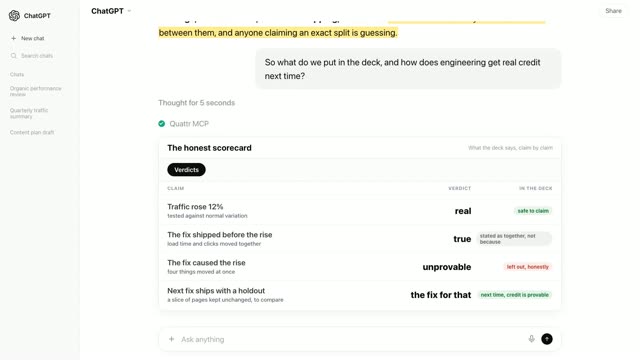 3 min 4 secThe fix shipped. Traffic rose. Now two teams want the credit.Lighthouse + Search Console + Rank tracking · Significance referee · Cross domain correlator◐Recreated from an anonymized session
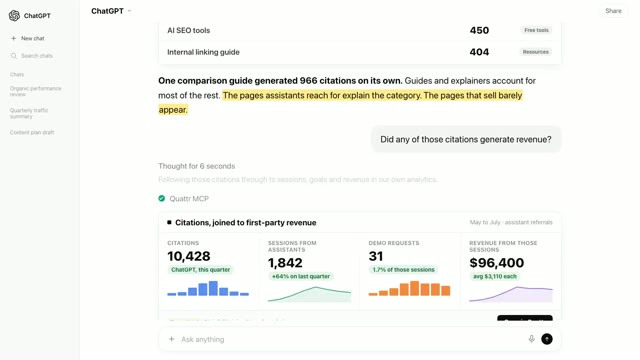 1 min 55 secChatGPT cites us. Does any of it become revenue?AI visibility + Web analytics · Search to revenue◐Recreated from an anonymized session
Related metrics and workflows
Verification
A definition is the smallest part of this.
The measurement matters because something acts on it. Here is the rest of the showcase, in the order most people find useful.