
AI referral conversions
also called Assistant referral conversionsAI-sourced conversions
Definition
Completions of your configured analytics goals on sessions that arrived from an AI assistant.
Scope, grain and dimensions
- Grain
- One traffic-source value (or the whole-domain total) for one date range.
- Dimensions
- source/medium · landing page · goal · country · device
- Required filters
- date range
- Aggregation
- The underlying conversion measure sums across rows, unlike the visitor and session measures beside it, which are distinct-count sketches, which is exactly why a conversion rate cannot be reassembled from a breakdown of the two.
- Metric type
- raw measure · conversions
Data sources
Where you'll see this
Named reports that normally include this metric.
AI referral traffic reportSearch to revenue report
Skills and analyses that use it
Skills carry the judgment; the analysis verbs do the reading.
Method rungs and levers
A rung tells you what a movement here can and cannot explain, read the rungs below it first.
levers L7 AI-answer visibility
Ask Quattr
- "Do AI referral visits convert?" Simulate this →
- "How many conversions came from AI assistants last month?" Simulate this →
- "Which goals do assistant visitors complete?" Simulate this →
Caveats, freshness and failure modes
Inherits the whole classification problem of the sessions metric: with no assistant classifier, the population being converted is assembled by hand.
Which goals are counted is a per-property configuration, so the same metric name means different things on two tenants, name the goals beside the number.
Assistant-referred volumes are small on most sites, so a conversion count can move by a large percentage on a handful of events.
- Freshness
- loads nightly, a same-day question gets yesterday's number, labelled as yesterday's.
Common failure modes
- Attributing a conversion to an assistant when the analytics property is on last-click and the assistant was only the first touch.
- Comparing this against the ad platform's own conversion count, which is measured on a different model entirely.
Not the same as
The confusions that cause the most wrong decisions.
AI referral conversions AI referral conversion rate Compare definitions →
The rate is its own measure in the semantic layer, not this count divided by anything you have to hand. Dividing a summed conversion count by a distinct-count session figure from a breakdown produces a different number from the rate the layer returns, and the two diverge most where the traffic is smallest, which is where assistant referrals live.
Watch this metric read in a real run
All runs →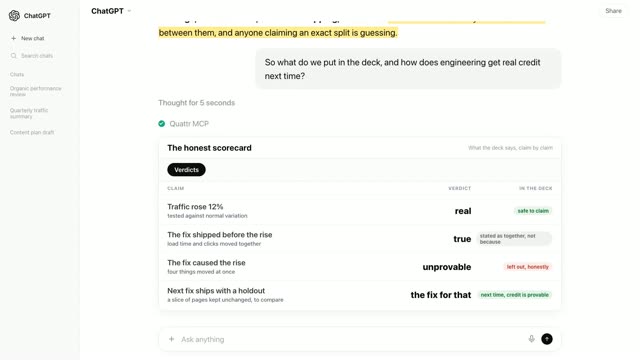 3 min 4 secThe fix shipped. Traffic rose. Now two teams want the credit.Lighthouse + Search Console + Rank tracking · Significance referee · Cross domain correlator◐Recreated from an anonymized session
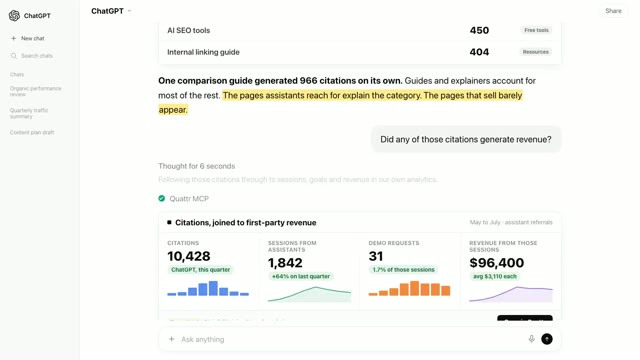 1 min 55 secChatGPT cites us. Does any of it become revenue?AI visibility + Web analytics · Search to revenue◐Recreated from an anonymized session
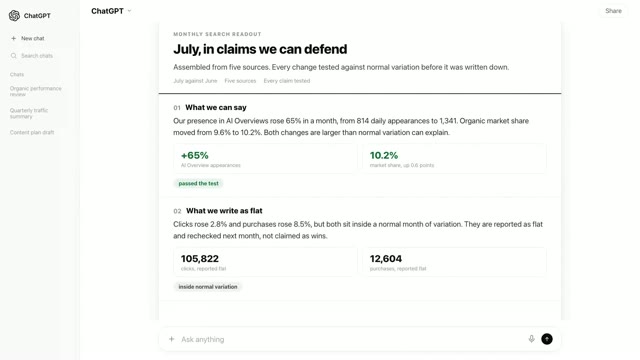 2 min 18 secThe deck is due tomorrow. The numbers live in five places.Search Console + Rank tracking + AI visibility + Web analytics + Google Ads · Monthly exec review◐Recreated from an anonymized session
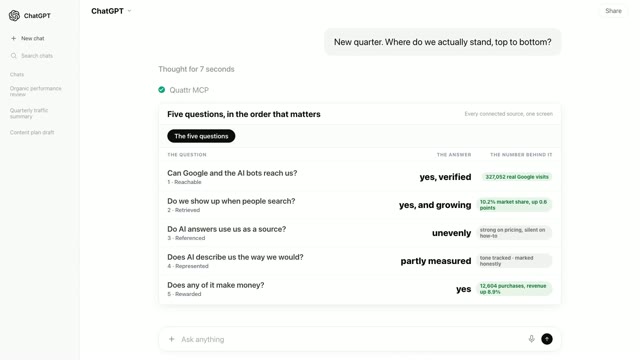 2 min 20 secWhere do we stand? Five questions answer it, in order.Search Console + Rank tracking + AI visibility · Monthly exec review◐Recreated from an anonymized session
Related metrics and workflows
Verification
A definition is the smallest part of this.
The measurement matters because something acts on it. Here is the rest of the showcase, in the order most people find useful.