
AI referral source split
also called AI assistant mixReferral split by assistant
Definition
How assistant-referred sessions divide across the individual assistants, which answer surface is actually sending the traffic.
Scope, grain and dimensions
- Grain
- One traffic-source value within one date range, as a share of the selected set.
- Dimensions
- source/medium · landing page · country · device
- Required filters
- date range
- Aggregation
- A composition of one period's sessions across traffic-source values. The parts sum to the selected set, not to all assistant traffic, because unclassified and referrer-stripped visits sit outside it, and because the sessions measure is a distinct-count sketch, the parts need not add to the whole-domain total either.
- Metric type
- share · percent of assistant-referred sessions attributed to each traffic-source value
Data sources
Where you'll see this
Named reports that normally include this metric.
Skills and analyses that use it
Skills carry the judgment; the analysis verbs do the reading.
Method rungs and levers
A rung tells you what a movement here can and cannot explain, read the rungs below it first.
levers L7 AI-answer visibility
Ask Quattr
- "Which AI assistant sends us the most visits?" Simulate this →
- "Is our assistant traffic concentrated in one surface?" Simulate this →
Caveats, freshness and failure modes
The denominator is whatever set of traffic-source rows was selected by hand, so two people can produce different splits from the same data.
The default breakdown ranks a top-N by volume, so a small assistant can fall outside it, but a named source can be requested explicitly, and any requested value that matched nothing is echoed back. A missing row is recoverable, not a dead end.
This split is not comparable to the per-engine cut on the AI-visibility side: that one is scoped to a tracked prompt basket, this one to whatever referrers the analytics property recorded.
- Freshness
- loads nightly, a same-day question gets yesterday's number, labelled as yesterday's.
Common failure modes
- Reading a missing assistant as zero traffic when it fell outside the top-N, instead of requesting it by name.
- Lining this split up against the per-engine citation split and expecting the shares to correspond.
Not the same as
The confusions that cause the most wrong decisions.
AI referral source split Citation category mix Compare definitions →
Both are compositions on the word 'AI', and they describe different populations on different datasets. The citation category mix divides your citations across content categories inside a tracked prompt basket at R3; this divides arriving sessions across referring assistants in web analytics at R5. Neither is a view of the other, and no row in one corresponds to a row in the other.
Watch this metric read in a real run
All runs →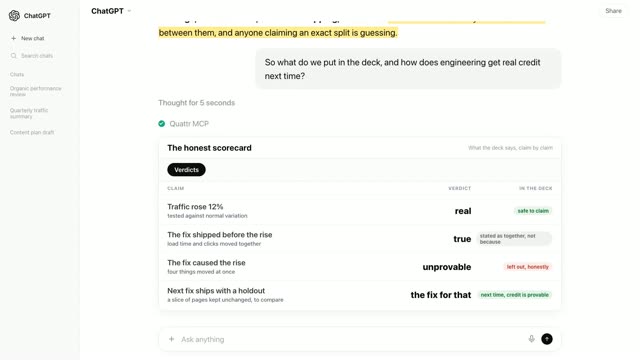 3 min 4 secThe fix shipped. Traffic rose. Now two teams want the credit.Lighthouse + Search Console + Rank tracking · Significance referee · Cross domain correlator◐Recreated from an anonymized session
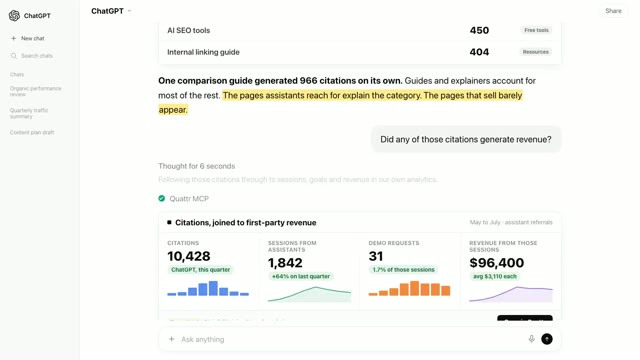 1 min 55 secChatGPT cites us. Does any of it become revenue?AI visibility + Web analytics · Search to revenue◐Recreated from an anonymized session
Related metrics and workflows
Verification
A definition is the smallest part of this.
The measurement matters because something acts on it. Here is the rest of the showcase, in the order most people find useful.