
Sessions
also called Total sessionsVisits
Definition
The number of distinct visits to the site in the period, from your web-analytics source.
How it's calculated
An approximate distinct count: the per-row session sketches are combined and estimated, with nulls read as zero. The measure is a HyperLogLog estimate over a combined session array, not a sum.
Scope, grain and dimensions
- Grain
- One number per date range, or one row per breakdown value.
- Dimensions
- country · device · page · keyword · source_medium · intent · category · subcategory1 · subcategory2
- Required filters
- date_range
- Aggregation
- Never summed across rows. The estimate is recomputed at whatever grain is queried, which is why a set of breakdown rows will not add up to the total.
- Metric type
- raw measure · sessions
Data sources
Where you'll see this
Named reports that normally include this metric.
AI referral traffic reportContent performance reportMonthly executive search reportSearch to revenue report
Skills and analyses that use it
Skills carry the judgment; the analysis verbs do the reading.
Analysis verbs
web_analytics_overviewpop_significancefunnel_dropoffcorrelate_domainssignificance_check
Method rungs and levers
A rung tells you what a movement here can and cannot explain, read the rungs below it first.
Ask Quattr
- "How many sessions did we get?" Simulate this →
- "Which landing pages drive the most sessions?" Simulate this →
How to read it
What arrived on the site, in the analytics source's own definition of a visit. It is the denominator most engagement questions eventually reduce to, and it is deliberately not reconciled against Search Console clicks, the two count different events at different moments.
Caveats, freshness and failure modes
An approximate distinct count, not a sum. Breakdown rows will not add to the total, and the difference is the estimator, not missing data.
When the analytics account is not on the enterprise tier, the tool swaps to a raw summed twin of this measure instead. That changes the construction, not just the source, and a summed session count double-counts across rows in a way the estimate does not.
The default scope is the product's own behavioural card scope, web search type plus google/organic, so an unqualified session count is organic sessions, not a raw all-source analytics total.
Whole-domain only today: the web-analytics dataset scopes by a whole-domain flag rather than by segment, so a non-default segment returns a note explaining the limitation instead of a number.
Analytics and Search Console will not reconcile and are not made to.
Visitor state and city breakdowns are unavailable, the geography dataset they need has a defect in the semantic layer.
- Freshness
- loads nightly, a same-day question gets yesterday's number, labelled as yesterday's.
Common failure modes
- Summing a session breakdown and expecting the site total.
- Comparing a session count across accounts on different analytics tiers without noticing the measure swapped.
Not the same as
The confusions that cause the most wrong decisions.
Sessions Users Compare definitions →
Sessions count visits, users count people. Both are approximate distinct counts over different sketches, and neither divides into the other.
Sessions Unique pageviews Compare definitions →
Sessions are an approximate distinct count of visits; unique pageviews are a sum of per-page uniques. One visit can contribute many unique pageviews.
Watch this metric read in a real run
All runs →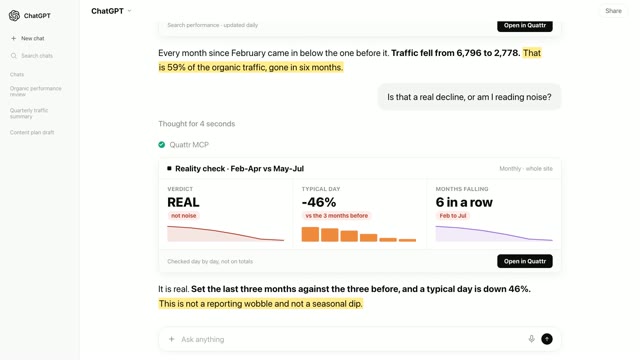 2 min 5 secTraffic more than halved in six months. Nobody could say why.Search Console · Anomaly investigator◐Recreated from an anonymized session
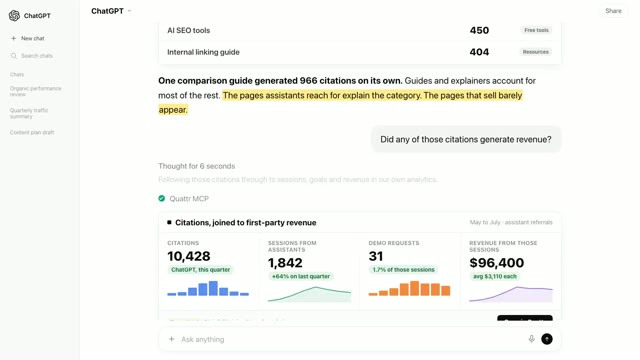 1 min 55 secChatGPT cites us. Does any of it become revenue?AI visibility + Web analytics · Search to revenue◐Recreated from an anonymized session
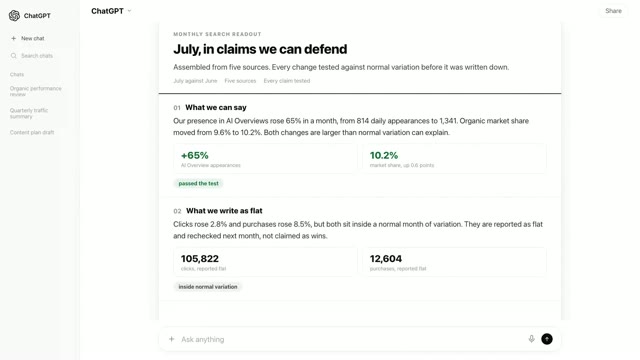 2 min 18 secThe deck is due tomorrow. The numbers live in five places.Search Console + Rank tracking + AI visibility + Web analytics + Google Ads · Monthly exec review◐Recreated from an anonymized session
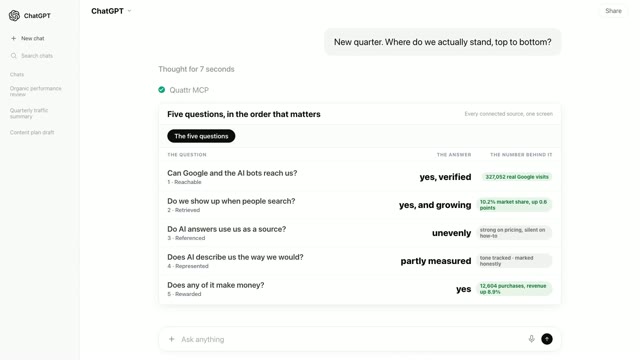 2 min 20 secWhere do we stand? Five questions answer it, in order.Search Console + Rank tracking + AI visibility · Monthly exec review◐Recreated from an anonymized session
Related metrics and workflows
Verification
A definition is the smallest part of this.
The measurement matters because something acts on it. Here is the rest of the showcase, in the order most people find useful.