
Citation category mix
also called Cited URL categoriesCitation category breakdown
Definition
The Citation Category summary on the cited-URL drilldown: your citations grouped by a category attached to the cited page, with each group's percentage of the slice.
Scope, grain and dimensions
- Grain
- One citation category within one tracked segment, date range and cited-URL slice.
- Dimensions
- citation category · answer engine · intent · branded vs non-branded · country · device
- Required filters
- tracker (unified segment id) · date range
- Aggregation
- The percentages complete the slice, so they are read together; a single group's figure means little without the mix beside it.
- Metric type
- share · percent of your citations in the slice
Data sources
Where you'll see this
Named reports that normally include this metric.
Skills and analyses that use it
Skills carry the judgment; the analysis verbs do the reading.
Analysis verbs
ai_visibility_drilldown
Method rungs and levers
A rung tells you what a movement here can and cannot explain, read the rungs below it first.
Ask Quattr
- "What kind of pages do AI answers cite us for?" Simulate this →
- "Are we cited for documentation or for comparisons?" Simulate this →
Caveats, freshness and failure modes
Which taxonomy this actually is has not been settled. The surface advertises citation types, blog, comparison, product, documentation, but the verb reads the generic content-category dimension, while a purpose-built citation-category dimension with exactly that taxonomy exists beside it and is not read.
The category field is not populated for every slice; when it comes back empty across the board the summary is omitted with a stated reason rather than shown as zeros.
A transient failure to fetch the category summary is reported separately from the category not being live at all, and neither affects the cited-URL rows in the same response.
Categories describe an attribute of the page; they are not a statement about why the engine chose it.
Every figure is scoped to a tracked prompt basket, a sample, not a census, so the basket's coverage belongs beside the number it produced.
- Freshness
- ~1 day behind, Daily prompt runs, available the following day.
Common failure modes
- Reading an omitted summary as an even split or as zero citations.
- Treating a transient failure of the category leg as evidence the field does not exist.
- Briefing content work off group labels before it is settled which taxonomy produced them.
Not the same as
The confusions that cause the most wrong decisions.
Citation category mix Citations per cited page Compare definitions →
The mix is a distribution over page groups; the page count is the citation total for one URL. The mix can shift with no change in total citations, and unlike the page count, which taxonomy the mix uses is still under review.
Citation category mix AI referral source split Compare definitions →
Two compositions that both carry the word AI, over different populations on different datasets. This divides your citations across content categories inside a tracked prompt basket at R3; the referral source split divides arriving sessions across referring assistants in web analytics at R5. No row in one corresponds to a row in the other, and neither is a view of the other.
Watch this metric read in a real run
All runs →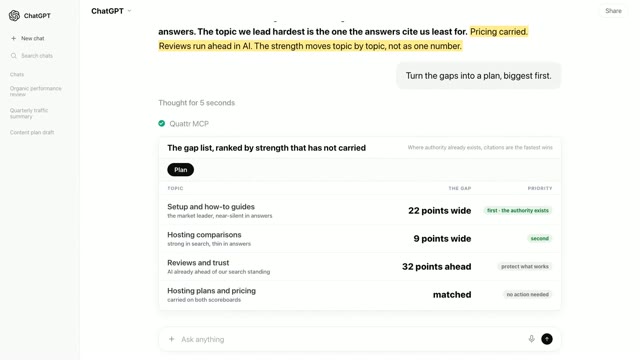
Related metrics and workflows
Verification
A definition is the smallest part of this.
The measurement matters because something acts on it. Here is the rest of the showcase, in the order most people find useful.