
AI citation rate
also called Citation rateCitation %Citation percentage
Definition
Your share of all the citations answer engines awarded across the tracked competitor set for a prompt basket, your citations as a percentage of every tracked domain's citations, not the proportion of answers that cited you.
How it's calculated
(your citations / all tracked domains' citations) × 100, computed by the semantic layer on every AI-visibility source. The product labels it a citation market share of tracked demand in answer engines, and the drilldown sources label the identical formula "Citation Share %", it is a share, not a rate of inclusion.
- Numerator
- Citations of your domain in answer-engine responses in the slice.
- Denominator
- Citations of every tracked domain, you and the tracked competitors, in the same slice.
Scope, grain and dimensions
- Grain
- One answer engine (or the cross-engine overall) for one tracked segment over one date range.
- Dimensions
- answer engine · intent · branded vs non-branded · country · device · competitor domain
- Required filters
- tracker (unified segment id) for segment-scoped reads · date range
- Aggregation
- Never average the per-platform percentages to get the cross-platform figure. The verbs run the summary dataset twice, once grouped by answer engine for the rows, once measure-only so the semantic layer re-aggregates the ratio, and the second read is the number reported as overall.
- Metric type
- share · percent of all tracked domains' answer-engine citations
Data sources
Where you'll see this
Named reports that normally include this metric.
AI visibility reportMonthly executive search report
Skills and analyses that use it
Skills carry the judgment; the analysis verbs do the reading.
Analysis verbs
ai_visibility_citation_auditai_visibility_overviewai_visibility_trendai_visibility_drilldownai_visibility_competitors
Method rungs and levers
A rung tells you what a movement here can and cannot explain, read the rungs below it first.
levers L7 AI-answer visibility
Ask Quattr
- "How often does ChatGPT cite us?" Simulate this →
- "Is our citation rate rising or falling?" Simulate this →
- "Which answer engine cites us least?" Simulate this →
How to read it
Read it per engine before reading it blended, engines differ enough that one weak engine can hide inside a healthy overall. Because the denominator is the tracked roster, it moves when a competitor gains or loses citations even if yours are flat. A move at low citation counts is direction, not a result.
Caveats, freshness and failure modes
The name says rate; the formula is a share. It does not answer "what fraction of answers cited us", it answers "what fraction of the tracked set's citations were ours", so it falls when a rival gains even if your own citations hold.
The denominator is the tracked competitor set, not every domain an engine could cite. An untracked domain taking citations does not appear in it.
Answer-engine citations and Google's on-SERP AI Overviews are different surfaces, on different datasets, measured separately and never rolled together.
Every figure is scoped to a tracked prompt basket, a sample, not a census, so the basket's coverage belongs beside the number it produced.
Engines are non-deterministic: the same prompt can answer differently twice, which is why this is reported as a rate over repeated observation rather than as a state.
The answer-engine filter keys on the platform key ("chatgpt", "gemini"), not the display name; filtering the display dimension with a key returns no rows.
Where a period-over-period comparison is attached, the delta percentage is returned as a fraction by the shared comparison helper and as a percentage by the significance verbs, check which one a card is rendering.
- Freshness
- ~1 day behind, Daily prompt runs, available the following day.
Common failure modes
- Reading it as an inclusion rate, "engines cite us in 12% of answers", when it is a share of the tracked set's citations.
- Reading a blended cross-engine figure as if it described every engine.
- Treating a week-over-week move at single-digit citation counts as a trend.
- Assuming an empty result means zero citations when it means the tracker, segment or platform filter did not bind.
Not the same as
The confusions that cause the most wrong decisions.
AI citation rate AI mention share Compare definitions →
Same denominator family, different behaviour counted. A citation is your URL used as a source of the answer; a mention is your brand named in the answer text. A majority of citations produce no mention, so the two shares diverge routinely.
AI citation rate AI share of voice Compare definitions →
Both are shares against the same tracked set, over different numerators. This one counts citations only; share of voice adds mentions at a weight of 1 against a citation's 1.25 and divides by the same weighted total. A rising citation share can sit beside a flat share of voice when mentions moved the other way.
AI citation rate AI Overview inclusion Compare definitions →
Different surfaces entirely. This is an answer engine citing your URL as a source; AI Overview inclusion is Google's on-SERP answer box, measured on a separate dataset. Every AI-visibility verb opens its description by disclaiming the swap.
AI citation rate Per-prompt citation share Compare definitions →
Same ratio at two grains, and they do not decompose into each other: the prompt-level figure divides within one prompt, the account-level figure divides across the whole slice. A prompt where you hold every citation can sit inside a slice where you hold very few.
Watch this metric read in a real run
All runs →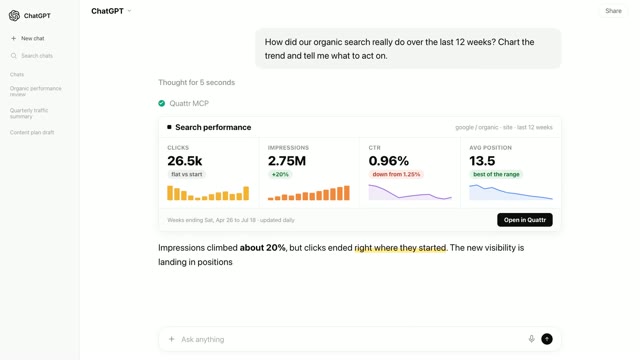 1 min 12 secCan your search data tell you what to do next?Search Console · Search pulse · Chart composer◐Recreated from an anonymized session
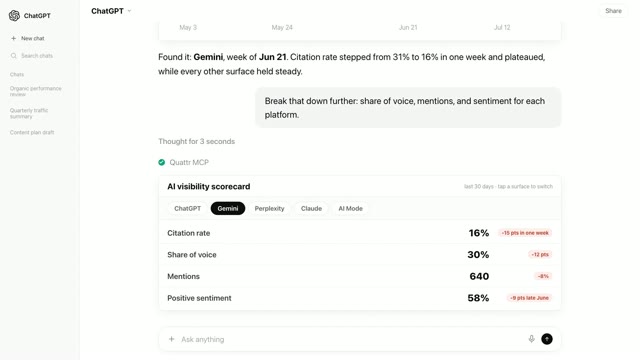 1 min 22 secYour next customer might never see a results page.AI visibility · AI visibility pulse◐Recreated from an anonymized session
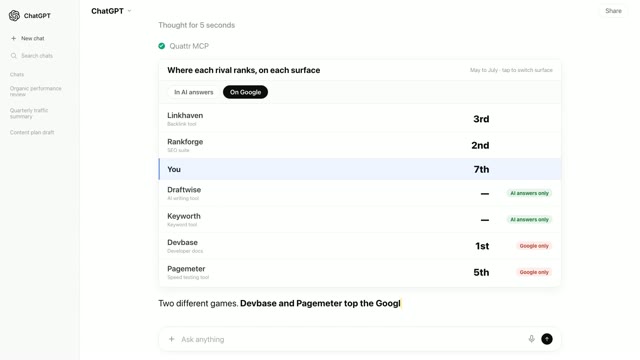 2 min 27 secYou know who beats you on Google. AI search has a different list.AI visibility + Rank tracking · AI vs traditional gap◐Recreated from an anonymized session
Related metrics and workflows
Verification
A definition is the smallest part of this.
The measurement matters because something acts on it. Here is the rest of the showcase, in the order most people find useful.