
AI mention share
also called Mentions %Share of answersMention rate
Definition
The share of answer-engine responses naming your brand, relative to the brands named across the tracked set.
How it's calculated
(your mentions / all tracked domains' mentions) × 100. Two differently named semantic-layer measures carry it, the grid's and the drilldown sources', and both compute the identical ratio under the label "Share of Answers".
- Numerator
- Mentions of your brand in answer-engine responses in the slice.
- Denominator
- Mentions of every tracked domain in the same slice.
Scope, grain and dimensions
- Grain
- One answer engine or competitor domain for one tracked segment over one date range.
- Dimensions
- answer engine · competitor domain · intent · country · device · branded vs non-branded
- Required filters
- tracker (unified segment id) for segment-scoped reads · date range
- Aggregation
- Never average the per-engine percentages for a cross-engine figure; the semantic layer re-aggregates the ratio on a measure-only read.
- Metric type
- share · percent of tracked answer-engine mentions
Data sources
Where you'll see this
Named reports that normally include this metric.
Skills and analyses that use it
Skills carry the judgment; the analysis verbs do the reading.
Analysis verbs
ai_visibility_overviewai_visibility_competitorsai_visibility_drilldown
Method rungs and levers
A rung tells you what a movement here can and cannot explain, read the rungs below it first.
levers L7 AI-answer visibility
Ask Quattr
- "How often do AI answers name us versus our rivals?" Simulate this →
- "Are we mentioned more than we are cited?" Simulate this →
How to read it
Mention share and citation rate answer different questions and routinely diverge, being named without being sourced is common, and the gap between the two columns is itself the read.
Caveats, freshness and failure modes
Two differently named semantic-layer fields feed this one output key depending on which source a verb reads. They compute the same ratio, so a grid figure and a drilldown figure are the same measure under two names, but the names differ in exports and in the app.
The denominator is the tracked competitor set, not every brand an engine could name.
Being named in an answer says nothing about being described correctly, that is the sentiment read, and canon flags the Represented rung as only partly instrumented.
Every figure is scoped to a tracked prompt basket, a sample, not a census, so the basket's coverage belongs beside the number it produced.
Engines are non-deterministic: the same prompt can answer differently twice, which is why this is reported as a rate over repeated observation rather than as a state.
- Freshness
- ~1 day behind, Daily prompt runs, available the following day.
Common failure modes
- Using mention share as a proxy for citation rate when a citation column is empty.
- Blending mentions and citations into a single AI visibility number.
Not the same as
The confusions that cause the most wrong decisions.
AI mention share AI citation rate Compare definitions →
Same denominator family, different behaviour counted. A mention is your brand named in the answer text; a citation is your URL used as a source. The two are carried as separate columns everywhere and a majority of citations arrive with no mention attached.
AI mention share AI mention count Compare definitions →
A share and a count. The share needs a denominator of all tracked brands' mentions; the count is your mentions alone and moves with basket size.
Watch this metric read in a real run
All runs →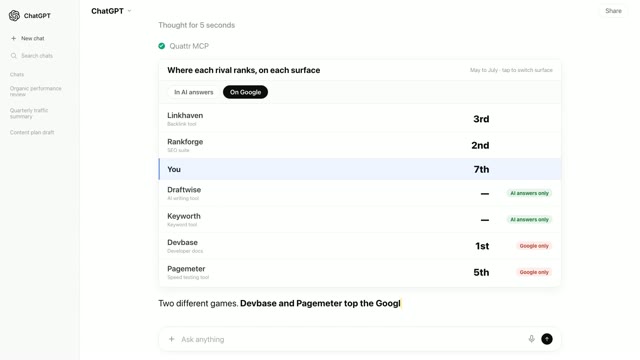
Related metrics and workflows
Verification
A definition is the smallest part of this.
The measurement matters because something acts on it. Here is the rest of the showcase, in the order most people find useful.