
Citations per cited page
also called Cited URL citationsCitations by page
Definition
How many times answer engines cited one specific URL of yours, or of a named competitor, in the period.
How it's calculated
A row count of market-share rank rows for the URL, filtered to rows that carry a cited page URL, one row is one citation instance. The leaderboard sums it per URL and orders descending.
Scope, grain and dimensions
- Grain
- One cited URL for one tracked segment over one date range.
- Dimensions
- cited URL · competitor domain · citation category · answer engine · intent · branded vs non-branded
- Required filters
- tracker or tracked segment id · date range
- Aggregation
- Additive across prompts; the verb sums it per URL and per citation category, and orders the leaderboard by it descending.
- Metric type
- raw measure · citations
Data sources
Where you'll see this
Named reports that normally include this metric.
AI bot activity reportAI referral traffic reportAI visibility report
Skills and analyses that use it
Skills carry the judgment; the analysis verbs do the reading.
Analysis verbs
ai_page_citationsai_visibility_drilldown
Method rungs and levers
A rung tells you what a movement here can and cannot explain, read the rungs below it first.
Ask Quattr
- "Which of our pages do AI answers cite most?" Simulate this →
- "Which of a competitor's pages earn their citations?" Simulate this →
- "Did we gain or lose cited pages this month?" Simulate this →
How to read it
This is the supply side of being referenced, the specific pages answers are built from. It joins naturally to whether AI crawlers fetched those pages, which is the question a citation count alone cannot answer.
Caveats, freshness and failure modes
A "citation" here is one rank row carrying a page URL, so the count is of citation instances rather than of distinct answers or distinct prompts.
Rows without a cited URL are filtered out twice, once by the measure itself and again in the verb, so the leaderboard describes pages, not every citation event in the period.
Your own pages are scoped by the configured customer site's exact www and apex aliases rather than by a domain dimension, so a page served from an unconfigured subdomain will not appear in your rows.
This is an aggregated cited-page count across all answer-engine runs in the period, not a per-engine sampled share estimate with a confidence interval.
New and lost cited URLs churn at low counts; weekly movement on a single URL is direction, not a result.
The shipped name-based formatter classifies this measure as a percentage because the word "citation" sits in its percent list. The verbs rename it before it reaches a card, so the count renders correctly today, but the raw field name would render "412" as "412%".
Answer-engine citations and Google's on-SERP AI Overviews are different surfaces, on different datasets, measured separately and never rolled together.
- Freshness
- ~1 day behind, Daily prompt runs, available the following day.
Common failure modes
- Reading a page's citation count as traffic, a citation is not a visit.
- Concluding a page lost citations when the prompt basket that used to reach it changed.
Not the same as
The confusions that cause the most wrong decisions.
Citations per cited page AI Overview inclusion Compare definitions →
A cited page is a URL an answer engine sourced; AI Overview inclusion is presence in Google's on-SERP answer box, measured on a different dataset. The verb descriptions open by disclaiming the swap.
Citations per cited page Citations per prompt Compare definitions →
Page grain versus prompt grain. One page can be cited across many prompts and one prompt can cite many pages, so neither total decomposes cleanly into the other.
Citations per cited page Average citation position Compare definitions →
How often a page is cited and where it sits when cited are separate readings, a page can hold the top slot on one prompt and be absent everywhere else.
Citations per cited page Citation category mix Compare definitions →
The mix is a distribution over content types; the page count is the citation total for one URL. The mix can shift with no change in total citations.
Watch this metric read in a real run
All runs →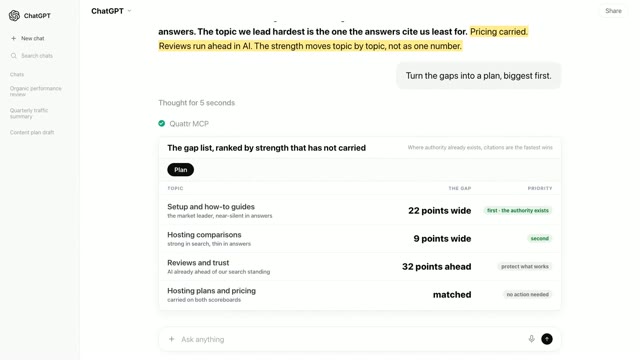
Related metrics and workflows
Verification
A definition is the smallest part of this.
The measurement matters because something acts on it. Here is the rest of the showcase, in the order most people find useful.