
Citations per prompt
also called Prompt citationsTotal citations for a prompt
Definition
How many citations one answer-engine prompt produced in the period, split into the citations your domain earned and the total across every cited domain.
How it's calculated
Two reads of the same rank dataset that differ only by the client filter, one restricted to your domain, one unrestricted, each summed per prompt in the verb and then joined on the prompt key. The client total is the restricted sum; the prompt total is the unrestricted sum, falling back to the client total when the unrestricted leg returns nothing for that prompt.
Scope, grain and dimensions
- Grain
- One prompt for one tracked segment over one date range, with a domain breakdown beneath it.
- Dimensions
- prompt · competitor domain · cited URL · answer engine · intent · branded vs non-branded
- Required filters
- tracker or tracked segment id · date range
- Aggregation
- Additive within a prompt across domains and URLs. The prompt tab orders by mentions, not by this total, so the busiest-citation prompt is not necessarily the first row.
- Metric type
- raw measure · citations
Data sources
Where you'll see this
Named reports that normally include this metric.
Skills and analyses that use it
Skills carry the judgment; the analysis verbs do the reading.
Analysis verbs
ai_visibility_drilldown
Method rungs and levers
A rung tells you what a movement here can and cannot explain, read the rungs below it first.
Ask Quattr
- "Who wins the prompts we are missing from?" Simulate this →
- "Which pages beat us on this prompt?" Simulate this →
- "Which prompts produce the most citations at all?" Simulate this →
How to read it
The client total against the prompt total is the competitive read at prompt grain. A prompt with a large total and a zero client total is the shape a coverage gap takes; a zero total on both sides is a prompt nobody was cited for.
Caveats, freshness and failure modes
The two totals come from two queries joined on the prompt key inside the verb, not from one keyed result set, they are the same query with and without the client filter, which is a narrower guarantee than a single result set.
There is no domain breakdown on this path. The prompt total names no rivals, so a prompt-to-winner-to-URL table cannot be assembled from it.
When the unrestricted leg returns no row for a prompt, the prompt total falls back to your own total, which makes your share of that prompt read as complete rather than unknown.
This is an aggregated cited-page count across all answer-engine runs in the period, not a per-engine sampled share estimate with a confidence interval.
Rows without a cited URL do not contribute, so a domain that was named but not sourced does not appear here.
Engines are non-deterministic: the same prompt can answer differently twice, so these totals count observations over repeated runs.
- Freshness
- ~1 day behind, Daily prompt runs, available the following day.
Common failure modes
- Assembling a prompt-to-winner-to-URL table by joining separate verb results, this path carries no winner.
- Reading a zero client total on a low-total prompt as a competitive loss.
- Reading a hundred-percent client share without checking whether the all-domain leg returned a row at all.
Not the same as
The confusions that cause the most wrong decisions.
Citations per prompt Cited pages per prompt Compare definitions →
This counts citation events for the prompt; the cited-pages count counts how many distinct pages of yours the answer drew on, and it comes from a different dataset and a different verb. A prompt can cite one page many times or many pages once.
Citations per prompt AI citation count Compare definitions →
Same behaviour at a different grain, computed on a different dataset, the account-level count is a semantic-layer citation sum, this is a per-prompt row count assembled in the verb. They will not add up.
Citations per prompt Citations per cited page Compare definitions →
Page grain versus prompt grain. One page can be cited across many prompts and one prompt can cite many pages, so neither total decomposes cleanly into the other.
Watch this metric read in a real run
All runs →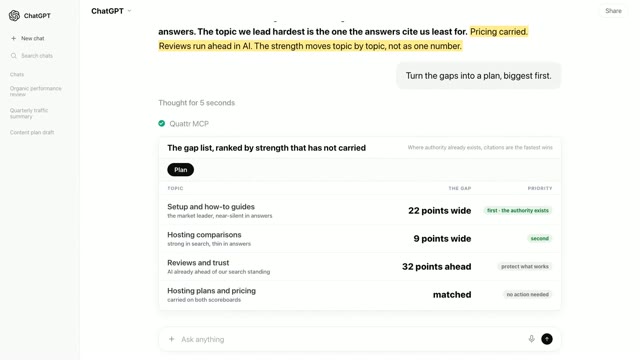
Related metrics and workflows
Verification
A definition is the smallest part of this.
The measurement matters because something acts on it. Here is the rest of the showcase, in the order most people find useful.