
Conversion-rate change
also called Conversion rate deltaConversion rate period over period
Definition
The difference between a period's conversion rate and a comparison period's, reported alongside both rates and their underlying counts.
How it's calculated
The rate under test is the product's OWN displayed conversion-rate measure, conversions divided by unique users, or, on tenants whose analytics supply a stored per-row rate, the average of those stored rates. Both periods' rates are fetched as the product's weighted period aggregates and the change is the selected rate minus the comparison rate, rounded to two decimal places. A relative form is reported beside it as a percentage to two decimal places. Both period rates are echoed in the response so the subtraction is checkable.
- Numerator
- Selected-period rate minus comparison-period rate
- Denominator
- Each rate's own denominator is set by the underlying measure: unique users, or none at all where the measure is an average of stored per-row rates
Scope, grain and dimensions
- Grain
- One value per pair of date ranges.
- Required filters
- date_range · comparison_range
- Aggregation
- Computed once from the two periods' weighted aggregates, not averaged over buckets, the per-bucket series exists but is used for the significance test, not for the change.
- Metric type
- derived metric · difference between two rates, on whatever scale the underlying rate measure carries, rounded to two decimal places
Data sources
Where you'll see this
Named reports that normally include this metric.
AI referral traffic reportSearch to revenue report
Skills and analyses that use it
Skills carry the judgment; the analysis verbs do the reading.
Analysis verbs
pop_significance
Method rungs and levers
A rung tells you what a movement here can and cannot explain, read the rungs below it first.
Ask Quattr
- "Did conversion rate really change versus last month?" Simulate this →
- "How much did conversion rate move?" Simulate this →
How to read it
The size of the move, kept separate from whether the move is distinguishable from noise. Read it beside the p-value and the verdict: a large change on thin traffic and a small change on heavy traffic can carry the same p-value, and only the pair tells the story. Because it is the difference between the two numbers the product itself displays, it should reconcile against the product UI exactly, which is the point of it.
Caveats, freshness and failure modes
The change and the significance test are computed on DIFFERENT quantities. The change is the difference between two weighted period aggregates; the test compares equal-weight per-bucket means. When traffic weights shift between periods those two can move in opposite directions, and when they do the tool refuses to transfer the verdict, it returns a can't-tell for the displayed rate and withholds the significance flag rather than making a claim about a quantity the test did not measure.
The denominator is not sessions. It is unique users, or, on tenants whose analytics supply a stored per-row rate, no explicit denominator at all, the measure is an average of stored rates. A change computed against a session-based rate will not match this one.
It is a difference between two rates, not a percentage-point figure and not a percent change, the relative form is a separate field with its own scale problem.
Fewer than two buckets in either period, or no within-period variation, returns a can't-tell with an explanatory note; the aggregate change is still reported, because it was already known before the test was attempted.
Whole-domain only; a non-default segment returns a note explaining the limitation.
The result is stamped observational in the payload.
- Freshness
- loads nightly, a same-day question gets yesterday's number, labelled as yesterday's.
Common failure modes
- Reconstructing the rate as conversions over sessions and comparing the two.
- Reading the value as percentage points.
- Presenting a significance verdict for the displayed change when the tool withheld one because the two quantities disagreed in direction.
- Quoting the change without the verdict beside it.
Not the same as
The confusions that cause the most wrong decisions.
Conversion-rate change Conversion rate Compare definitions →
One is a level for a single period; the other is the difference between two of those levels. They share a definition and a denominator, what differs is the question, and the fact that only the change carries a significance verdict.
Conversion-rate change Relative change Compare definitions →
One is an absolute difference between two rates, in percentage points; the other expresses that difference relative to the comparison period. Confirm which you have before quoting it, they answer different questions and are not interchangeable.
Watch this metric read in a real run
All runs →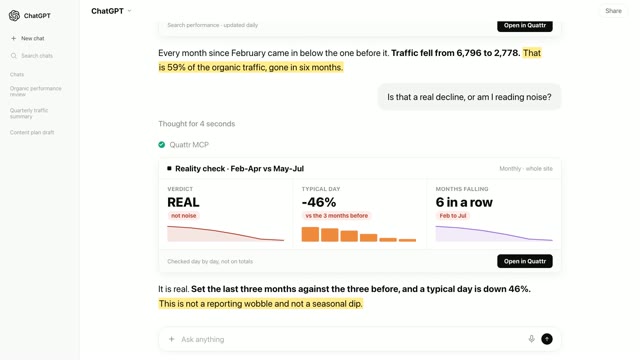 2 min 5 secTraffic more than halved in six months. Nobody could say why.Search Console · Anomaly investigator◐Recreated from an anonymized session
 3 min 4 secThe fix shipped. Traffic rose. Now two teams want the credit.Lighthouse + Search Console + Rank tracking · Significance referee · Cross domain correlator◐Recreated from an anonymized session
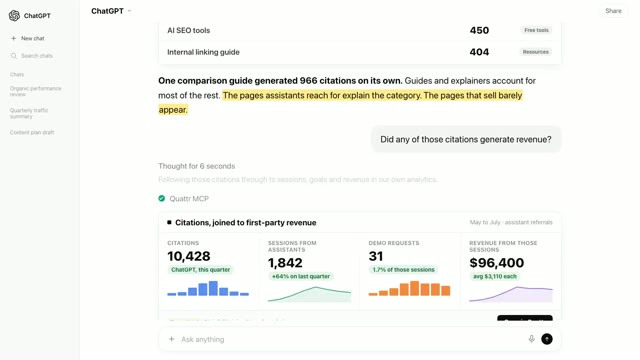 1 min 55 secChatGPT cites us. Does any of it become revenue?AI visibility + Web analytics · Search to revenue◐Recreated from an anonymized session
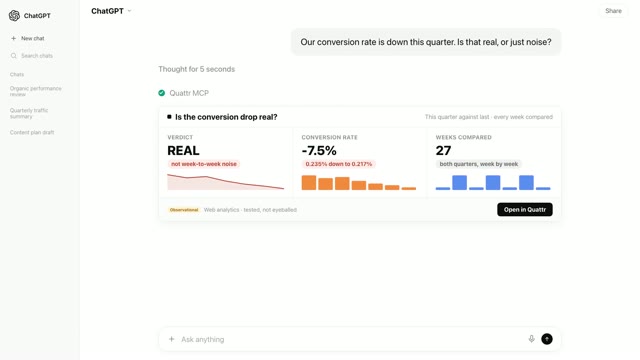 2 min 26 secConversion rate fell 7.5%. The number is real. The panic is not.Web analytics · Significance referee◐Recreated from an anonymized session
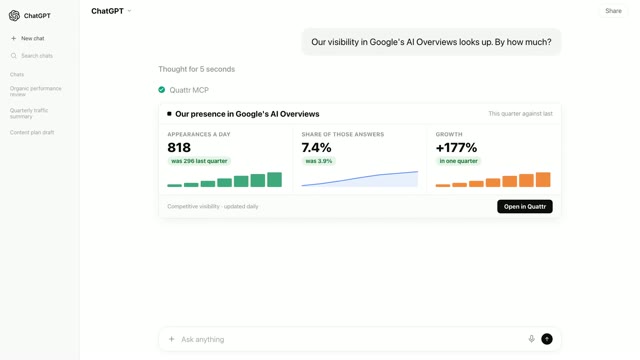 2 min 2 secSomething went right this quarter. Now prove it before you say it out loud.Rank tracking + Search Console · SERP feature watch · Significance referee◐Recreated from an anonymized session
Related metrics and workflows
Verification
A definition is the smallest part of this.
The measurement matters because something acts on it. Here is the rest of the showcase, in the order most people find useful.