
Funnel drop-off rate
also called Step drop-offBiggest leak
Definition
The share of a funnel step's count that did not carry through to the next step, plus the step where the largest single drop occurs.
How it's calculated
The caller supplies an ordered list of steps, each an existing web-analytics count metric. Each step's total is fetched, and in the compute engine the drop-off for a step is the previous step's count minus this step's, divided by the previous step's count. The first step has no previous step and returns nothing; a previous count of zero returns nothing rather than dividing. The biggest leak is the largest drop-off among the legs that have one.
- Numerator
- Previous step count minus this step count
- Denominator
- Previous step count
Scope, grain and dimensions
- Grain
- One rate per step after the first, per date range.
- Required filters
- date_range
- Aggregation
- Computed per consecutive pair over already-aggregated step totals.
- Metric type
- rate · fraction of the previous step's count
Data sources
Where you'll see this
Named reports that normally include this metric.
Skills and analyses that use it
Skills carry the judgment; the analysis verbs do the reading.
Analysis verbs
funnel_dropoff
Method rungs and levers
A rung tells you what a movement here can and cannot explain, read the rungs below it first.
Ask Quattr
- "Where do users fall out of the funnel?" Simulate this →
- "Which step leaks the most?" Simulate this →
How to read it
Where the funnel loses people, at aggregate grain. Locating the leak comes before recommending anything, a step with a large drop and small volume is a different problem from a small drop on the whole audience. The canonical macro-funnel runs sessions to conversions to transactions.
Caveats, freshness and failure modes
Direction is published as neutral because the shipped renderers disagree with the arithmetic. More drop-off is plainly worse, but neither shared oracle knows the field: one finds no classifying word in its name and falls through to its higher-is-better default, and the other classifies it as a plain count with no unit at all, so a rising leak can be painted as an improvement, and a fraction can be rendered as though it were a number of things. Never let the automatic colouring or formatting speak for this field.
This is a macro-funnel over aggregate counts, not a per-user event sequence. Drop-off is the relative decline between consecutive totals and is directional, not a per-user retention rate. The tool carries this caveat in its own payload.
Steps can span two different traffic scopes. Behavioural steps are read on organic search traffic while conversion and transaction steps are read across all traffic sources, mirroring the product's own card defaults, so a mixed funnel compares populations, and an all-source conversion count can legitimately exceed an organic session count above it. The tool discloses this when it happens.
There is no ordered step or event dimension in the model, so the caller supplies the order. A different step order produces different drop-offs from the same data, and the tool does not validate that the order is a real funnel.
Steps are drawn from a fixed list of count metrics, sessions, users, conversions, transactions, unique pageviews and events, and nothing else can be a step.
Because the step counts come from differently constructed measures, some approximate distinct counts and some plain sums, a drop-off between two of them mixes estimator behaviour with real attrition.
A step with no data is kept as absent and excluded from the arithmetic rather than counted as zero; fewer than two steps with data returns an explanatory note.
Whole-domain only; the result is stamped observational.
- Freshness
- loads nightly, a same-day question gets yesterday's number, labelled as yesterday's.
Common failure modes
- Trusting the automatic direction or unit on this field, both are wrong, and a bigger leak can be painted as a win.
- Reading a drop-off as a per-user retention rate.
- Choosing an order that is not a real funnel and reporting the resulting leak.
- Comparing steps read on different traffic scopes without saying so.
- Reading a step count of zero as total attrition when the measure simply had no data.
Not the same as
The confusions that cause the most wrong decisions.
Funnel drop-off rate Conversion rate Compare definitions →
Conversion rate is a single measured rate over users for the whole period; a funnel drop-off is the relative decline between two chosen aggregate counts. The end-to-end product of the drop-offs will not equal the conversion-rate measure.
Watch this metric read in a real run
All runs →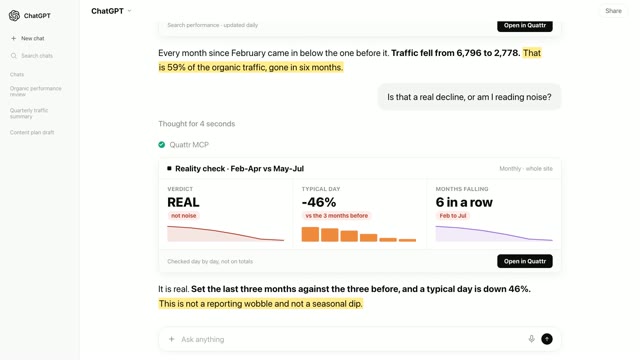
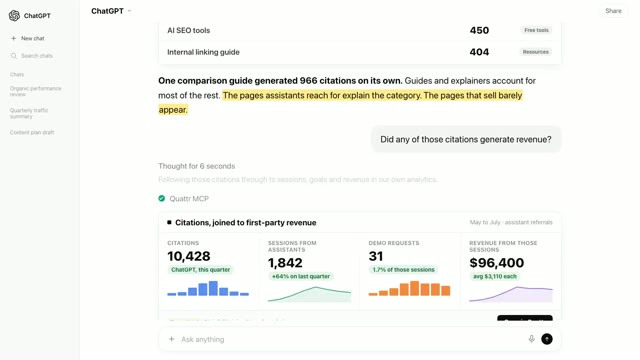
Related metrics and workflows
Verification
A definition is the smallest part of this.
The measurement matters because something acts on it. Here is the rest of the showcase, in the order most people find useful.